Look, if you're job hunting in today’s market, understanding keyword usage can be a significant factor in getting your resume noticed. The takeaway is clear: using the right keywords can dramatically improve your chances of passing through an applicant tracking system.
Choosing the right keywords for your ATS-friendly resume means targeting what employers want and using industry-specific terms to help your resume stand out.
How Do Keywords Affect ATS Performance?
Keywords serve as the bridge between your qualifications and what potential employers are looking for in applicants. An ATS scans for these keywords to determine if you fit the job requirements.
What Exactly is an ATS?
An applicant tracking system is software used by employers to filter job applications. Essentially, it helps hiring managers sift through numerous resumes quickly and efficiently. Without the right keywords, your resume may be overlooked. Think about it: in a typical job application, studies show that around 75% of resumes never reach a human because they fail ATS screening.
Why Are Keywords Important?
- Relevance: Keywords align your skills with what the employer wants.
- Visibility: Using specific terms increases the chances of your resume appearing in searches.
- Compatibility: An ATS-friendly resume must match the job description closely.
How to Choose the Right Keywords for Your Resume?
To select effective keywords, analyze job postings, industry trends, and skills listed in your field. This process can lead to a highly tailored and relevant resume.
Analyze Job Descriptions
Look at the language used in job postings that interest you.
- Highlight repeated terms: If a phrase or skill keeps popping up, it’s essential.
- Identify specific skills: These might be hard or soft skills required for the job.
Use Industry-Specific Jargon
Each field has its own language. Knowing these terms can be your secret weapon. For instance, a marketing role might focus on terms like “SEO” and “content strategy,” while a tech job might include phrases like “cloud computing” or “JavaScript.”
- Research industry standards: Resources like the Bureau of Labor Statistics can provide insights into industry-specific roles.
- Check online forums: Websites like Indeed Career Guide can help you understand trending terms in your field.
How to Effectively Incorporate Keywords into Your Resume?
Simply listing keywords is not enough. They should flow naturally in your resume content to create an ATS-friendly resume that reads well for both machines and humans.
Placement of Keywords
Here's how to incorporate keywords:
- Resume Summary/Profile: This is prime real estate for keywords, ensuring they are front and center.
- Work Experience: Describe your roles with industry terms; it shows both experience and familiarity with the field.
Avoiding Keyword Stuffing
You want to enhance your resume, not ruin it. Keyword stuffing can make your resume sound robotic and may even lead to rejection.
- Balance is key: Presence of keywords should feel organic.
- Use varied terms: Synonyms or related phrases can help maintain natural language while providing variety.
Summary Table of Effective Resume Keywords
| Keyword Type | Example | Placement |
|---|---|---|
| Hard Skills | Python, Budgeting | Skills Section |
| Soft Skills | Communication, Teamwork | Resume Summary/Experience |
| Industry Jargon | Agile, SaaS | Throughout the Resume |
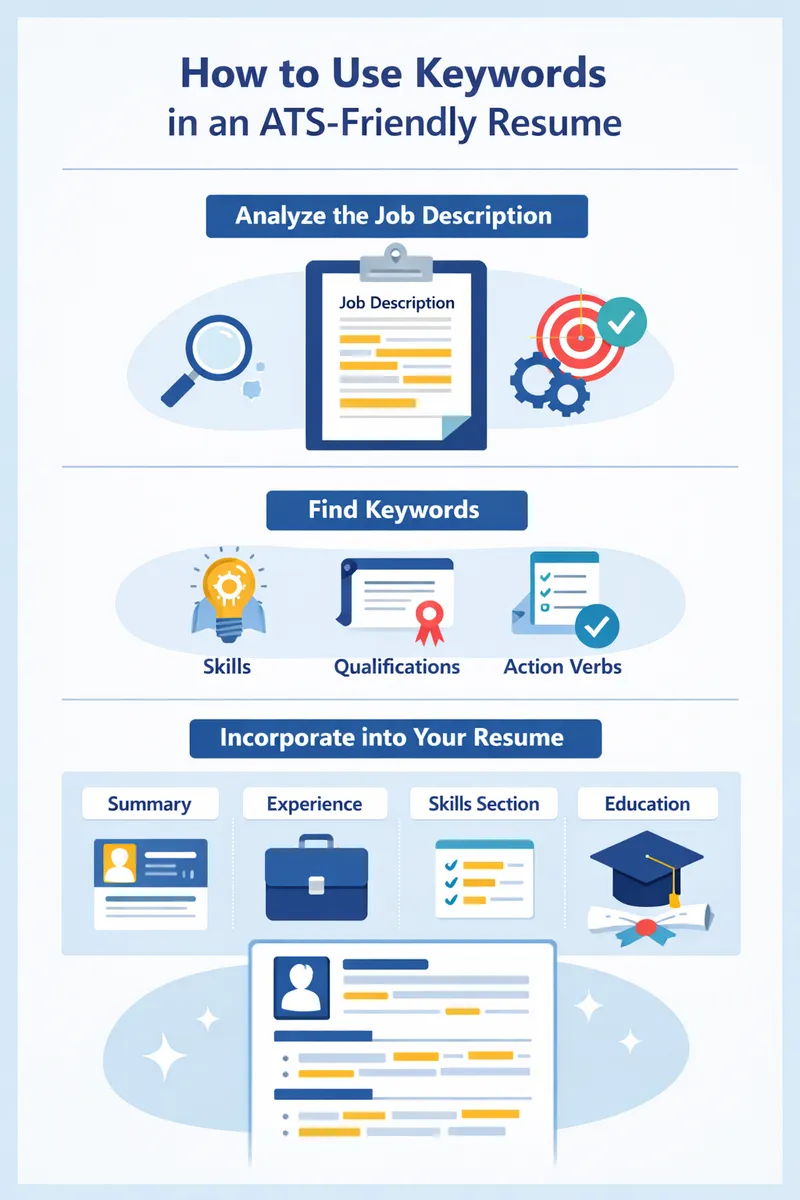
A visual breakdown of how to identify and use keywords in an ATS-friendly resume. It could illustrate the process of analyzing job descriptions and incorporating them into different sections of a resume.
Key Takeaways
- Keywords are essential for getting your resume past the ATS.
- Analyze job postings to gather relevant terms.
- Carefully incorporate keywords naturally into your resume.
In today's job market, having an ATS-friendly resume isn't just a good idea, it's essential. If you want to boost your chances of landing an interview, make sure to optimize your resume accordingly. For further guidance, consider using our Resume Builder or Resume Checker tools to fine-tune your application.
Trust me, it's worth the effort. Your future self will thank you.