What is a resume summary?
A resume summary (also called a professional summary) is a short paragraph — usually 2 to 4 sentences — at the very top of your resume, directly under your name and contact details. It states who you are professionally, your years of experience, your strongest relevant skills, and one or two concrete achievements. Its job is simple: give a recruiter, in the few seconds they spend on a first scan, a reason to keep reading.
A strong resume summary quickly conveys your value, highlighting the skills and experiences most relevant to the job you're applying for.
What should a resume summary include?
Four things, in roughly this order:
1.A professional identity — your role or field and seniority ("Registered nurse with 8 years in acute care").
2.Your most relevant skills — chosen from the job description, not from everything you can do.
3.One or two quantified achievements — "Increased sales by 30% in one year" says more than any adjective.
4.A fit statement — what you bring that the employer actually asked for.
And three things it should not include: career goals (that's an objective), first-person pronouns run wild, and claims you can't back in an interview.
How long should a resume summary be?
Two to four sentences — roughly 40 to 90 words. You don't need a novel. If it fills more than four lines on the page, recruiters skim past it, which defeats its purpose.
- Use action verbs.
- Be direct.
- Include metrics where possible: "Increased sales by 30% in one year."
Resume summary examples
- Sales professional: "Results-driven sales professional with over 10 years in technology sales. Achieved 120% of sales targets annually, earning multiple Top Performer awards."
- Career changer: "Creative marketing professional transitioning from education. Skilled in digital marketing strategies and expert in social media engagement."
- Recent graduate: "Computer science graduate with internship experience at two SaaS startups. Built and shipped a customer-facing analytics dashboard used by 2,000+ accounts."
- Returning to work: "Operations coordinator returning after a two-year caregiving break, with 6 years of logistics experience and current certification in supply-chain management."
Tailor whichever pattern fits: swap in the keywords from the specific job description — both recruiters and Applicant Tracking Systems (ATS) match against the posting's own language.
Resume summary vs resume objective — what's the difference?
A summary describes what you have done and can do; an objective states what you want. For almost every applicant with any experience, the summary wins.
| Resume Objective | Resume Summary |
|---|---|
| States your career goals | Highlights key achievements |
| Less detailed | More compelling narrative of you |
| Can feel generic | Appeals directly to the job's needs |
The exception: if you have no work history at all, a one-line objective plus a skills section can substitute — but even most first-job applicants can write a summary around coursework, projects, or volunteer work.
How to write yours
Writing an effective resume summary isn't about listing experiences. It's about selection: the two or three facts about you that best match this job.
Here's the thing. This isn't a one-time task. Always revisit and revise your summary for each application.
- Use our Resume Checker to refine your resume and make sure your summary stands out.
- Consider feedback from peers or mentors. Fresh eyes catch what you miss.
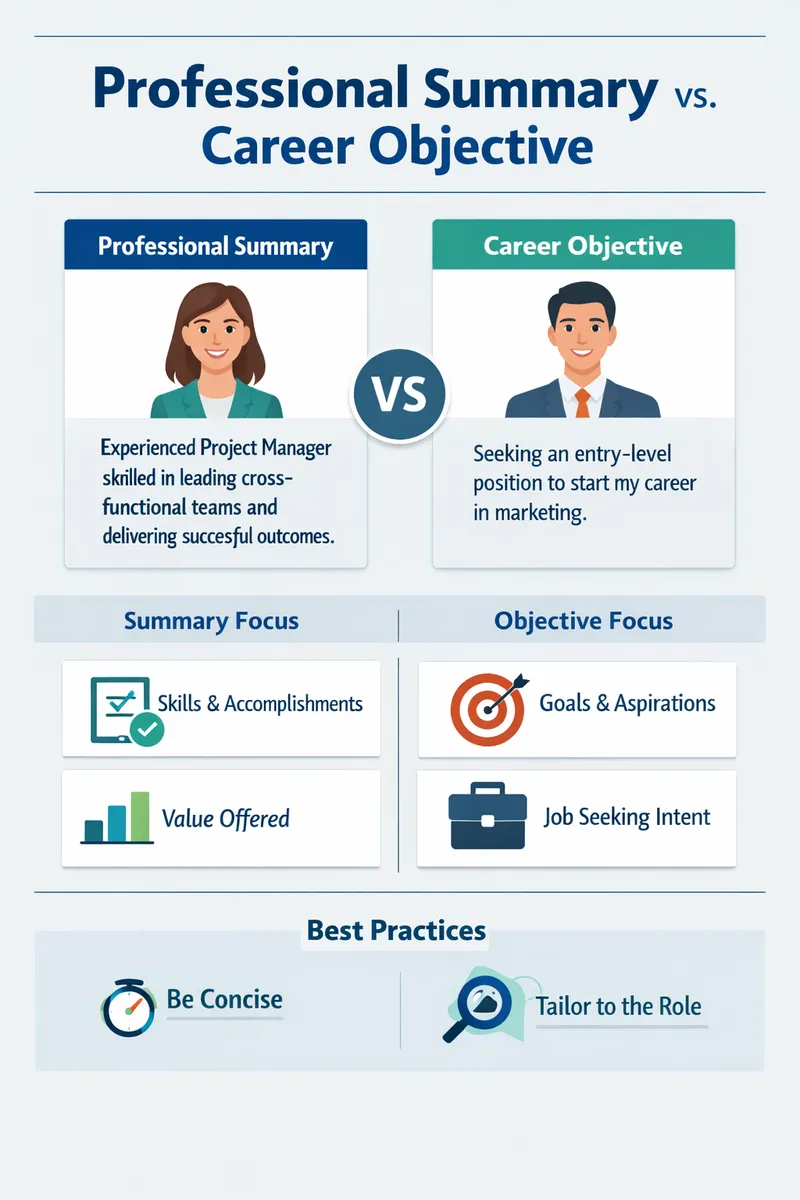
A visual representation comparing examples of professional summaries to objectives, emphasizing the difference and best practices for crafting each one.
Key takeaways
- A resume summary is a 2-4 sentence pitch at the top of your resume — identity, relevant skills, quantified proof, fit.
- Tailor it to each role using the posting's own keywords, and keep it under four lines.
- Use a summary rather than an objective unless you have no experience to summarize.
Crafting a strong resume starts at the top. If you want the rest of the page to match the summary, OneTwo Resume builds the whole document around the same principles.