You want a remote job. Every role you've ever had involved a commute, a badge, and a desk you sat at five days a week. So when a posting asks for "proven remote work experience," it's easy to assume you're out of the running.
You're probably not. Most office jobs today already involve a lot of remote-style work. You just haven't been describing it that way.
You don't need a remote title. Show the skills remote teams hire for: async communication, self-management, and results with distributed people.
This guide covers how to find that hidden experience, how to write it on your resume, and how to avoid the mistakes that make hiring managers skeptical. These remote work tips work whether you're targeting fully remote jobs or hybrid work arrangements.
What Do Hiring Managers Actually Mean by "Remote Experience"?
They rarely care where you sat. They care whether you can get work done without someone watching, communicate clearly in writing, and stay productive across time zones and tools.
It's a proxy for trust
Here's the thing. When a manager writes "remote experience required," they're trying to screen out a specific risk: the person who goes quiet for three days, misses deadlines, and needs constant check-ins. Remote experience is just shorthand for "I won't have to babysit this person."
So your job isn't to prove you worked from your kitchen. It's to prove you're reliable when nobody's looking.
The core skills behind the requirement
Most remote-ready skill sets boil down to a short list:
- Written communication. Clear emails, docs, Slack messages, and status updates.
- Self-direction. Prioritizing your own work without daily supervision.
- Async collaboration. Moving projects forward when teammates aren't online at the same time.
- Tool fluency. Comfort with platforms like Slack, Teams, Zoom, Asana, Jira, Notion, or Google Workspace.
- Outcome focus. Measuring yourself by results, not hours at a desk.
Did you do any of those in an office? Almost certainly.
Why this matters more now
Remote and hybrid arrangements aren't going away. The Bureau of Labor Statistics: Telework or Work at Home Data tracks telework monthly through the Current Population Survey, and it shows telework remains a regular part of how a large share of Americans work. That means plenty of competition for remote jobs, and plenty of candidates who can say "I worked remotely." You need to say something more specific.
How Do You Find Remote-Style Experience in an In-Office Job?
Audit your past roles for anything involving distributed teams, digital tools, or independent work. Most office jobs include more of this than people realize.
Run a quick experience audit
Grab a notepad and go through each job. Ask yourself:
1.Did I work with anyone in another office, city, or country?
2.Did I manage vendors, clients, or contractors I rarely met in person?
3.Did I ever lead a project mostly through email, video calls, or a project management tool?
4.Did I work independently for long stretches with minimal check-ins?
5.Did I write documentation, SOPs, or training materials others used without me?
6.Did I work from home occasionally, during a snowstorm, a move, or a company-wide shift?
Even two or three "yes" answers give you material. And honestly? Number six counts. If your company went remote for a stretch in 2020, that's real remote experience. Use it.
Look for the hidden distributed work
A lot of in-office roles are secretly distributed. Think about an account manager whose clients are all in other states. Or an IT specialist who supports three branch offices over remote desktop. Or a marketing coordinator who runs campaigns with a freelance designer they've never met.
That's distributed collaboration. It just happened to be done from an office chair.
Don't forget the tools
List the actual platforms you used. Hiring managers and applicant tracking systems both scan for tool names. "Coordinated projects in Asana with a 9-person team across 3 offices" beats "strong organizational skills" every single time.
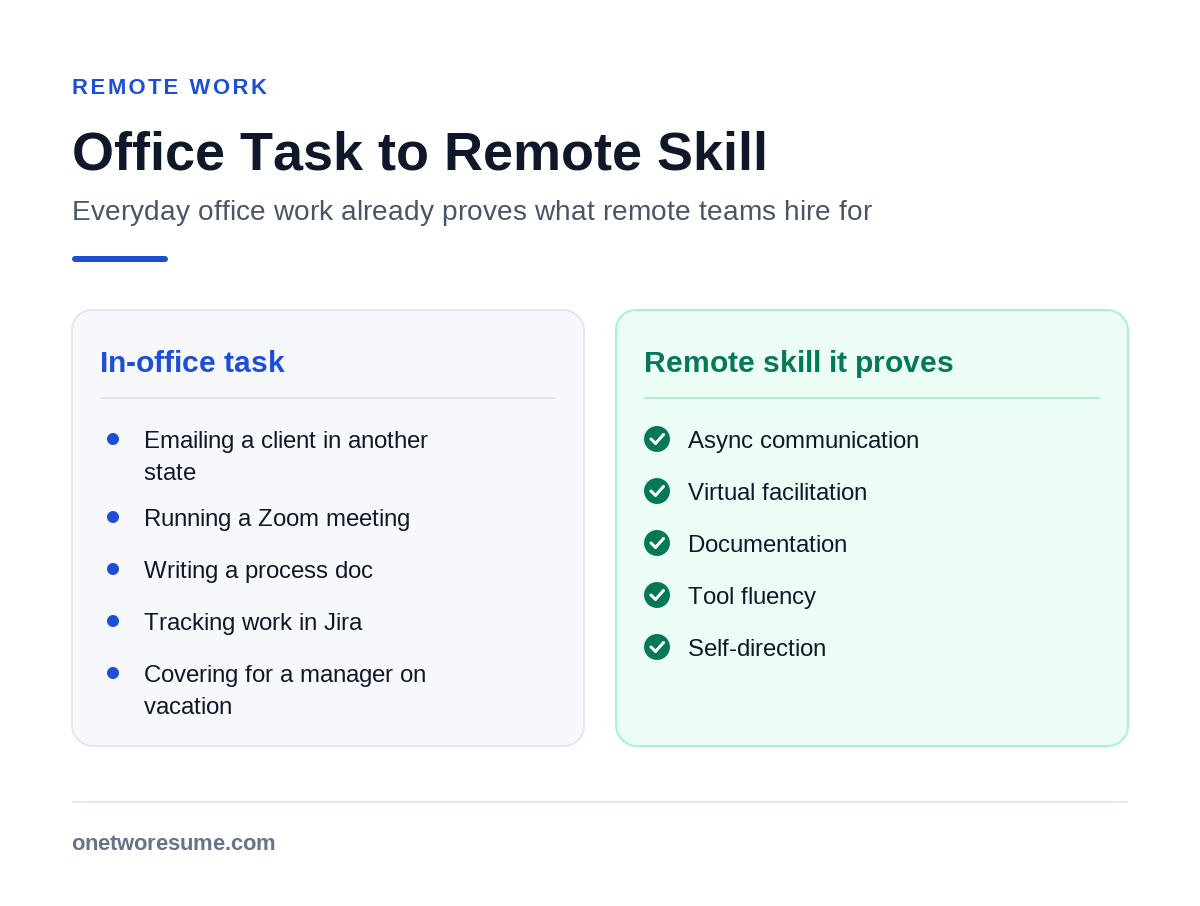
Office Task to Remote Skill: Everyday office work already proves what remote teams hire for
How Should You Write the Experience Section?
Weave remote-relevant details into your existing bullets rather than inventing a separate section. Lead with the result, name the tools, and mention distributed collaborators when true.
Rewrite bullets, don't add fluff
The biggest mistake people make is tacking on a vague line like "Comfortable working remotely." It says nothing. Instead, rework your existing bullets so the remote-friendly parts show up naturally.
Here's how that looks in practice:
| Generic In-Office Bullet | Remote-Ready Rewrite | Skill Signaled |
|---|---|---|
| Managed client accounts | Managed 25 client accounts across 6 states via Zoom and email, keeping retention above team target | Virtual relationship management |
| Worked on cross-functional projects | Led a product launch with teams in Chicago and Austin using Asana and weekly async updates | Async collaboration |
| Trained new hires | Wrote a 30-page onboarding guide that let new hires ramp up without daily shadowing | Documentation |
| Handled IT support tickets | Resolved support tickets for 3 branch offices using remote desktop tools | Remote troubleshooting |
| Worked independently | Owned monthly reporting end to end with no direct oversight, delivering on time every cycle | Self-management |
Notice that none of these lie about where you sat. They just describe what you actually did with more precision.
Should you ever add a "Remote" label?
Only if it's true. If you worked remotely for a defined period, you can note it next to the job, something like "Hybrid, 2 days remote" or "Fully remote, Mar 2020 to Jun 2021." The Indeed Career Advice: How To List Remote Work on Your Resume guide walks through a few clean formatting options for this.
But don't stretch it. Saying a fully in-office job was remote is the kind of thing that falls apart in a reference check. Not worth it.
Back it up in your summary and skills
Your summary can tie the thread together. Something like: "Operations specialist with 5 years coordinating distributed vendors and cross-office teams through Slack, Asana, and Google Workspace." Short. Specific. Credible.
Then list your collaboration tools in the skills section. If you want a model for how this reads in a polished format, browse our Resume Examples, or look at the Remote Work Coordinator Resume Example to see how remote-centric language is structured.
What Else Can Strengthen Your Case?
Your resume is one piece. Side projects, certifications, and a sharp LinkedIn profile help prove you can thrive outside an office.
Create proof if you're light on it
If your audit came up thin, build some evidence. Freelance a small project. Volunteer for a nonprofit that runs on Slack. Join an open-source effort. A few months of real distributed work fills the gap fast.
Match your LinkedIn to your resume
Recruiters will check. Make sure your headline and About section echo the same remote-ready story. Our LinkedIn Optimizer can help you tighten it up.
Test before you send
Run your draft through the Resume Checker to see whether the tool names and collaboration keywords are actually landing. Truth is, a lot of great experience gets lost because it's phrased in a way ATS software doesn't pick up.
One of the most underrated remote work tips? Treat the application itself like a remote task. Clear, concise, on time, no hand-holding needed. That's the first proof point a hiring manager sees.
Key Takeaways
- Remote experience is really about trust, written communication, and self-direction, not location.
- Audit every past role for distributed teams, digital tools, and independent work.
- Rewrite existing bullets with tools, numbers, and remote collaborators instead of adding vague claims.
- Only label a role as remote or hybrid work if it genuinely was.
- Fill gaps with freelance, volunteer, or open-source projects.
- Keep your LinkedIn and resume telling the same story.
- Apply these remote work tips consistently across your summary, experience, and skills.
Ready to Rewrite Your Experience?
You don't need a remote job title to land remote jobs. You need to describe your work in the language remote teams understand. OneTwo Resume makes that easier. Open the Resume Builder, drop in your rewritten bullets, and see how much more remote-ready your experience looks in about 20 minutes.