Here's a situation that trips up a lot of people. You're a strong candidate. Your skills match the posting. But the hiring manager is in Berlin, the team lead is in Singapore, and you're in Chicago. Before they even read your experience, they're wondering one thing: will this person actually be around when we need them?
That question decides more applications for global remote jobs than most candidates realize. And most resumes don't answer it at all.
Name your time zone, state your exact overlap hours, and prove it with past examples of cross-time-zone collaboration in your summary and bullets.
Let's break down how to do that without sounding desperate or vague.
Why Does Time Zone Flexibility Matter So Much to Global Employers?
Distributed teams run on overlap. If a recruiter can't quickly figure out when you're available, they'll often move on to a candidate who made it obvious.
The hidden screening question
Job postings for global teams often say things like "must overlap 4 hours with CET" or "available for US Eastern mornings." Sometimes it's not written down at all. Truth is, many hiring managers assume a candidate who doesn't mention availability either hasn't thought about it or can't do it.
Remote work is no longer a niche arrangement. The Bureau of Labor Statistics tracks telework in its Current Population Survey, and that data shows telework has become a normal part of the US workforce. More remote workers means more competition for the best remote jobs, so small signals like availability carry real weight.
Async vs. sync teams
Not every global team works the same way. Some are heavily asynchronous, built around written updates and recorded videos. Others expect daily standups across continents. Your resume should show you can handle both:
- Sync teams want to know your overlap window.
- Async teams want proof you communicate clearly in writing.
- Hybrid work setups with regional hubs want both, plus occasional travel flexibility.
What recruiters are really scanning for
Look, recruiters spend very little time on a first pass. They're looking for three quick answers: Where are you? When can you work? Have you done this before? If your resume answers all three in the top third, you're ahead.
Where Should Time Zone Flexibility Go on Your Resume?
Put it in three places: your header, your professional summary, and your experience bullets. Each spot does a different job, and together they build a believable picture.
Your header
This is the easiest win. Next to your location, add your time zone and a short availability note. For example:
- Lisbon, Portugal (WET/UTC+0) | Available 08:00 to 18:00 UTC
- Austin, TX (CT/UTC-6) | Overlap with EMEA mornings and APAC evenings
Using UTC offsets matters. Not everyone knows what "MST" means, but everyone can do math with UTC. And remember daylight saving time shifts, so the core hours are what really count.
Your professional summary
One sentence is enough. Something like: "Product designer with 5 years on distributed teams across 4 time zones, comfortable with async workflows and 4+ hours of daily overlap with US Eastern." That's specific. It's also honest, and it's easy to verify in an interview.
Your experience bullets
This is where you prove it. Claims in a header are nice. Evidence in your work history is what actually convinces people. Write bullets that mention the geography and the outcome together:
- "Coordinated weekly releases with engineering teams in Kraków and Manila, cutting handoff delays by restructuring standups into async video updates."
- "Ran client calls for 3 APAC accounts from a US base, scheduling early-morning sessions twice a week."
If you're building this from scratch, a Resume Builder makes it easier to test different header and summary versions side by side.
How Do You Phrase Time Zone Flexibility Without Sounding Vague?
Swap generic claims like "flexible hours" for numbers, time ranges, and named regions. Specific language reads as competence, while vague language reads as filler.
Weak phrasing vs. strong phrasing
Here's a quick comparison of what not to write and what works better:
| Weak Phrasing | Strong Phrasing | Why It Works |
|---|---|---|
| "Flexible with time zones" | "Available 07:00 to 15:00 UTC, with 4 hours overlap with US Eastern" | Gives exact hours anyone can check |
| "Worked with international teams" | "Collaborated daily with teams in London, Bangalore, and São Paulo" | Names real regions and frequency |
| "Good communicator" | "Wrote weekly async status docs read by 20+ stakeholders across 3 continents" | Shows the skill in action |
| "Can work any hours" | "Open to 2 early or late calls per week for APAC syncs" | Sets realistic, sustainable boundaries |
| "Remote experience" | "3 years fully remote on a team spread over 9 hours of time difference" | Quantifies the challenge you handled |
Notice that last column. Every strong version answers a question the recruiter would otherwise have to ask.
Don't overpromise
But here's the thing. Saying you'll work any hour is a red flag, not a selling point. Experienced remote managers know burnout is real. "Available 24/7" makes you sound like someone who hasn't done this before. Pick a sustainable window and stick to it.
Mention your async tools
Tools signal real experience. Listing things like Slack, Loom, Notion, Linear, or Jira shows you know how distributed teams actually work. Keep it in your skills section or weave it into bullets. The Indeed guide on writing a resume for remote jobs also recommends highlighting remote-specific tools and self-management skills, which pairs nicely with your time zone details.
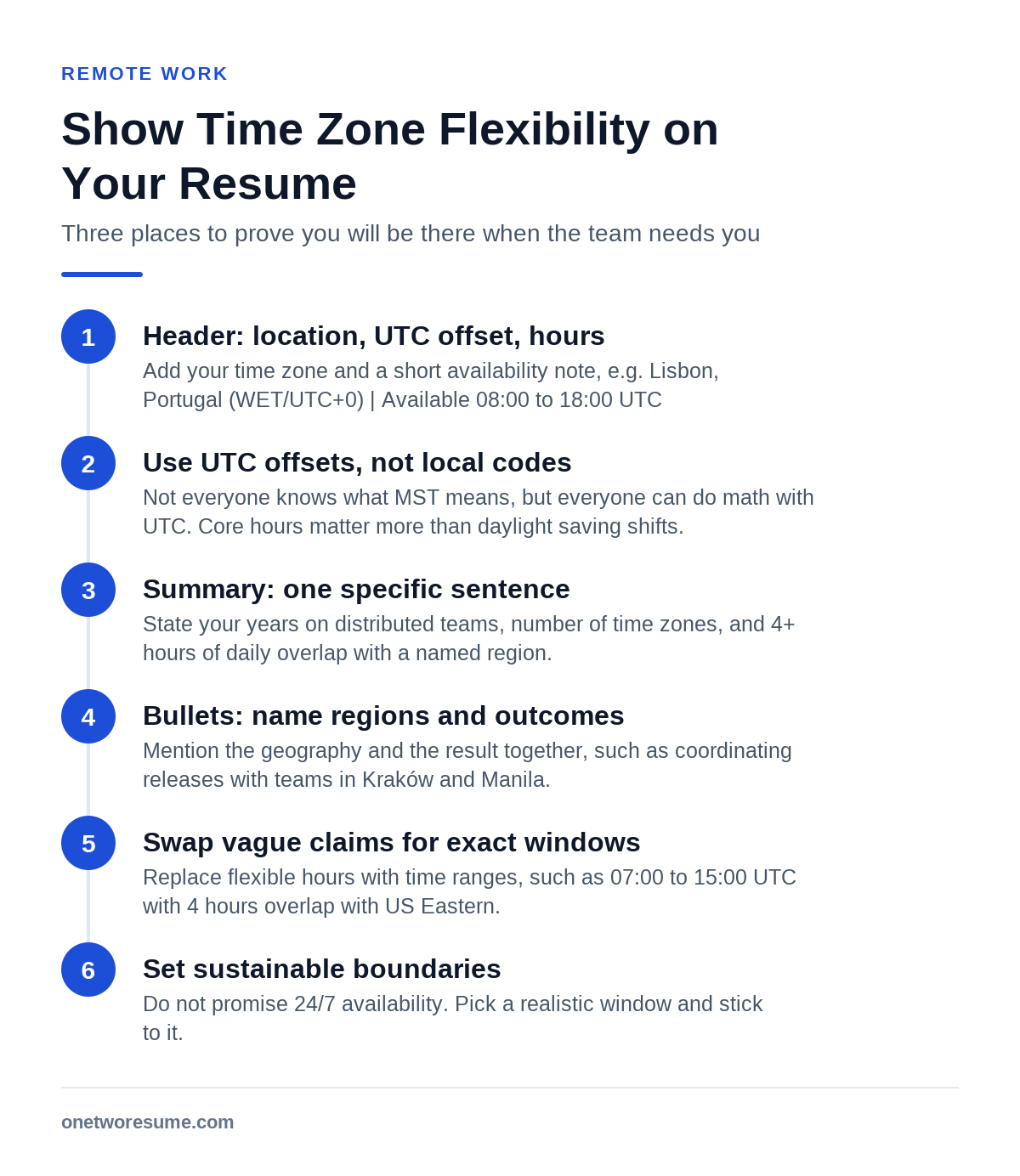
Show Time Zone Flexibility on Your Resume: Three places to prove you will be there when the team needs you
How Do You Back This Up Beyond the Resume?
Your resume opens the door, but consistency closes the deal. Match your LinkedIn, cover letter, and remote interview answers so the story holds up everywhere.
Keep LinkedIn consistent
Recruiters cross-check. If your resume says UTC+1 and your LinkedIn says you're in Toronto, that's confusing. Add your availability to your About section and headline if it fits. A LinkedIn Optimizer can help you tighten that profile so it lines up with your resume.
Prep for the remote interview
Expect questions like "How do you handle a 10-hour time difference?" or "Tell me about a time a handoff went wrong." Have one specific story ready. Bonus points if the interview itself is scheduled at an awkward hour and you show up sharp and on time. That's proof in real life.
Tailor for each role
Different roles need different emphasis. A creative professional working with overseas studios might highlight review cycles across time zones. Browsing Resume Examples helps you see how this looks by field. For instance, the Multimedia Artists and Animators Resume Example is a good model if you're doing render handoffs or client feedback loops across continents.
When you're trying to find remote jobs at scale, it's tempting to send one generic resume everywhere. Don't. A 5-minute tweak to your overlap hours for each posting can make a real difference. Before you hit submit, run it through a Resume Checker to make sure the formatting survives applicant tracking systems.
One more tip for work from home veterans
If you've been doing work from home for years but always on a single-country team, don't panic. Look for smaller examples: a vendor overseas, a conference call with a partner office, a freelance client abroad. Those count. Pretty much any cross-border collaboration is fair game.
Key Takeaways
- Recruiters for global remote jobs want to know where you are and when you're available, fast.
- Add your city, UTC offset, and core working hours to your resume header.
- Use one sentence in your summary to state your overlap and distributed team experience.
- Prove flexibility in experience bullets by naming regions, frequency, and outcomes.
- Swap vague phrases like "flexible hours" for exact time windows.
- Don't promise 24/7 availability. Sustainable boundaries look more professional.
- Keep LinkedIn, cover letters, and remote interview answers consistent with your resume.
- Tailor overlap details for each application, then check ATS compatibility.
Ready to Make Your Availability Obvious?
Time zone flexibility is one of those details that quietly wins or loses interviews. Get it right, and you remove a major doubt before anyone has to ask. OneTwo Resume gives you the tools to build, check, and polish a resume that shows global employers exactly when and how you work best. Start today and make your next application impossible to overlook.