So you've got two offers on the table. Nice work. But now comes the awkward part: you like one company more, and the other one is paying more. Or maybe they're close, and you want to see if your favorite will move.
Here's the thing. A competing offer is the strongest position you'll ever have in salary negotiation. It's not a hypothetical. It's proof that the market values you at a specific number. But how you use it matters a lot. Handle it well and you get a raise before day one. Handle it badly and you come off like you're running an auction.
Share the competing offer as honest context, not a threat. Name a specific number and ask your preferred employer if they can close the gap.
Why Does a Competing Offer Change the Negotiation?
A real offer replaces guesswork with evidence. Recruiters know another company has already done the vetting and put money behind you, so your ask becomes much harder to dismiss.
It shifts the conversation from opinion to fact
Without a second offer, most job offer negotiation relies on salary research and your own sense of worth. That's useful, but a hiring manager can always say, "Our range is our range." With a written offer in hand, you're not arguing about what you might get. You're reporting what you did get.
It creates a timeline
Offers expire. That gives the company a reason to act quickly instead of letting your request sit in someone's inbox for a week. Urgency, used honestly, helps everyone make a decision.
It tells them you're in demand
Truth is, companies want people other companies want. A competing offer often raises your perceived value inside the hiring team, not just on paper.
How Should You Prepare Before Making the Ask?
Get clear on the full value of both offers and decide your walk-away number before you talk to anyone. Preparation keeps you calm and specific when the conversation gets real.
Compare total compensation, not just base salary
A $5,000 higher base can easily get wiped out by a weaker bonus, worse health coverage, or less equity. Break both offers down line by line.
| Component | What to Compare | Why It Matters |
|---|---|---|
| Base salary | Annual gross pay | Sets the baseline for future raises |
| Bonus | Target percentage and payout history | "Target" isn't guaranteed |
| Equity | Grant value, vesting schedule, cliff | Can be worth a lot or nothing |
| Benefits | Health premiums, 401(k) match, PTO | Often worth thousands per year |
| Sign-on bonus | Amount and clawback terms | Easy for companies to approve |
| Flexibility | Remote policy, schedule | Affects cost and quality of life |
Do your salary research anyway
Even with two offers, check whether both are on the low end. The Occupational Outlook Handbook - Bureau of Labor Statistics gives median pay and job outlook by occupation, and the BLS Occupational Employment and Wage Statistics data breaks wages down by location and percentile. If both offers sit below the median for your area, you've got even more room to push.
Decide three numbers
- Your target: what you'll actually ask for.
- Your happy number: what you'd accept on the spot.
- Your walk-away: below this, you take the other offer.
Write them down. Seriously. It's way easier to stay steady when you've already made the hard decisions.
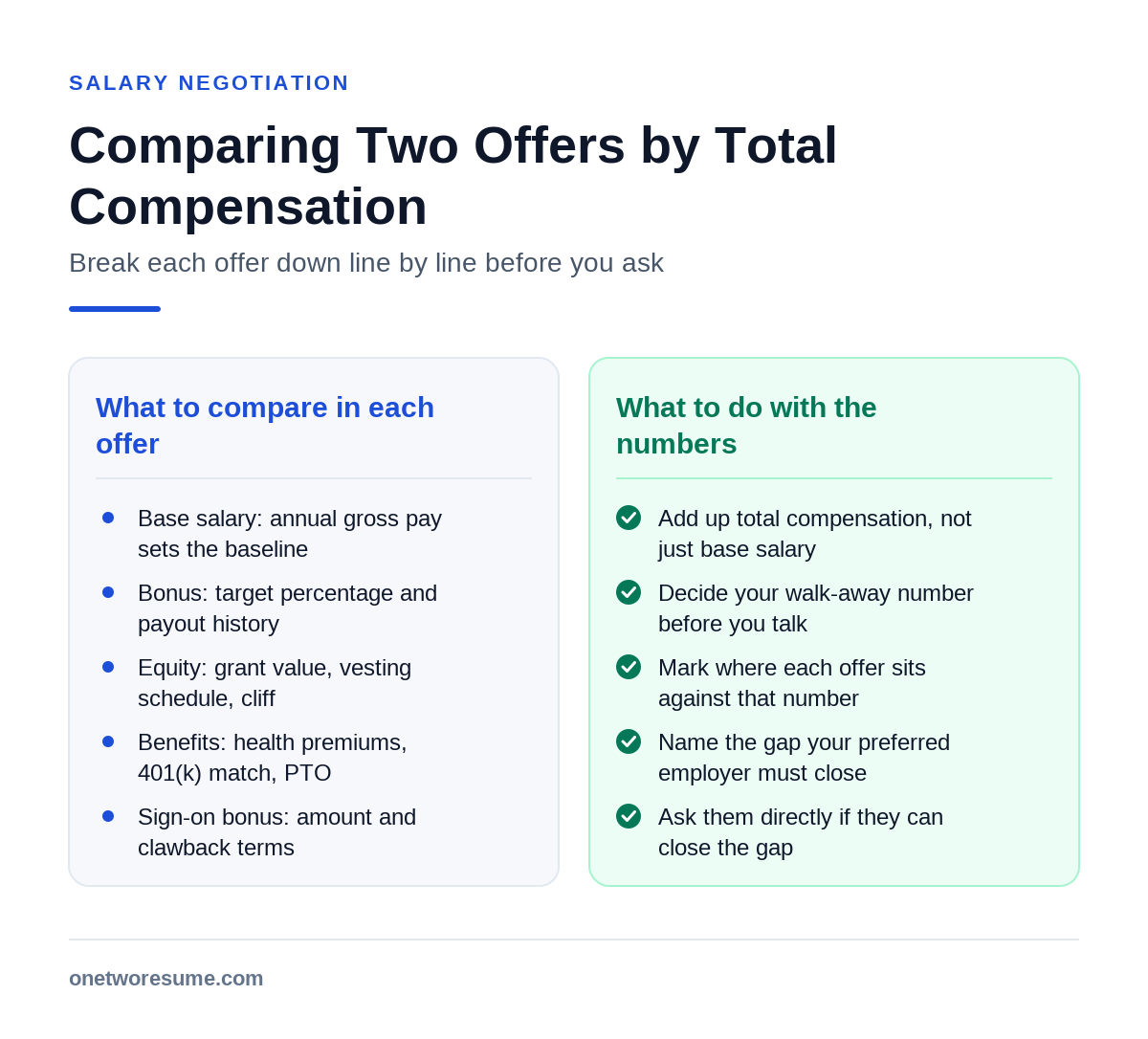
Comparing Two Offers by Total Compensation: Break each offer down line by line before you ask
What Do You Actually Say to the Employer?
Lead with enthusiasm, share the competing number plainly, and make a clear ask. Keep it short, warm, and specific so the recruiter has something concrete to take to the hiring manager.
Open with genuine interest
Start by saying this company is your first choice (if it is). Recruiters need to know that closing the gap actually closes the deal. Otherwise, why would they fight for budget?
Use a simple script
Something like this works well:
"I'm really excited about this role, and honestly, you're my first choice. I've received another offer at $128,000 base with a $10,000 sign-on bonus. I'd love to make this work. Is there any flexibility to get closer to that number?"
That's it. No drama. No ultimatum. And notice there's a real figure in there. Vague statements like "I have other options" don't give anyone anything to work with.
Know what not to do
- Don't bluff about an offer you don't have. Recruiters talk, and some will ask for details.
- Don't share the other company's name unless it helps you. It usually isn't necessary.
- Don't negotiate over text if you can avoid it. A phone call feels more collaborative.
- Don't forward the actual offer letter unless they specifically ask and you're comfortable with it.
What If They Can't Match the Offer?
A no on base salary isn't the end of the conversation. Ask about sign-on bonuses, equity, extra PTO, or an early review, since those often come from different budgets.
Ask about other levers
Base pay bands can be rigid, especially at bigger companies. But a sign-on bonus usually comes out of a different bucket. So does a six-month salary review or an extra week of vacation. Try: "I understand the base is fixed. Could we look at a sign-on bonus to bridge the difference?"
Weigh the non-money stuff honestly
Maybe your preferred company pays $8,000 less but offers better growth, a shorter commute, or a manager you clicked with. Those things are real. Just make sure you're choosing them on purpose, not settling because the conversation felt uncomfortable.
Decline the other offer gracefully
Whichever way you go, call the other company. Thank them. Keep it brief. You might want to work there in two years, and burning a bridge over one awkward email is a rookie move.
How Do You Handle Salary Expectations Going Forward?
Every offer you negotiate becomes your new baseline. Documenting your wins and keeping your profile fresh puts you in a stronger spot for the next salary negotiation.
Keep your materials ready
The best time to update your resume is right after you land a job, while the details are fresh. Use our Resume Builder to capture new achievements as they happen, and run it through the Resume Checker before your next search.
Stay visible
Recruiters reach out more when your profile is sharp. A quick pass with our LinkedIn Optimizer can mean more inbound interest, and more inbound interest often means more offers to compare next time.
Learn how to negotiate salary as a habit
Look, knowing how to negotiate salary isn't a one-time skill. It's something you'll use at every job change and every review. The more you practice, the less scary it gets.
Key Takeaways
- A competing offer is real evidence, so present it as context, not a threat.
- Compare total compensation, including bonus, equity, and benefits, before you make an ask.
- Do salary research with BLS data to check whether both offers are fair for your market.
- Set your target, happy, and walk-away numbers before any conversation.
- Use a short, warm script with a specific number and a clear question.
- If base pay won't move, ask about sign-on bonuses, PTO, or an early review.
- Never bluff, and always decline the other offer politely.
Ready for Your Next Move?
Getting two offers starts with a resume that gets you in the door. OneTwo Resume gives you the tools to build, check, and polish your application so you're the candidate companies compete over. Start building today, and walk into your next salary negotiation with options.