It's one of the most predictable interview questions out there. And it still trips people up. Maybe your manager micromanages every email. Maybe you've been passed over for promotion twice. Maybe the company just feels stuck. Whatever the real reason, you've probably wondered how to explain it without sounding bitter, disloyal, or like a flight risk.
Here's the good news. You don't have to lie, and you don't have to trash anyone. You just need to frame it well.
Focus on what you're moving toward, not away from. Keep it short, honest, and positive, then pivot to why this new role fits you.
Why Do Interviewers Ask This Question in the First Place?
Interviewers aren't digging for gossip. They want to know whether you'll leave them for the same reason, and whether you handle tough situations with maturity.
They're checking for red flags
Look, hiring someone is expensive and slow. So a recruiter wants to spot patterns early. If you say you're leaving because your boss is "impossible," they start wondering whether you'll say the same thing about them in 18 months. Fair or not, that's how it lands.
They're quietly listening for things like:
- Conflict with managers or coworkers
- Performance problems you're avoiding
- Unrealistic expectations about the next job
- A habit of job hopping without a clear reason
They're testing your professionalism
Truth is, how you talk about your current employer tells them how you'll talk about them. Discretion matters. Someone who can describe a frustrating situation calmly is someone who can probably handle a frustrating client, too.
They want to see if the fit makes sense
This question often shows up early, sometimes in the very first phone interview with a recruiter. At that stage, they're screening for alignment. If your reason for leaving lines up with what their role offers, you've basically answered half the interview for them.
What Makes a Strong Answer (and What Kills One)?
The best answers are forward-looking, brief, and tied to the job you're applying for. The worst ones are long, emotional, and focused on what someone else did wrong.
The "toward, not away" framework
Here's the thing. Almost every negative reason has a positive flip side. Hate your micromanaging boss? You're looking for more autonomy. Stuck with no promotion path? You want room to grow. Burned out from chaos? You're drawn to a team with clear processes.
Same truth. Different framing. And the second version is the one that gets you hired.
Keep it to 30 to 60 seconds
Seriously. Two or three sentences about why you're leaving, then one or two about why this role excites you. That's it. The longer you talk about your current job, the more likely you are to slip into complaining. On a phone interview especially, where they can't see your body language, rambling sounds like nerves.
Common mistakes to avoid
- Oversharing. Nobody needs the full saga of the 2023 reorg.
- Blaming people by name or title. "My director" is still a person they can picture.
- Making it all about money. Pay can be part of it, but leading with it can make you seem easy to poach.
- Sounding desperate. "I just need to get out" isn't a reason. It's a cry for help.
- Lying. References and backchannel checks exist. Don't invent a story you can't back up.
Here's a quick comparison of how to reframe common real reasons:
| Real Reason | What Not to Say | What to Say Instead |
|---|---|---|
| Bad manager | "My boss is a control freak." | "I'm looking for a role with more ownership over my projects." |
| No promotion | "They keep passing me over." | "I've grown a lot here, and I'm ready for responsibilities my current role can't offer." |
| Low pay | "They're cheap." | "I'm looking for a role that reflects the scope of what I'm now doing." |
| Burnout | "The place is a mess and I'm exhausted." | "I do my best work on teams with clear priorities and sustainable pacing." |
| Layoffs or instability | "The company is sinking." | "After recent restructuring, I'm looking for a stable place to build long-term." |
| Boredom | "It's mind-numbing." | "I've mastered my current scope and want to tackle harder problems." |
| Career change | "I hate this field." | "I've discovered a strong interest in X and have been building skills toward it." |
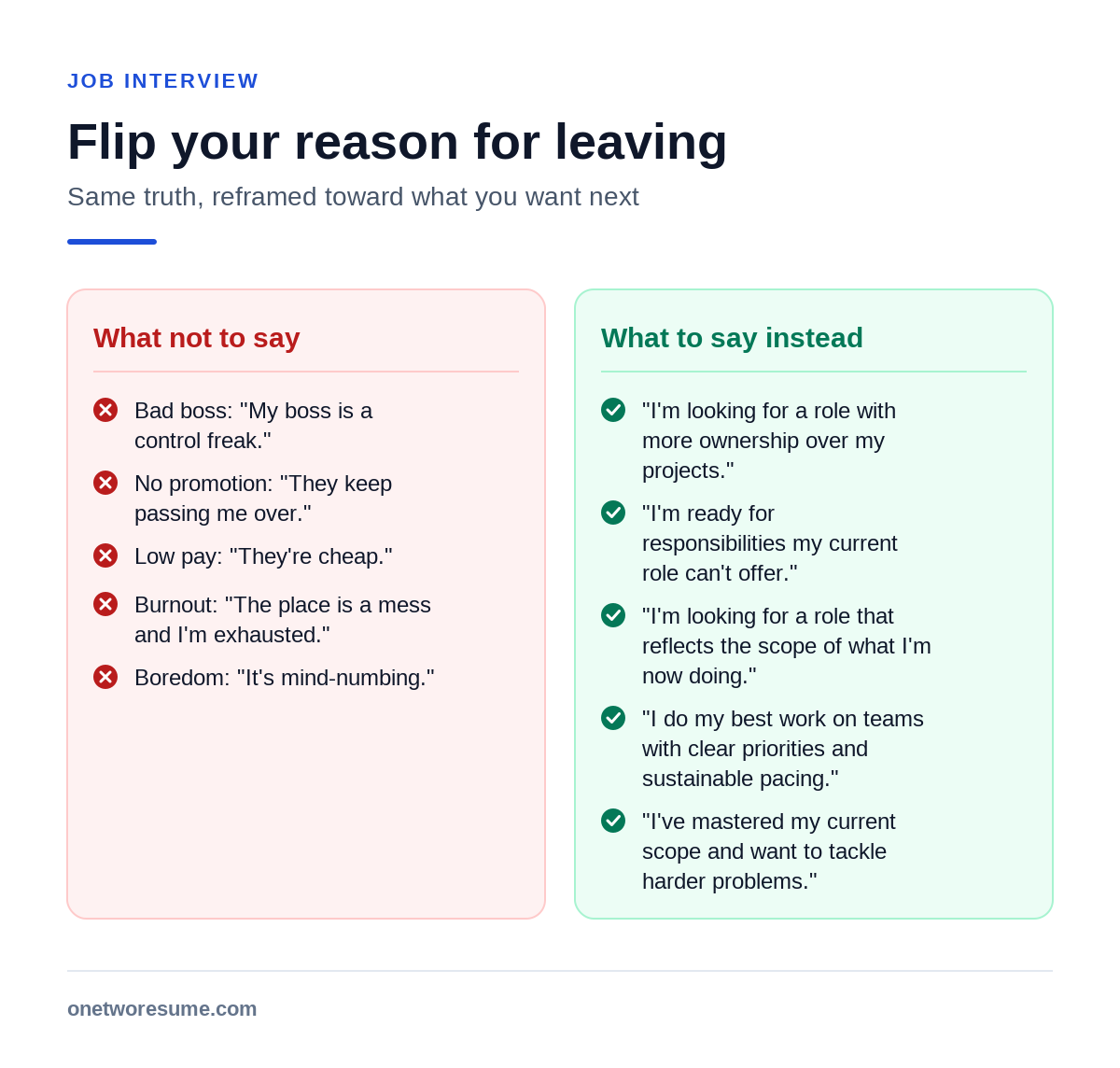
Flip your reason for leaving: Same truth, reframed toward what you want next
How Do You Build Your Answer Step by Step?
Start with a neutral line about your current role, name what you want next, and connect it directly to the job. Practice it out loud until it sounds natural, not rehearsed.
Step 1: Acknowledge something good
Open with a genuine positive about your current job. It doesn't have to be gushing. "I've learned a lot about enterprise sales in my three years at Acme" works fine. It signals you're not running from a fire.
Step 2: Name what you're looking for
Then state the gap, framed as a goal. More leadership. A different industry. Remote flexibility. A bigger technical challenge. Be specific. Vague answers like "new challenges" sound like you didn't think about it.
Step 3: Connect it to this role
This is where most people drop the ball. Tie your goal to something concrete in the job posting or company. For example:
- "I've really enjoyed building our customer onboarding process at my current company, and I've learned a ton. But the team is small, and there's no path to managing people. Your posting mentions leading a team of four, and that's exactly the next step I'm working toward."*
Clean. Positive. Done.
What if it comes up in a behavioral interview?
Sometimes the question gets folded into a behavioral interview format, like "Tell me about a time you disagreed with your manager." That's different. Now they want a story, so use the STAR method (Situation, Task, Action, Result). Keep the focus on what you did and how it resolved, not on how wrong the other person was. End with what you learned. That's the part they'll remember.
What If Your Situation Is Complicated?
Got fired, laid off, or leaving after a short stint? Be honest, be brief, and spend most of your answer on what you learned and what you want next.
You were laid off
Layoffs are common and rarely carry stigma anymore. Just say it plainly: "My role was eliminated in a company-wide restructuring." No need to apologize.
You were let go
Harder, but manageable. Own it in one sentence, share what you learned, and move on. "The role wasn't the right fit for my strengths. I've since focused on X, which is why this position appeals to me."
You're leaving after less than a year
Address it directly before they wonder. "The role turned out to be quite different from what was described, and I'd rather make a thoughtful move now than stay somewhere I can't contribute fully." Then show you've researched this company carefully so it won't happen again.
If you're exploring a pivot entirely, the Bureau of Labor Statistics: Occupational Outlook Handbook is a solid way to research growth outlooks for different careers, which gives your "why I'm changing" story real substance.
How Should You Prepare Before the Interview?
Write your answer down, trim it, and say it out loud a few times. Make sure your resume and LinkedIn tell the same story your answer does.
Align your materials with your story
Your answer should match what's on paper. If you say you want leadership, your resume should highlight moments where you already led something. Use our Resume Builder to sharpen those bullets, and run it through the Resume Checker to make sure it passes ATS filters before a recruiter ever calls. And don't forget your LinkedIn Optimizer, since recruiters will check that before your phone interview too.
Practice for different formats
A phone interview with a recruiter needs a tight, 30-second version. A final round with a hiring manager might allow a bit more context. Prep both. For more practice prompts and common interview questions, Indeed Career Advice: Interviewing has a deep library worth browsing.
Do a gut check
Read your answer back. Does it mention anyone negatively? Is it longer than four sentences? Does it end on the new role? If you've got a yes, no, yes, you're golden.
Key Takeaways
- Interviewers ask this to spot red flags and test your professionalism, not to collect gossip.
- Frame your reason around what you're moving toward, not what you're escaping.
- Keep it to 30 to 60 seconds, especially on a phone interview.
- Follow a simple structure: something positive, what you want, why this role fits.
- If it's asked as a behavioral interview question, use the STAR method and focus on your actions.
- Be honest about layoffs, firings, or short stints, but keep it brief and future-focused.
- Make sure your resume and LinkedIn back up the story you're telling.
Ready to Make Your Move?
Knowing what to say is half the battle. The other half is getting the interview in the first place. OneTwo Resume helps you build a resume that tells a clear, confident career story, so when the recruiter asks why you're leaving, your answer and your experience line up perfectly. Browse our Resume Examples for inspiration, then start building yours today.