Few interview questions cause more sweaty palms than this one. You know it's coming. You've probably rehearsed it. And yet, when the interviewer leans back and asks, "So, what's your biggest weakness?", your mind goes blank or you blurt out something like "I'm a perfectionist."
We've all been there. The good news? This question is far more predictable than it feels, and once you understand what's really being asked, it becomes one of the easier ones to answer well. If you're figuring out how to ace an interview, getting this answer right is a quick win.
Pick a real but non-critical weakness, explain the specific steps you're taking to fix it, and back it up with a concrete result.
Why Do Interviewers Ask About Your Biggest Weakness?
Interviewers aren't trying to trap you. They want to see self-awareness, honesty, and evidence that you actively work on getting better. The weakness itself matters less than how you talk about it.
What They're Actually Testing
Here's the thing. Nobody expects you to be flawless. A hiring manager asking this question is usually checking three things:
- Self-awareness. Can you honestly assess your own performance?
- Coachability. Do you respond to feedback or get defensive?
- Fit. Is your weakness going to cause real problems in this specific role?
That last point is sneaky. A weakness that's harmless for a data analyst could be a dealbreaker for a sales rep.
Why Fake Answers Backfire
Look, interviewers have heard "I work too hard" thousands of times. It reads as evasive. Worse, it suggests you either lack self-awareness or don't trust them with the truth. Neither is a great look.
Truth is, a genuine, slightly uncomfortable answer almost always lands better than a polished non-answer. The career experts at Indeed Career Advice: Interviewing make the same point: authenticity paired with an improvement plan beats a disguised strength every time.
How Do You Structure a Strong Weakness Answer?
Use a simple three-part formula: name the weakness, show what you're doing about it, and share proof of progress. Keep the whole answer under 90 seconds.
The Three-Part Formula
Think of it as Weakness, Action, Result.
1.Weakness: State it plainly in one or two sentences. No hedging.
2.Action: Describe the specific habit, tool, course, or system you've adopted.
3.Result: Give a tangible outcome. A project delivered on time, positive feedback, a measurable improvement.
That's it. Short, honest, forward-looking.
Choosing the Right Weakness
The sweet spot is a weakness that's real, fixable, and not central to the job. Before your interview, read the job description carefully. If you want a deeper sense of what a role truly demands, the Occupational Outlook Handbook from the Bureau of Labor Statistics breaks down the core duties and skills for hundreds of occupations. Use it to rule out weaknesses that hit the role's must-haves.
Weaknesses to Avoid
- Anything that's a core requirement of the job ("I'm not great with numbers" for an accountant role)
- Character flaws like dishonesty or chronic lateness
- Humblebrags disguised as weaknesses
- Personal issues unrelated to work
| Answer Type | Example | How It Lands |
|---|---|---|
| Humblebrag | "I care too much about my work." | Evasive, forgettable |
| Dealbreaker | "I struggle to meet deadlines." (project manager role) | Raises red flags |
| Vague | "I could be more organized." | Lacks substance |
| Strong | "I used to avoid delegating. Now I use weekly check-ins and handed off 2 reports last quarter." | Honest, credible, growth-focused |
What Are Good Weakness Examples for Entry-Level Candidates?
Entry-level candidates should pick weaknesses tied to inexperience, not attitude. Interviewers expect skill gaps early in a career, so focus on how quickly you learn.
Example 1: Public Speaking
"Presenting to groups has been a challenge for me. In my final year of college, I'd get nervous and rush through slides. So I joined my university's Toastmasters club and volunteered to present our capstone project. By the end of the semester, my professor specifically praised my delivery. I still prep more than most people, but I'm much more comfortable now."
Example 2: Asking for Help
"During my internship, I tended to spend hours stuck on problems instead of asking questions. I didn't want to seem unprepared. My manager pointed out that it was slowing projects down, so I started setting a 30-minute rule. If I'm stuck that long, I ask. It cut my turnaround time noticeably and honestly made me learn faster."
Example 3: Limited Experience With a Tool
"I haven't used Salesforce in a professional setting yet. I noticed it's listed in this role, so I've started Salesforce's free Trailhead modules and completed the admin beginner trail last month." Simple. Proactive. Hard to argue with.
What Are Good Weakness Examples for Senior Candidates?
Senior candidates should share weaknesses tied to leadership, scale, or strategy. Your answer should show the maturity to spot your own blind spots before they hurt your team.
Example 1: Delegation
"Early in my time as a team lead, I held onto too much work because I knew I could do it quickly. That bottlenecked my team and limited their growth. I now map out each quarter's projects and deliberately assign stretch work to direct reports. Last year, two of my team members were promoted, partly because of projects they owned end-to-end."
Example 2: Impatience With Slow Processes
"I can get frustrated when decisions move slower than I'd like, especially in larger organizations. I've learned that pushing harder usually backfires. Now I spend more time upfront aligning stakeholders, which feels slower but actually gets approvals through faster."
Example 3: Being Too Detail-Oriented at a Strategic Level
"As I moved into a director role, I kept getting pulled into the weeds on execution. It meant I wasn't spending enough time on long-term planning. I now block 4 hours every Friday for strategy work and rely on my managers for status updates."
Notice the pattern? Senior answers show self-correction at a bigger scale. And they always connect back to team or business outcomes.
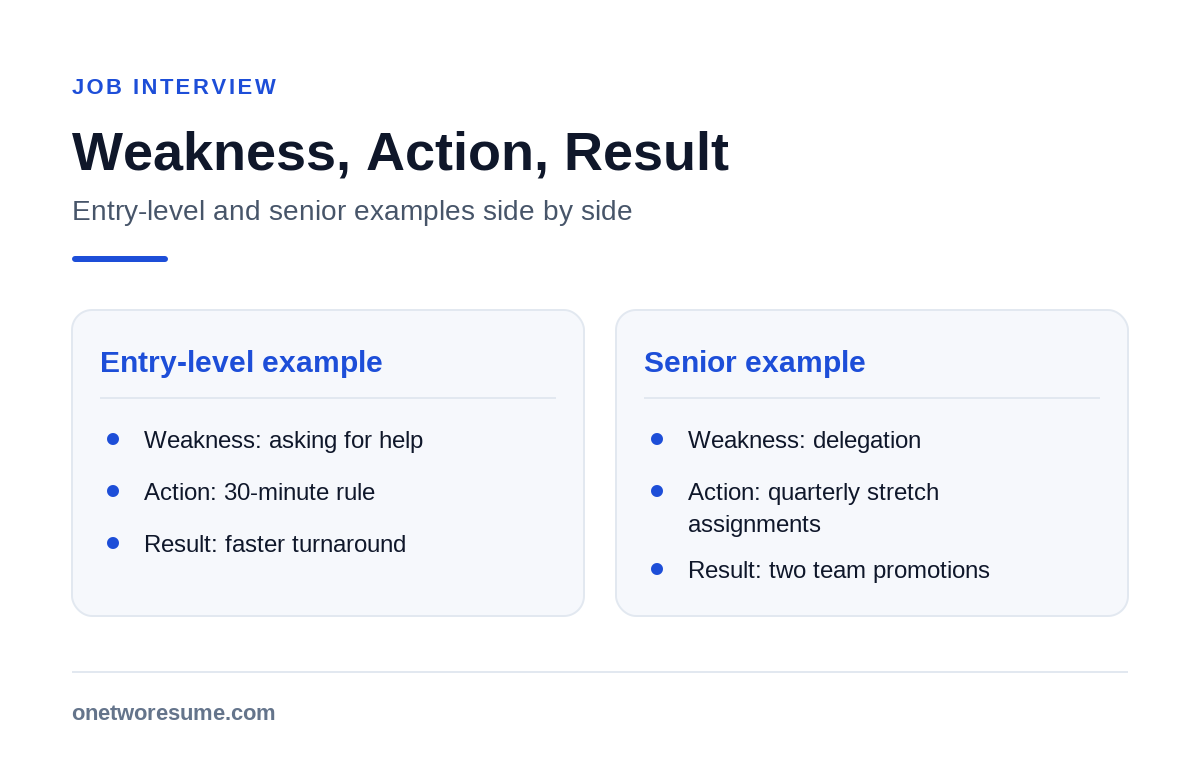
Weakness, Action, Result: Entry-level and senior examples side by side
How Should You Deliver Your Answer in a Video or Behavioral Interview?
Format changes how your answer comes across. In a video interview, keep it tight and look at the camera. In a behavioral interview, frame your weakness as a short story with a clear turning point.
Video Interview Tips
A video interview strips away a lot of body language, so your tone and pacing carry more weight. A few job interview tips that help:
- Look at the camera lens, not your own face on screen.
- Keep your answer to about 60 to 90 seconds. Rambling feels longer on video.
- Jot 3 bullet notes on a sticky note near your webcam. Not a script, just prompts.
- Smile slightly when you get to the "result" part. It signals confidence.
Behavioral Interview Framing
In a behavioral interview, the question might come phrased differently: "Tell me about a time you received critical feedback." Same idea, different packaging. Use the STAR method (Situation, Task, Action, Result) and fold your weakness into the story. The structure keeps you from wandering off track.
Practice Out Loud
Want to know how to ace an interview without sounding robotic? Practice your answer out loud 3 or 4 times, then stop. Over-rehearsing makes you sound canned. You want it to feel natural, like you're explaining something you've genuinely thought about. Because you have.
Make Your Resume Tell the Same Story
Here's something people miss. Your weakness answer should line up with what's on paper. If you say you've been building presentation skills, a resume bullet about leading a client demo backs that up nicely. Use our Resume Builder to add achievements that reinforce your growth story, then run it through the Resume Checker to make sure it's ATS-friendly. Need inspiration? Browse Resume Examples for your role and seniority level.
And don't forget your online presence. Recruiters often check LinkedIn before the interview, so a quick pass with our LinkedIn Optimizer helps keep everything consistent.
Key Takeaways
- Interviewers want self-awareness and coachability, not perfection.
- Use the Weakness, Action, Result formula and keep answers under 90 seconds.
- Choose a real weakness that isn't a core requirement of the role.
- Entry-level candidates should focus on skill gaps and learning speed.
- Senior candidates should focus on leadership, delegation, and strategic blind spots.
- Skip humblebrags. They're forgettable at best and evasive at worst.
- Adjust delivery for video interview and behavioral interview formats.
- Learning how to ace an interview means aligning your answers with your resume and LinkedIn.
Ready to Walk In Confident?
The weakness question isn't a trap. It's an opportunity to show you're honest, self-aware, and always improving. Nail that, and you're well on your way to figuring out how to ace an interview from start to finish. When you're ready to put your best foot forward on paper too, OneTwo Resume has the tools to build a resume that tells your growth story clearly. Good luck out there. You've got this.