Applying for a job at the company you already work for feels strange. They know you. You know them. So why write a cover letter at all?
Because the hiring manager on the other team probably doesn't know you as well as you think. They've seen your name in Slack. Maybe they sat next to you at the holiday party. But they haven't seen your best work up close, and they definitely don't know why you want their role. That's the job your internal transfer cover letter has to do.
Treat it like a business case: show what you've already delivered, why the new role fits, and how you'll protect your current team.
Let's break down how to write one that actually moves the needle.
Why does an internal transfer need a different cover letter?
An internal cover letter isn't an introduction, it's a repositioning. Your reader already has an impression of you, so your job is to update it with proof that you're ready for something new.
You're not a stranger, so don't write like one
Here's the thing. Most standard cover letter tips assume the reader has never heard of you. They tell you to open with a hook and explain who you are. Internally, that falls flat. Writing "I'm excited to apply to Acme Corp" when you've worked at Acme for three years sounds a little odd, right?
Instead, you can skip the company pitch entirely. You already bought in. Spend that space on what you've learned from the inside and how it makes you a stronger candidate than any outside hire.
Your biggest advantage is context
An external candidate has to guess how the company works. You don't. You know the internal tools, the approval chains, the quirks of the quarterly planning cycle, and which teams depend on each other. That means a shorter ramp-up time, and hiring managers care a lot about ramp-up time.
Say it plainly. Something like: "Because I've worked closely with your team on the last two product launches, I already understand your workflows and stakeholders."
There's also a hidden risk
Truth is, people may have pigeonholed you. If you've been "the reliable ops person" for four years, a marketing manager might struggle to picture you in a campaign role. Your letter has to gently break that mental box. That's why evidence matters more here than enthusiasm.
The folks at Indeed make a similar point in their guide on How To Write an Internal Cover Letter (Indeed Career Advice), noting that you should highlight accomplishments within the company and explain your motivation for the move.
What should you include in an internal transfer cover letter?
Focus on three things: internal wins with real results, skills that transfer directly to the new role, and a clear reason for the move. Keep it to one page and around 250 to 400 words.
Internal achievements with numbers
Vague claims don't work when people can check. And they can. So be specific:
- "Cut invoice processing time from 5 days to 2 by rebuilding our approval workflow"
- "Trained 12 new hires on the CRM during the Q2 onboarding push"
- "Managed a vendor relationship worth $400K annually"
Pick two or three that connect to the job you want. Not your entire career history. Just the highlights that make the hiring manager nod.
Relationships and cross-team exposure
Did you collaborate with the target team before? Mention it. Did someone on that team praise your work? You can reference the project (not name-drop for clout, but to show the connection is real). Internal hiring often runs on trust, and shared history builds it fast.
A forward-looking reason for the move
Why now? Why this team? Your answer should be about growth, not escape. "I want to build on my analytics work in a role focused on strategy" sounds great. "My current manager and I don't get along" does not. Even if the second one is true. Especially if it's true.
A transition plan
This one gets overlooked constantly. Hiring managers on both sides worry about leaving your current team in a lurch. A single sentence fixes that: "I'd plan a 3 to 4 week handover, including documenting my current processes and helping train my replacement." It shows maturity, and it makes saying yes much easier.
How should you format an internal cover letter?
Keep the standard cover letter format but make it shorter and warmer. Address the hiring manager by name, cut the company praise, and end with a specific next step like a conversation.
The structure that works
The core cover letter format doesn't change much. You still want a greeting, an opening, a body, and a close. But the proportions shift. Here's how internal and external letters compare:
| Element | External Cover Letter | Internal Transfer Cover Letter |
|---|---|---|
| Opening | Hook plus why you love the company | Your current role and the position you're applying for |
| Company knowledge | Researched from outside | First-hand insight from working there |
| Achievements | Past employers, broad results | Internal projects the reader may recognize |
| Tone | Formal and polished | Professional but familiar |
| Length | 300 to 450 words | 250 to 400 words |
| Closing | Request for an interview | Request for a conversation plus transition plan |
| References | Usually separate | Can mention colleagues who know your work |
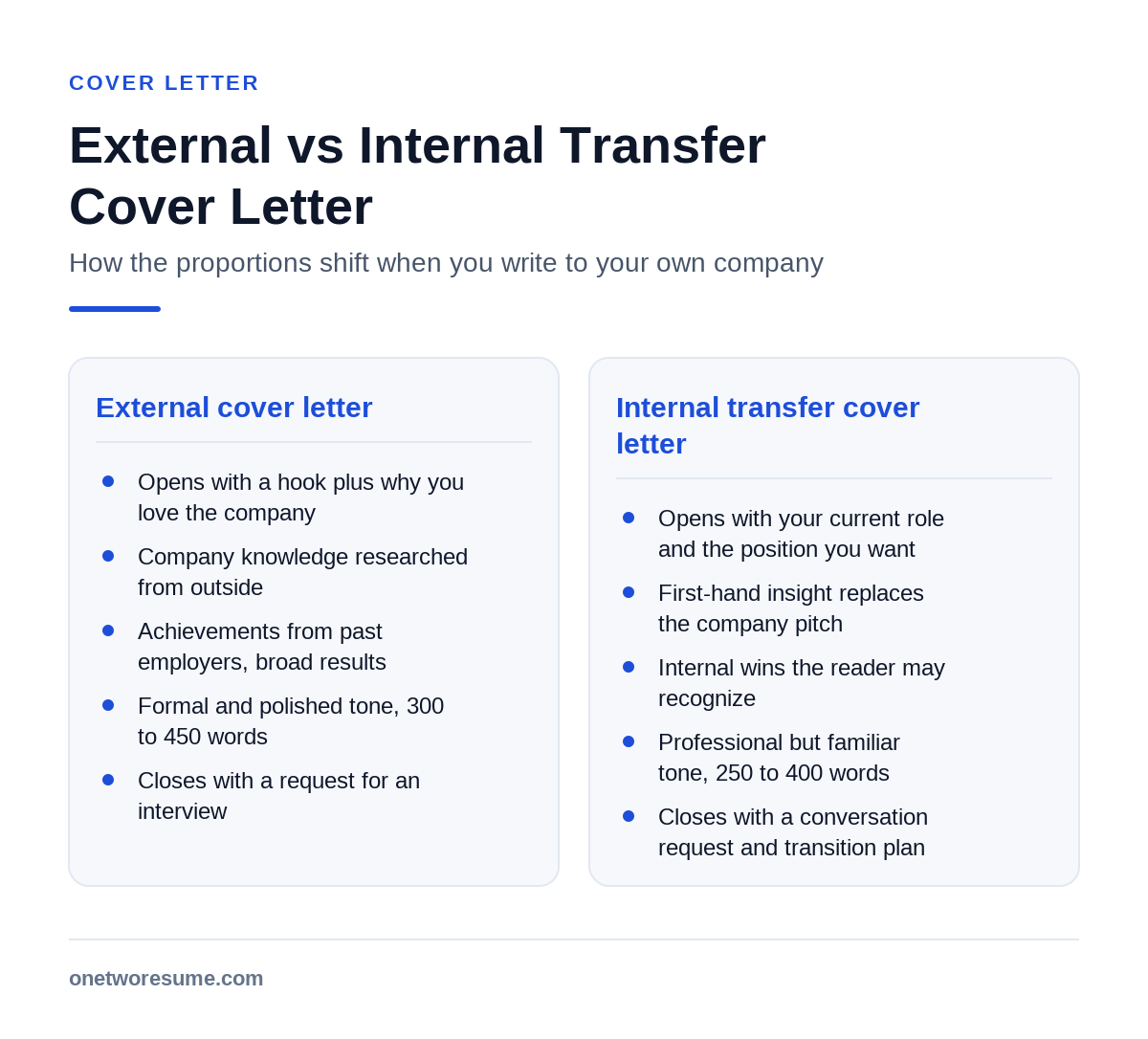
External vs Internal Transfer Cover Letter: How the proportions shift when you write to your own company
Should you tell your manager first?
In most cases, yes. Look, word travels fast inside a company. Your manager hearing about your application from someone else is a bad look and can sour the relationship. Many companies actually require manager notification as part of internal mobility policies, so check with HR. The Occupational Outlook Handbook , Human Resources Specialists (U.S. Bureau of Labor Statistics) describes how HR specialists handle recruiting, placement, and employee relations, which is exactly why they're a good first stop for policy questions.
You can even mention it in your letter: "I've discussed this opportunity with my manager, Jordan, who supports my application." That one line can carry a lot of weight.
Update your resume too
Your cover letter and resume should tell the same story. If your resume still reflects your job from two years ago, fix that before you hit submit. A tool like our Resume Builder makes it quick to tailor your experience toward the new role, and the Resume Checker can flag gaps before a hiring manager does.
What mistakes sink internal applications?
The biggest mistakes are assuming people already know your value, sounding negative about your current team, and skipping the formal application. Familiarity isn't a free pass.
Coasting on reputation
Some people send a two-line email and figure their reputation will do the rest. Bad idea. If there are external candidates, they'll be submitting polished applications. You need to match that effort. Arguably exceed it.
Complaining, even subtly
Phrases like "looking for a team that values my input" can read as a dig at your current team. Hiring managers notice. And it might get back to your current boss. Keep everything positive and forward-facing.
Copying generic templates
Browsing cover letter examples is smart for inspiration. But internal letters need internal details. If your letter could be sent to any company, it's not doing its job. One of the best cover letter tips I can give you: mention at least one project, tool, or initiative that only an insider would know about.
If you're switching into a specialized area, looking at role-specific samples helps too. For example, someone moving from legal ops into a technical review role might study an eDiscovery Specialist Resume Example to see which skills to highlight. You can also browse our full library of Resume Examples for other roles.
Forgetting your online presence
Internal hiring managers do look at LinkedIn. Weird but true. If your profile still describes your first job at the company, it undercuts everything in your letter. A quick refresh with our LinkedIn Optimizer keeps your story consistent.
A quick internal cover letter example
Here's a short opening you can adapt:
- "Dear Priya, I'm applying for the Senior Data Analyst role on your team. Over the past three years as an Operations Coordinator, I've built the weekly reporting dashboards your team uses for capacity planning, and I'd love to take that work further in a dedicated analytics role. I've already discussed this move with my manager, who's supportive, and I've drafted a handover plan to make the transition smooth."*
Short. Specific. Confident. That's the vibe.
Key Takeaways
- An internal cover letter repositions you, it doesn't introduce you.
- Lead with 2 to 3 internal achievements backed by real numbers.
- Explain why you want the move in terms of growth, never frustration.
- Include a brief transition plan to ease concerns on both teams.
- Keep the standard cover letter format but aim for 250 to 400 words.
- Talk to your manager before applying, and check HR's internal mobility policy.
- Use cover letter examples for structure, but fill them with insider details.
- Make sure your resume and LinkedIn tell the same story as your letter.
These cover letter tips work best when the rest of your application backs them up. Ready to pitch yourself for that next role? OneTwo Resume has the tools to help you build a tailored resume, check it for gaps, and polish your profile so your internal move feels like the obvious choice.