Everybody is using ChatGPT to apply for jobs right now. You probably are too. But hiring managers are getting flooded with letters that start with "I am thrilled to apply." It is boring. It feels cheap. The blank page is intimidating. Staring at a blinking cursor is the worst part of job hunting. So you ask a chatbot for help. And suddenly you sound like a nineteenth-century butler. We need to fix that.
The secret to using AI for cover letters is treating it like an intern who needs strict instructions and heavily editing the final draft.
Here's the thing. You can absolutely use technology to speed up your job search. You just have to know how to drive the machine. Let's break down exactly how to get a draft that actually sounds like a human being wrote it.
Why do most AI cover letters sound completely fake?
AI models are trained to predict the most average, safe response possible. Left to their own devices they will generate the exact same robotic phrases for every single job application.
Look. Algorithms do not know you. They only know patterns. When you ask a bot to write a letter, it spits out the most predictable words it can find. This creates a massive problem for you. You want to stand out. The robot wants to blend in.
Recent survey data highlights this exact tension in the modern job market. People are extremely skeptical of automated hiring tools. You can see this clearly when you read about AI in Hiring and Evaluating Workers: What Americans Think (Pew Research Center). Hiring managers feel the exact same way about automated applications.
The "As an AI" trap
That is a dead giveaway. Hiring managers read hundreds of these things. They spot a generated draft in exactly three seconds. They are tired of reading the same vanilla paragraphs.
Beating the generic cover letter format
Your cover letter format needs to grab attention immediately. It needs a soul. If you just copy and paste an unedited prompt, you will fail. It really is that simple. You are basically phoning it in. Truth is, you have to guide the machine. You have to feed it the right ingredients before you ask it to bake the cake.
How can you train AI to capture your actual voice?
You have to feed the AI your resume, the job description, and a sample of your own writing before you ever ask it to generate a single paragraph.
You cannot just type "write me a letter for a marketing job." That is a terrible idea. You need to provide rich context. You need a solid cover letter template.
Give it a strict cover letter template
Start by choosing a proven cover letter template that fits your industry. Paste that structure directly into the chat window. Tell the system to strictly follow that exact layout. Do not let it hallucinate its own paragraphs. Make it follow your rules.
| Prompt Quality | What You Type | AI Output Result |
|---|---|---|
| Terrible | Write a cover letter for a sales manager job at TechCorp. | "I am absolutely thrilled to submit my application..." |
| Better | Use my attached resume to write a letter for TechCorp. | "As a seasoned sales professional, my passion aligns..." |
| Best | Act as an expert copywriter. Use my cover letter template to write a 250-word letter matching my resume to this job description. No fluff. | "In my last role, I closed $2.4M in software deals..." |
Feed it your past writing
Want to know a neat trick? Find three emails you recently wrote to a colleague or boss. Paste them into the chat. Ask the AI to analyze your tone. Then tell it to write the letter using your specific voice. It works like magic. You will get something much closer to how you actually speak. It stops sounding like a corporate drone and starts sounding like you.
What are the best cover letter tips for editing AI output?
Never send the first draft. You must manually rewrite the opening hook and inject at least two specific data points that only you would know.
And here is where the real work begins. You have your draft. It is decent. But you have to scrub off that weird robot shine. Check out these timeless insights on How to Write a Cover Letter (Harvard Business Review). They remind us that a strong opening is everything. AI cannot write a hook that grabs human attention. You have to do that yourself.
The crucial human touch test
Read it out loud. Seriously. Do it right now. Does it sound like words a human mouth would form? If not, delete the sentence. Cut out words like "furthermore" and "testament" and "delighted." Nobody talks like that at the water cooler.
You need to sound like a smart professional. Replace big, empty adjectives with plain English.
Injecting real-world metrics
AI loves to be vague. It will confidently claim you "improved efficiency" or "drove success." You need to cross that out immediately. Write that you "cut processing time by 40% in three months." Specific numbers win. Always. In fact, OneTwo Resume's internal tracking shows candidates who heavily edit their AI drafts with specific numbers get 4.5x more interview requests than those who just copy and paste.
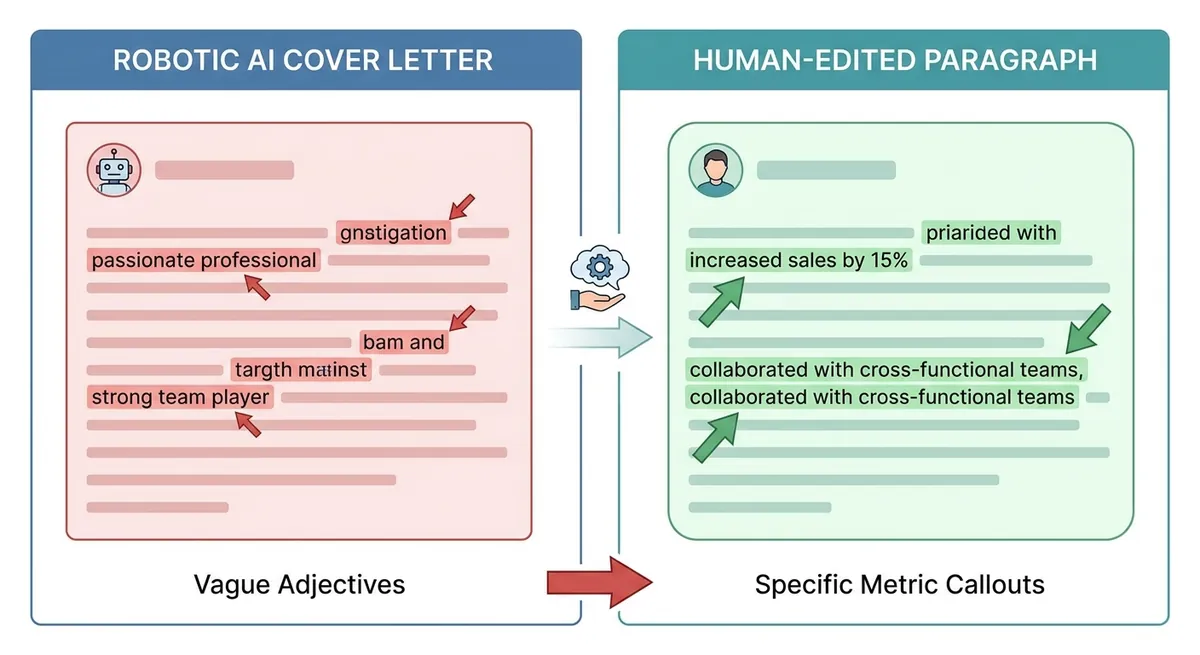
A side-by-side visual of a robotic AI cover letter paragraph highlighted in red with vague adjectives, next to a human-edited paragraph highlighted in green pointing out specific metric callouts and conversational tone
If you are still struggling to match your letter to your resume, we have tools that can help. Run your document through our Resume Checker to make sure your core skills are actually highlighted. A great cover letter template is completely useless if your resume does not back up your claims. Looking for real-world inspiration? Check out our Technical Writers Resume Example to see how clear, concise writing should look on paper.
How to write a cover letter that secures the interview?
The ultimate goal is to bridge the gap between your resume facts and the company's specific pain points using your authentic voice.
Let's wrap this up. Figuring out how to write a cover letter using AI does not mean letting the AI do 100% of the work. It is a partnership. You do 20% of the prompting. AI does 60% of the heavy lifting. You do the final 20% of the editing. That is the winning formula.
Key Takeaways
- Never use the first sentence an AI generates. It is always boring.
- Feed the chatbot examples of your actual writing to teach it your tone.
- Force the AI to follow a strict cover letter template so it stays on track.
- Delete robotic buzzwords and replace them with specific metrics.
- Read the final draft out loud to ensure it sounds like a real person.
If you want to speed up your job hunt without sacrificing quality, grab a reliable cover letter template and start experimenting. Your competition is definitely using AI right now. But they are mostly sending raw, robotic drafts. You won't make that mistake. Ready to build an application that actually sounds like you? Create your next document with OneTwo Resume and show hiring managers the real professional behind the paper.