We have all been there. You just finished updating your document. It looks absolutely flawless. You feel a massive wave of relief. Then you remember your online presence needs an update too. The temptation is incredibly strong. You just highlight the text, hit Ctrl+C, and paste it all into your profile. Job done, right?
Wrong. It's actually a massive mistake.
A resume is a targeted, formal document tailored for one specific job application, while your LinkedIn profile is a dynamic landing page designed to market your entire career brand to a broad audience.
Here's the thing. Treating a social networking site like a digital filing cabinet kills your visibility. If you want recruiters to actually reach out to you, you have to approach the platform differently.
Why does copying your resume hurt your job search?
Pasting your resume word-for-word creates an incredibly rigid and boring profile. It completely ignores the social nature of the platform and strips away your personal voice.
The formatting nightmare
Resumes are built for 8.5x11 paper. They use tight margins. They rely on dense bullet points to squeeze years of experience onto a single page. Paste that directly into a web browser or a mobile app. It looks terrible. It becomes a massive wall of text. Nobody wants to read that on a phone screen.
When hiring managers see a giant block of copied text, they just scroll past. It's a total snoozefest.
You lose the human element
Resumes are formal by design. You drop pronouns. You start every single line with an action verb. "Spearheaded quarterly marketing initiatives." That sounds completely unnatural on a social network.
Look. People hire people. They want to know what it's like to work with you. A direct copy-paste job makes you sound like a corporate robot.
The Pew Research Center: Searching for Work in the Digital Era report clearly showed how the internet changed job hunting years ago. It became heavily focused on networking and personal visibility. A cold, formal document doesn't spark conversations.
What are the real differences between these two tools?
Think of your resume as a highly tailored highlight reel for one specific audience. Your profile serves as a comprehensive career portfolio meant to attract a wide variety of opportunities.
Outbound vs. inbound strategies
You send a resume out to apply for a specific role. You are the hunter. You customize the document to match that one specific job description.
LinkedIn works the other way around. It brings people to you. You are the bait. You need your profile to appeal to recruiters who might have jobs you never even knew existed. This is why generalized LinkedIn for job seekers is so completely different from targeted resume writing.
Space and depth constraints
A resume should ideally be one or two pages. You cut out older jobs. You trim down early career details to save space.
But the web gives you endless room. You can include links to live projects. You can add recommendations from former coworkers. You can list dozens of skills. The folks over at the Indeed Career Guide: Resume vs. LinkedIn Profile break down this distinction perfectly. A resume gets you the interview for a specific application. A great profile gets you tapped on the shoulder for hidden opportunities.
| Feature | Traditional Resume | LinkedIn Profile |
|---|---|---|
| Tone | Formal and objective | Conversational and first-person |
| Length | Strictly 1 to 2 pages | Unlimited space for media and context |
| Audience | One specific hiring manager | A global network of recruiters and peers |
| Purpose | Outbound application | Inbound lead generation |
How do you build a profile that actually gets noticed?
Write your summary in the first person and focus heavily on adding the right industry terms. This helps recruiters find you naturally through search results before you even apply.
Write a human "About" section
One of the absolute best LinkedIn profile tips is to tell a story in your summary. Start with "I'm a software engineer who loves solving complex backend problems" instead of "Results-driven IT professional with 10 years of experience."
It makes a massive difference. It feels like a real conversation over coffee.
Optimize for the search bar
Recruiters use special search tools to find talent. They don't just browse randomly. They type in specific LinkedIn keywords to filter candidates by skill.
If you're an accountant, they search for "Excel", "GAAP", or "QuickBooks". You must make sure those exact words are scattered naturally throughout your headline and experience sections. Sprinkling in the right LinkedIn keywords makes you discoverable. Need help finding the right words? You can run your current document through our Resume Checker to see which core skills you need to carry over to your digital presence.
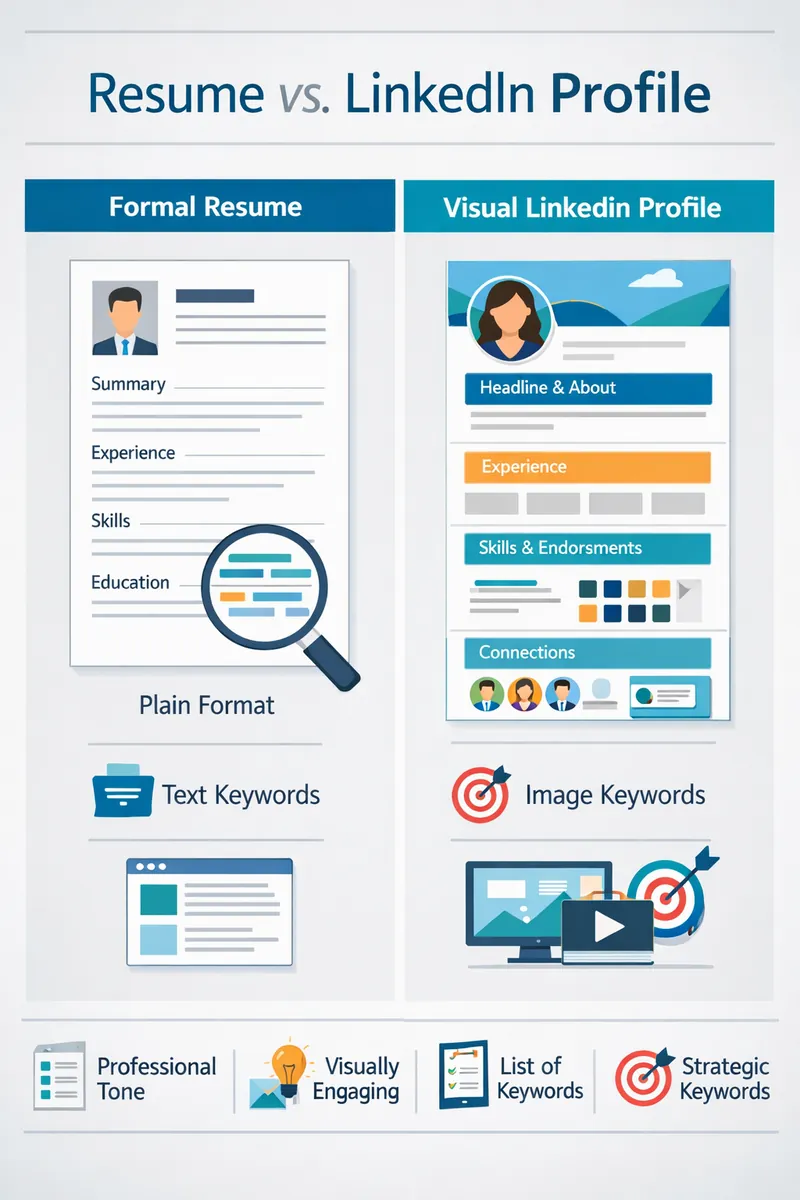
A side-by-side visual comparing a formal resume document with a dynamic, highly visual LinkedIn profile, highlighting the differences in tone, formatting, and keyword placement.
Turn your headline into a billboard
"Marketing Manager at Company X" is a wasted opportunity. It tells them your title, but it doesn't tell them your value.
Instead, use the space to explain what you actually do. "Marketing Manager | Helping B2B SaaS companies scale through organic content." Much better. Small LinkedIn profile tips like this add up quickly to boost your search rankings.
Should anything match between your resume and profile?
You absolutely must keep your job titles, employment dates, and company names consistent across both platforms. Discrepancies in these core facts will immediately raise red flags for employers.
Keep the hard facts straight
Don't get too creative with your job titles online if your actual HR title was different on your application. When a recruiter cross-references your profile with your submitted document, the dates and titles need to align perfectly. If they don't match up, they might assume you're lying about your background.
Repurpose, don't repeat
Truth is, you shouldn't throw away your resume content entirely. Take your best bullet points and expand on them.
Did you increase sales by 20%? Great. On your profile, you can write a short paragraph explaining the context of how you did it. Tell the story behind the metric. If you're struggling to build that foundational document first, check out our Resume Builder to get the hard facts down on paper. Once that is perfectly polished, you can use our LinkedIn Optimizer to translate it for the web.
Key Takeaways
- Never copy-paste directly. It creates formatting errors and makes you sound like a robot.
- Write in the first person. Use "I" and "my" to make your online presence conversational and approachable.
- Focus on search terms. Integrate specific LinkedIn keywords so recruiters can find you easily.
- Keep the dates accurate. Your employment timeline and official titles must match your formal application exactly.
- Expand on the details. Use the unlimited digital space to tell the story behind your biggest career wins.
Following these LinkedIn profile tips will completely change how you network online. Stop settling for a boring digital filing cabinet. Build an active portfolio that works for you 24/7. Ready to get started? Let OneTwo Resume help you craft the perfect documents to land your next big role.