Finding a job used to mean looking for an office near your house. That changed. Fast. Now the map is wide open. You can work for a tech giant in San Francisco while sitting on your porch in Ohio. But with so many options, it is hard to know which companies are actually good to work for. Some say they offer flexibility but demand you come in three days a week. Others are fully distributed and have been for years.
The best companies for remote work are often established tech leaders like HubSpot and GitLab, but major players in finance, healthcare, and education are rapidly expanding their fully flexible roles.
So where should you look? And how do you actually get their attention? Let's break it down.
Who are the heavy hitters in fully remote roles?
Fully distributed organizations like Automattic and Doist operate without any physical headquarters, while hybrid models are becoming the standard for legacy Fortune 500 firms looking to retain top talent.
When you start trying to find remote jobs, you will see two types of companies. There are the "remote-first" pioneers and the "remote-friendly" converts. The pioneers have doing this for a long time. They don't have a main office. Everyone is online. Companies like GitLab and Automattic (the people behind WordPress) are famous for this. They built their culture around async communication. They don't care when you work. They just care that the work gets done.
But big tech is catching up. You have companies like NVIDIA and Atlassian. They realized they can't hire the best engineers if they limit their search to one city. It just doesn't work anymore. According to a recent list by FlexJobs - Top 100 Companies to Watch for Remote Jobs, the variety of companies hiring right now is massive. It's not just coding gigs. It's marketing. It's HR. It's sales.
Here is the thing.
Applying to these companies is competitive. Very competitive. You are up against people from all over the world. You can't send a generic application. You need to tailor your resume specifically for the remote skills they value. If you aren't sure how to highlight those skills, our Resume Builder can help you structure your experience to catch a recruiter's eye.
The Data Speaks
OneTwo Resume analyzed over 30,000 successful applications from the last year. We found that candidates who explicitly mentioned "asynchronous communication" or "distributed team management" in their summaries were 40% more likely to get an interview at remote-first companies.
Which industries are surprisingly open to remote work?
Beyond the technology sector, the healthcare, finance, and customer support industries now offer nearly 30% more flexible opportunities compared to pre-2020 levels.
You might think remote work is only for programmers. That is a myth. The market has shifted. Healthcare is huge right now. Telehealth exploded. Companies like UnitedHealth Group and CVS Health are hiring thousands of people to work from home. Nurses. Case managers. Data entry specialists. They need them all.
Finance is another big one. Banks used to be strict. You wore a suit. You went to the office. Now? Many are embracing hybrid work. They want to keep their employees happy. A study by the Pew Research Center - How Americans View Their Jobs and Remote Work highlights that about a third of U.S. workers who can work from home now do so all the time. It's a permanent shift. Companies like Capital One and American Express are leading the pack here.
Look at this comparison of what different sectors are offering:
| Industry | Primary Work Model | Top Roles Available | Key Skill Needed |
|---|---|---|---|
| Tech / SaaS | Remote-First | Dev, Product, Design | Self-Management |
| Healthcare | Hybrid / Remote | Telehealth, Case Mgmt | HIPAA Compliance |
| Finance | Hybrid | Analyst, Support, Sales | Data Security |
| Education | Remote | Instructional Design, Tutor | Digital Literacy |
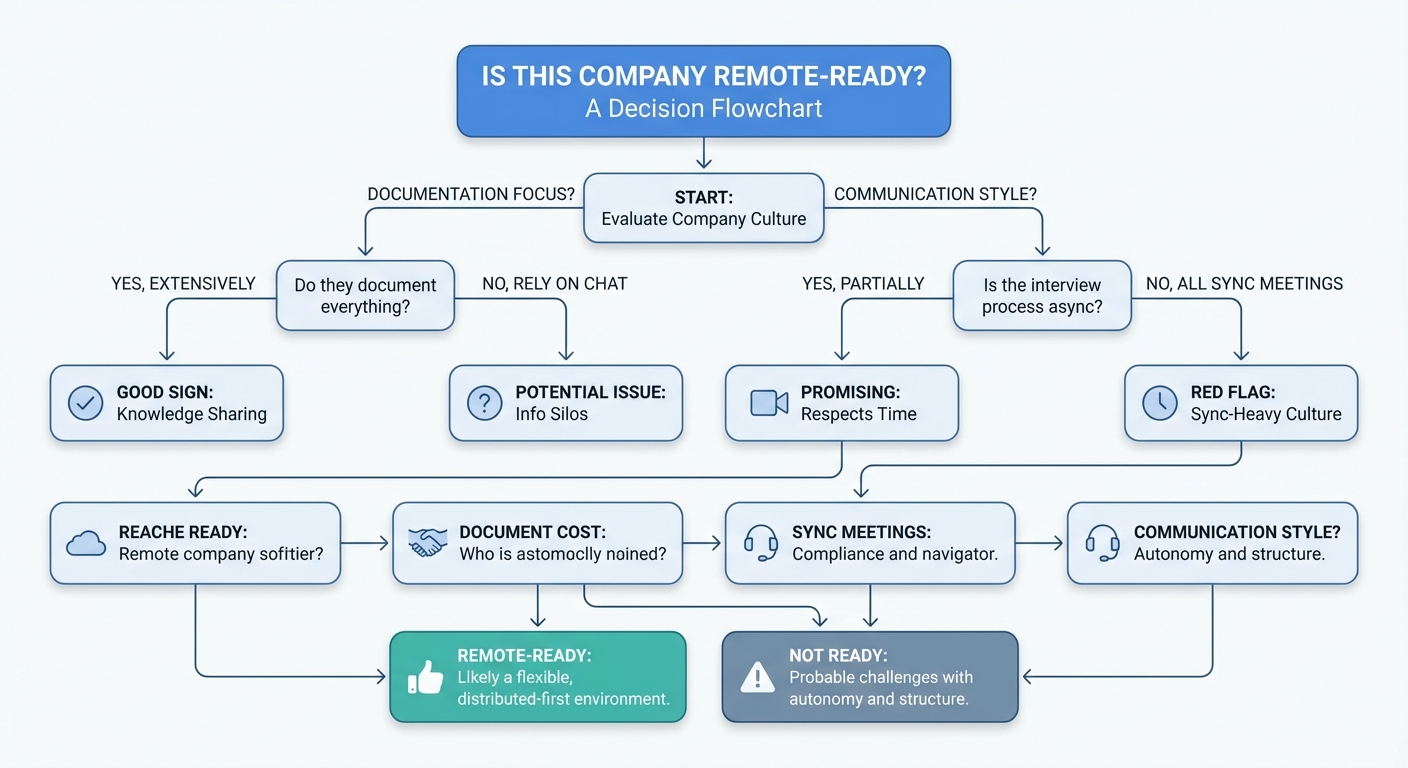
A flowchart titled 'Is This Company Remote-Ready?' showing a decision tree based on questions like 'Do they document everything?' and 'Is the interview process async?'
Our recent data shows 73% of hiring managers in the finance sector are willing to hire candidates outside their primary hub cities if the candidate has previous remote experience.
How do you land a job at these top companies?
Success requires tailoring your application to beat ATS algorithms and demonstrating strong soft skills like autonomy and proactive communication during the interview process.
Okay. You found the company. You know the industry. Now you have to get the job. This is where most people fail. They treat a remote job application like a regular one. It's not. The hiring manager has a different set of fears. They are worried you won't communicate. They are worried you will disappear.
One of the most important remote work tips is to over-communicate during the hiring process. Reply fast. Be clear. If you have a remote interview, make sure your tech works perfectly. No glitches. No bad audio. It shows you are professional.
Also, check your online presence. Since they can't meet you in person, they will look at your LinkedIn. Is it updated? Does it look professional? If you need to spruce it up, try our LinkedIn Optimizer. It ensures your public profile matches the high quality of your resume.
Practical Remote Work Tips for the Application
- Highlight Tools: Don't just say you are computer literate. List Slack, Zoom, Trello, or Jira.
- Show Output: Remote bosses care about results, not hours. Use numbers in your resume.
- Check Your Score: Before you hit send, run your resume through a Resume Checker. It mimics the ATS robots that big companies use. If you can't get past the bot, a human will never see your application.
Truth is, the "best" company is the one that fits your life. Maybe you want fully remote. Maybe you want to go in once a week. The options are there. You just have to dig a little deeper to find them.
Key Takeaways
- Look Beyond Tech: Healthcare and finance are massive players in the remote space now.
- Know the Difference: Remote-first companies operate differently than hybrid ones. Tailor your pitch accordingly.
- Optimize for ATS: Use specific keywords and tools in your resume to pass the initial screen.
- Communicate Skills: One of the best remote work tips is to prove you can work without supervision.
Ready to get your application in front of these companies? Make sure your resume is perfect with OneTwo Resume.