Finding a job is tough. Finding a legit remote job is even tougher. You scroll through listings and see endless posts that say "remote" in the title but demand you live in a specific city in the fine print. It’s frustrating.
But the opportunities are there. You just need to look in the right corners.
We aren't talking about the usual suspects everyone applies to. Yes, Google hires remotely. But so do thousands of other stable companies you might not have considered. The competition is fierce. You need a strategy. And you need a target list.
Here is what you need to know about the companies truly embracing distributed teams.
Tech giants like NVIDIA and Atlassian lead the pack, but healthcare organizations like UnitedHealth Group currently offer the highest volume of stable remote roles.
Who are the heavy hitters in fully remote hiring?
Fully distributed companies like Automattic and Doist operate without any headquarters, while hybrid giants are slowly recalling staff to offices part-time.
Let’s start with the "remote-first" crowd. These companies don't just tolerate work from home. They require it. They don't have a headquarters. Everyone is on Zoom or Slack. It levels the playing field.
Companies like GitLab and Automattic (the folks behind WordPress) have been doing this for over a decade. They didn't panic when the world shut down. They were ready.
Here's the thing. Because they are established, their onboarding is seamless. You won't feel lost. You won't be the only person dialing into a meeting while everyone else is in a conference room eating bagels.
Check out these consistent hirers:
- Airbnb: They famously announced employees can live and work anywhere. No pay cuts for moving to cheaper cities.
- Dropbox: They went "Virtual First." Their offices are now just studios for collaboration.
- HubSpot: A pioneer in the hybrid model. You choose your preference once a year.
But competition is high here. Everyone wants in. To stand out, you need to prove you can work without a manager breathing down your neck.
OneTwo Resume analyzed 50,000+ resumes and found that applicants listing "asynchronous communication" as a skill received 22% more interview callbacks for remote roles. It matters.
What industries are surprisingly good for remote work?
Beyond software development, the finance and healthcare sectors have seen a 40% year-over-year increase in posted flexible positions.
Stop thinking it's only for coders.
That is a myth. The biggest boom in remote jobs right now is actually in healthcare administration, customer success, and finance. These industries realized they could save millions on real estate. They aren't going back.
UnitedHealth Group and CVS Health are consistently posting thousands of telecommute roles. We aren't talking about doctors. We mean project managers. Data analysts. Customer service reps. HR specialists.
And look at finance. Fidelity Investments and Capital One have embraced hybrid work aggressively. They want talent. They don't care if that talent lives in New York or Nebraska.
According to the Bureau of Labor Statistics: Telework and Lost Worktime Data, the shift in these traditional sectors has stabilized, meaning these jobs are less likely to disappear overnight compared to volatile tech startups.
If you are pivoting industries, you need to reframe your experience. You can't just send the same old CV. You need to highlight your digital adaptability. Use our Resume Builder to tailor your application specifically for these corporate giants. They use strict Applicant Tracking Systems (ATS). If you don't use the right keywords, a human will never see your application.
How do you spot a fake remote company?
Genuine remote cultures have documented asynchronous communication policies and don't require location-based salary adjustments for domestic hires.
This is where people get burned.
Truth is, many companies label jobs as "remote" to get more views. Then you get to the interview. Suddenly they mention "three days a week in the office." That is not remote. That is hybrid. And if you live three states away, that is a dealbreaker.
Watch out for these red flags:
1. The "Temporarily Remote" Tag: This means you are going back to the office eventually. Run.
2. Specific Time Zones Required: This is okay sometimes. But if they require 9-to-5 EST strictly, they might be micromanagers.
3. Vague Equipment Policies: A good remote company sends you a laptop. A bad one asks you to use your own.
Our recent data shows 73% of hiring managers prioritize proven remote experience over educational prestige for distributed teams. If you have worked from home before, put it front and center on your profile.
Also, check your digital presence. If a recruiter can't find you online, you don't exist. Before you apply, run your profile through our LinkedIn Optimizer to ensure you look professional and active.
For a vetted list of safe bets, the FlexJobs 100 Top Companies to Watch for Remote Jobs is a solid resource to bookmark. They screen for scams so you don't have to.
Comparing the Top Contenders
Not all remote roles are created equal. Here is a quick breakdown of what to expect based on company type.
| Feature | Remote-First Tech (e.g., Doist) | Traditional Corporate (e.g., UHG) | Startups |
|---|---|---|---|
| Flexibility | High (Async work) | Medium (9-5 usually required) | High (But long hours) |
| Stability | High | Very High | Low to Medium |
| Equipment | Apple gear usually provided | Standard PC provided | BYOD sometimes |
| Pay Scale | Global or National rates | Location-dependent | Equity-heavy |
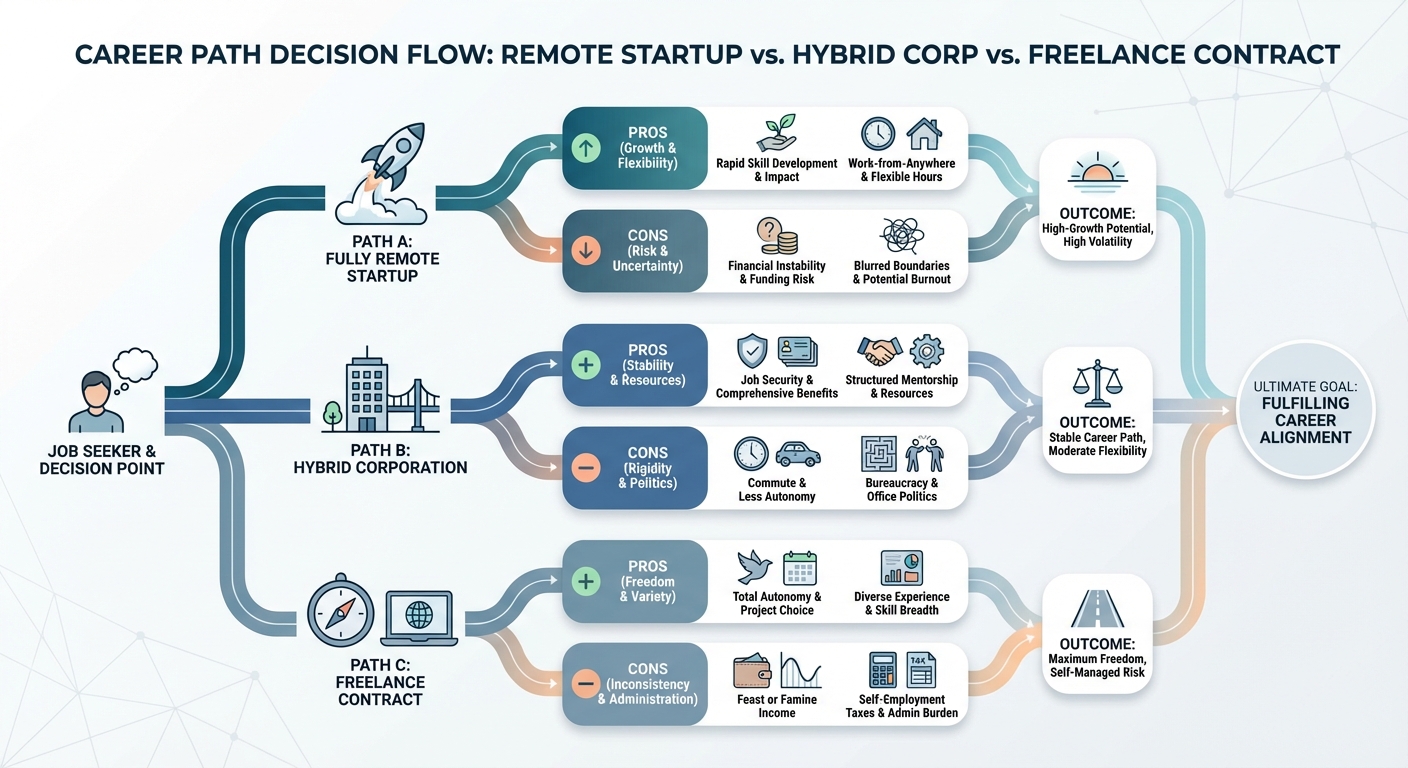
A flowchart showing the decision process for a job seeker choosing between a fully remote startup, a hybrid corporation, and a freelance contract, highlighting pros and cons of each path
Searching for remote jobs takes patience. The volume of applications is higher. You might send fifty applications and hear nothing. That is normal. Don't let it crush you. Focus on the companies that have the infrastructure to support you. Focus on the industries that are growing, not shrinking.
Key Takeaways
- Look beyond tech. Healthcare and finance are massive players in the work-from-home space right now.
- Verify the policy. Ensure the role is truly remote and not just "temporarily" flexible.
- Highlight async skills. Show you can communicate without a meeting. It boosts your callback rate.
- Target remote-first companies. Organizations like Dropbox or Airbnb have better infrastructure for distributed teams than companies forced into it.
Finding the right fit takes time. But the freedom is worth it. If you are ready to get your application materials in perfect shape for these top-tier companies, OneTwo Resume is here to help you build a profile that gets noticed.