You stare at the email. The number looks good. Actually, it looks pretty great. But a nagging voice in the back of your head asks a dangerous question. Could I get more?
It is the classic dilemma. Push too hard and you might annoy your future boss. Don’t push at all and you might leave thousands of dollars on the table. It’s stressful.
Here is the thing. Most people treat negotiation like poker. They think it requires bluffing or a stone-cold face. It doesn't. It requires data. Knowing when to speak up and when to sign the dotted line is a skill you can learn.
Negotiate when the offer falls below market value or your specific needs. Accept when the package exceeds your target and fits your long-term career goals.
Is the First Offer Actually the Best Offer?
Most initial offers are not the final limit. Hiring managers usually leave room in the budget because they expect a counteroffer from a qualified candidate.
Let’s look at the numbers. But only about 45% of candidates actually do it. That is a massive gap.
If you don't ask, the answer is always no. But you need grounds to ask. This is where salary research becomes your best friend. You cannot just pick a number out of thin air because you have student loans to pay. That won't work.
You need to know the market rate for your role in your specific city with your level of experience. If the offer is lower than the average, you have a green light to negotiate. It’s business. It’s not personal.
And sometimes, you have unique skills that justify a premium. Maybe you know a specific coding language or have a certification that is rare in the industry. If you have checked your qualifications with a tool like our Resume Checker, you know exactly how strong your profile looks to an employer. Use that confidence.
But be careful. If you are applying for an entry-level role with a fixed cohort salary, there might be zero wiggle room. That’s okay. You just need to identify which game you are playing.
Doing the Legwork
Before you even get on the phone, look at the data. Sites like Glassdoor or Payscale are good starting points. But also look at industry reports. Proper salary research involves looking at multiple sources to find a consensus range. Once you have that range, you can frame your request logically.
The "Hiring Manager" Perspective
Put yourself in their shoes. They spent weeks looking for you. They like you. Why? Because they proved their value upfront.
For more tactics on how to handle the conversation itself, check out the Harvard Business Review’s 15 rules for negotiating a job offer. They break down the importance of likability and justification.
When Should You Just Take the Deal?
Accept the offer when it hits your aggressive target number or when the company offers non-monetary benefits that outweigh a slightly lower salary.
Sometimes, you win immediately. You open the letter and the number is higher than you expected. It happens.
In this case, negotiating just for the sport of it can backfire. Pushing for $95,000 might make you look out of touch. Or worse, greedy.
Truth is, money isn't everything. A massive job offer negotiation win might be about flexibility rather than cash. If they offer four days remote, or extra vacation time, or significant equity, that has value. Calculate it.
Also, consider your current situation. If you are unemployed and bills are piling up, your risk tolerance is lower. That is reality. It is okay to prioritize security over a potential 5% bump.
The Rigid Budget Reality
Some companies have strict pay bands. If they tell you, "This is the absolute max for this grade level," believe them. If you keep pushing after they have drawn a hard line, you risk having the offer rescinded. It is rare, but it happens.
According to Indeed Career Advice, waiting to negotiate until you have a firm offer in hand is standard, but recognizing when the conversation is over is just as important. If they say no twice, listen.
Listen to Your Gut
If the money is decent but the team seems amazing, that is a factor. A toxic job that pays $5,000 more is not worth the therapy bills. Trust me on that one.
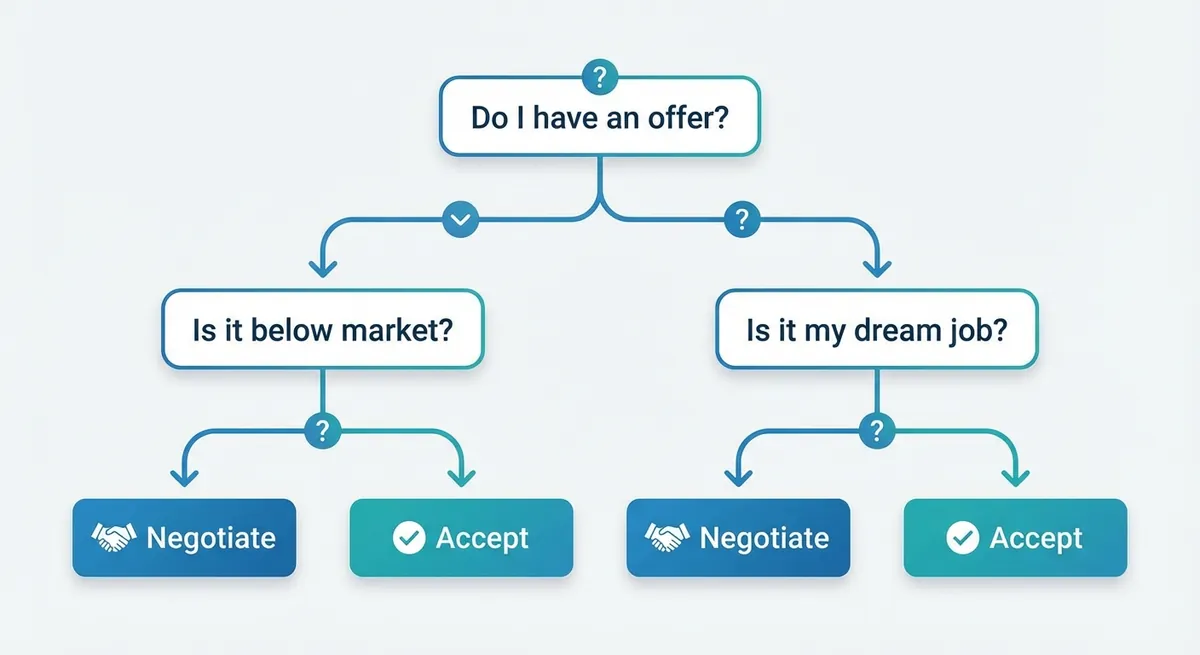
A decision tree flowchart starting with 'Do I have an offer?' branching into 'Is it below market?' and 'Is it my dream job?' leading to 'Negotiate' or 'Accept' outcomes.
Can You Negotiate If You Already Work There?
Yes, but you need to demonstrate new value or expanded responsibilities. Tenure alone is rarely enough justification for a significant pay bump.
So you aren't a new hire. You want to ask for a raise. This is trickier. You don't have the "I might not take the job" card to play.
But you do have the "I am already doing the work" card. And that is powerful.
Make sure your professional presence reflects your current status. Before you walk into that meeting, update your credentials using our LinkedIn Optimizer. If your profile looks like a top-tier professional, your boss will treat you like one.
Your salary expectations should be backed by a list of wins. Did you save the company money? Did you launch a project? Bring that list.
The Timing Matters
Don't ask for a raise the day after the company announces layoffs. Read the room. The best time is during annual reviews or right after you have completed a major successful project.
Here is a quick breakdown of when to push and when to pause:
| Scenario | Action | Why? |
|---|---|---|
| Offer is below market average | Negotiate | You are undervalued based on data. |
| Company has strict pay bands | Accept/Soft Ask | HR hands are likely tied. |
| You are currently underpaid | Negotiate | Retention is cheaper than rehiring. |
| Offer exceeds your "thrive" number | Accept | You won. Don't overplay your hand. |
| You have no competing offers | Calculated Risk | You have less power, so be polite but firm. |
Knowing Your Walk-Away Point
If you ask for a raise and they say no, what will you do? If you aren't prepared to leave, your bargaining power is limited. It helps to have your resume ready just in case. You can use our Resume Builder to keep a draft updated silently. It gives you peace of mind.
Look, thorough salary research combined with a little bit of bravery changes your career trajectory. You don't get what you deserve. You get what you negotiate.
Key Takeaways
- Data is your shield. Never negotiate based on feelings. Use specific market numbers for your location and role.
- Most offers are flexible. 73% of hiring managers expect you to push back. It is part of the dance.
- Read the room. If the offer is already generous or the budget is fixed, accept the win gracefully.
- Value isn't just cash. Vacation days, remote work, and sign-on bonuses are often easier to negotiate than base salary.
- Be prepared to walk. The strongest negotiator is the one who isn't desperate.
Negotiating is scary. We get it. But with the right preparation and tools from OneTwo Resume, you can walk into that conversation with your head high. Go get what you earned.