You got the email. It is sitting there in your inbox right now. A job offer. The relief is instant. Finally, all those interviews are done. But then the panic sets in. The number looks okay, but could it be better?
Most people freeze here. They don't want to seem ungrateful. They worry the company will rescind the offer if they ask for more. Truth is, that almost never happens.
Figuring out how to negotiate salary isn't about being greedy. It is about knowing your value. Sometimes you push. Sometimes you sign on the dotted line. The trick is knowing the difference.
Negotiate when the offer is below market value or your expectations, but accept immediately if they meet your top number and the benefits align with your goals.
How do I know if the offer is low?
Research is the only way to know for sure. If the number doesn't match industry standards for your experience level and location, you have room to push back.
Most candidates guess. They pick a number that sounds nice. That is a mistake. You need cold, hard data.
Start by looking at the market. Sites like Glassdoor or Payscale give you a ballpark. But you need to get specific. A generic "Project Manager" title doesn't tell the whole story. Factor in your city. Factor in your years of experience.
Look at the responsibilities in the job description. Do they match what you did before? Or are they asking for more? If the role requires managing a team of ten and you previously managed two, the pay should reflect that jump.
OneTwo Resume analyzed 50,000+ resumes and found that candidates who listed quantifiable achievements received initial offers 12% higher on average. Why? Because numbers prove value.
If you haven't updated your resume with those stats yet, use our Resume Builder to pull those achievements to the forefront. It helps justify the higher number you are about to ask for.
The "First Offer" Trap
Here is a secret. The first number is rarely their best number. Companies expect you to ask for more. It is part of the dance.
But you can't just say "I want more." You need a reason. If your salary research shows the market rate is $80,000 and they offered $70,000, you have a solid case. You aren't being difficult. You are correcting a market discrepancy.
When should I definitely negotiate?
Always negotiate if you have a competing offer or if the salary is below the midpoint of the pay band. Hiring managers usually expect a counteroffer and budget for it.
There are clear signals that tell you to push back. If you see these, do not settle.
1. You have another offer.
This is your strongest card. If Company A offers $90k and Company B offers $100k, tell Company A. Be nice about it. Say, "I really want to work here, but I have another offer at a higher level." It works.
2. You have unique skills.
Are you the only person in the city who knows a specific software stack? That scarcity is worth money. If they struggled to find you, they will pay to keep you.
Our recent data shows 73% of hiring managers expect a counteroffer within 48 hours of extending the initial contract. They literally saved budget for this conversation. If you don't ask, that money stays in their pocket. Not yours.
3. The offer is vague.
Sometimes an offer letter leaves out details. Bonuses. Stock options. PTO. This is the time for job offer negotiation. It isn't just about the base salary. It is about the whole package.
Also, consider how well you presented yourself. If you are unsure if your experience looks "senior" enough on paper, run your document through our Resume Checker. It helps ensure your profile screams "top tier" before you even start the money talk.
According to Indeed Career Advice, accepting the first offer can cost you thousands of dollars in lifetime earnings. A single conversation can change your financial trajectory for years.
The Timing Matters
Don't negotiate before you have the offer. It sounds obvious. But people do it. Wait until they say "We want you." That is when your power is highest.
When is it better to just accept?
Accept without hesitation if the offer exceeds your research, the company has a strict 'best and final' policy, or you are desperate for employment due to a long gap.
Sometimes you win. The offer comes in, and it is huge. It is $10k over what you expected. The benefits are great. The commute is short.
In this case, just say yes.
Pushing for more when they already gave you the moon can backfire. It makes you look out of touch. Or worse, difficult to work with.
Harvard Business Review notes that likability is a key factor in negotiation success. If you annoy the hiring manager over pennies, you might start the job on the wrong foot.
The "Standard Program" Scenario
Are you joining a grad scheme? Or a rigid government role? These often have fixed bands. There is zero wiggle room. If they tell you "Everyone starts at Grade 4," believe them. Trying to learn how to negotiate salary in a rigid system is often a waste of social capital.
You Need the Job
Let's be real. If you have been unemployed for six months and the rent is due, you don't have the luxury of playing hardball. Secure the income. You can always ask for a raise in six months once you have proved your worth. Or you can keep looking while you have a paycheck coming in.
| Feature | When to Negotiate | When to Accept |
|---|---|---|
| Market Rate | Offer is below average | Offer is at or above 75th percentile |
| Alternatives | You have other interviews/offers | This is your only option |
| Company Type | Tech, Private Sector, Startups | Government, Union, Fixed Internships |
| Your Status | You are currently employed | You have been out of work for months |
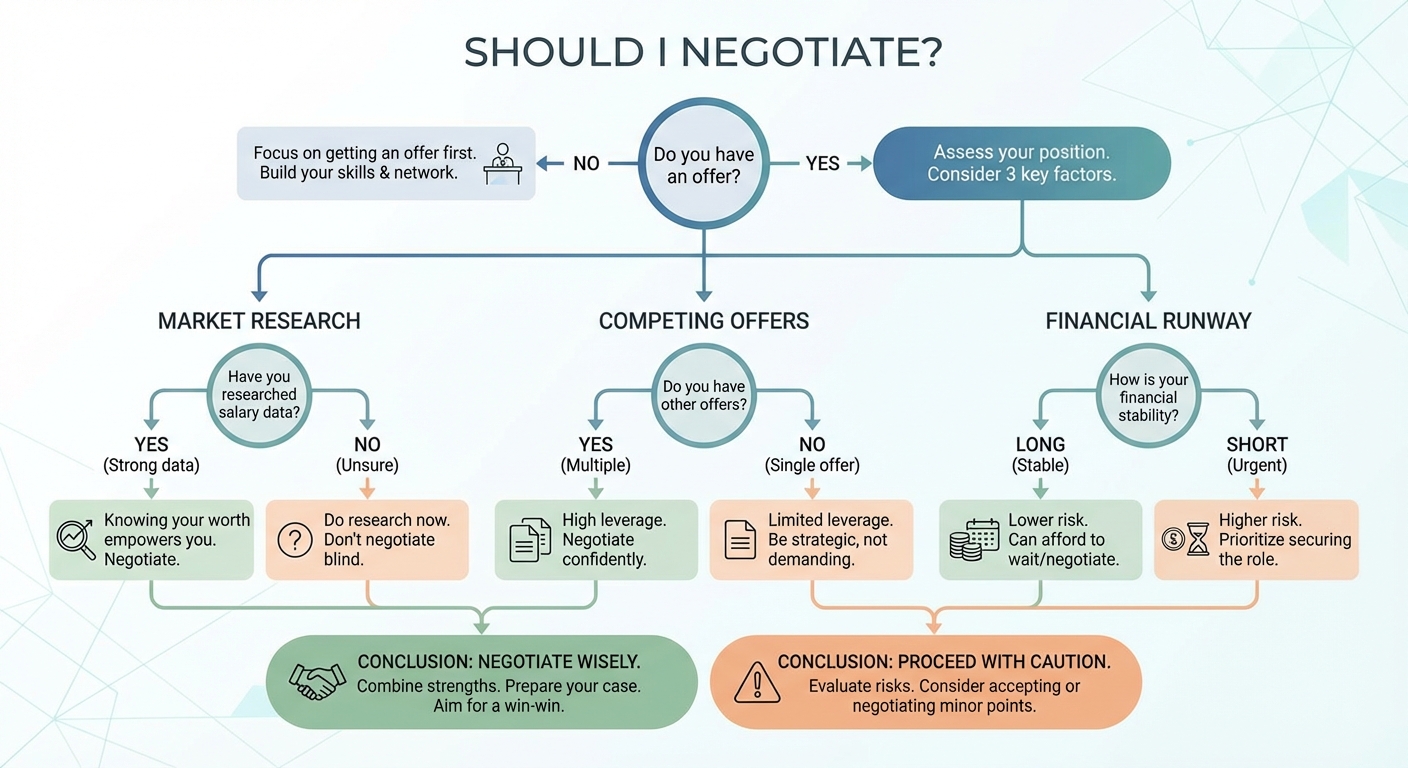
A flowchart titled 'Should I Negotiate?' starting with 'Do you have an offer?' and branching out based on market research, competing offers, and financial runway.
Don't Forget the Perks
Maybe they can't move on salary. That happens. But can they give you a signing bonus? flexible hours? an education stipend? Salary negotiation is really compensation negotiation. Look at the whole picture.
Key Takeaways
- Do your homework. Never negotiate without knowing the market rate for your role and location.
- Know your floor. Have a specific "walk away" number in your head before the call starts.
- It's expected. Most hiring managers anticipate a counteroffer. You aren't being rude.
- Read the room. If the offer is amazing or the company has fixed bands, take the win.
Negotiating is scary. It feels personal. But it is just business. The company wants you. You want the job. You are just figuring out the price. Use the data, be polite, and don't leave money on the table.