You want to leave your current field. Maybe you're a teacher looking to get into corporate training. Or a nurse trying to break into medical sales. Switching careers feels like a massive mountain to climb. You look at your work history and panic. None of your past job titles match the roles you actually want now.
But don't freak out. You just need a different approach. A standard chronological resume will get you automatically rejected.
Here's the thing. You need a hybrid resume.
A hybrid resume combines your relevant skill sets with a brief work history to prove you are highly qualified for a completely new career path.
What exactly is a hybrid resume anyway?
This format puts your core competencies front and center before listing your standard chronological work history. It forces recruiters to see what you can do instead of just where you worked.
The chronological trap
Most people default to a chronological format. It lists your most recent job at the top. This works perfectly if you want to keep doing the exact same thing. But it fails miserably during a career transition. A recruiter spends about six seconds looking at your application. If their eyes immediately land on "High School Math Teacher" and they're hiring a "Data Analyst", you're toast. They will move on to the next pile.
The best of both worlds
The hybrid format fixes this problem entirely. It marries the functional resume with the chronological one. First, you hit them with a powerful skills section. Then you provide the solid work history to prove you actually held a job.
It gives them the context they desperately need.
How do you uncover your transferable skills?
Finding the overlap between your old job and your new target role requires deep research. You must translate your past daily tasks into the exact language your new industry speaks.
Audit your professional past
Look at everything you did over the last five years. Did you manage a budget? Did you resolve angry customer complaints? Write it all down. These are your transferable skills. They are the golden thread connecting your past to your future. You just have to package them correctly.
Translate for your new audience
Look, nobody in tech cares that you "managed classroom behavior". But they definitely care that you "facilitated conflict resolution and maintained strict compliance protocols". Same exact skill. Different words.
If you're unsure what words to use, go read the U.S. Bureau of Labor Statistics: Occupational Outlook Handbook. It is a massive directory. It breaks down the exact terminology used across hundreds of different professions. Find your target job and steal their vocabulary.
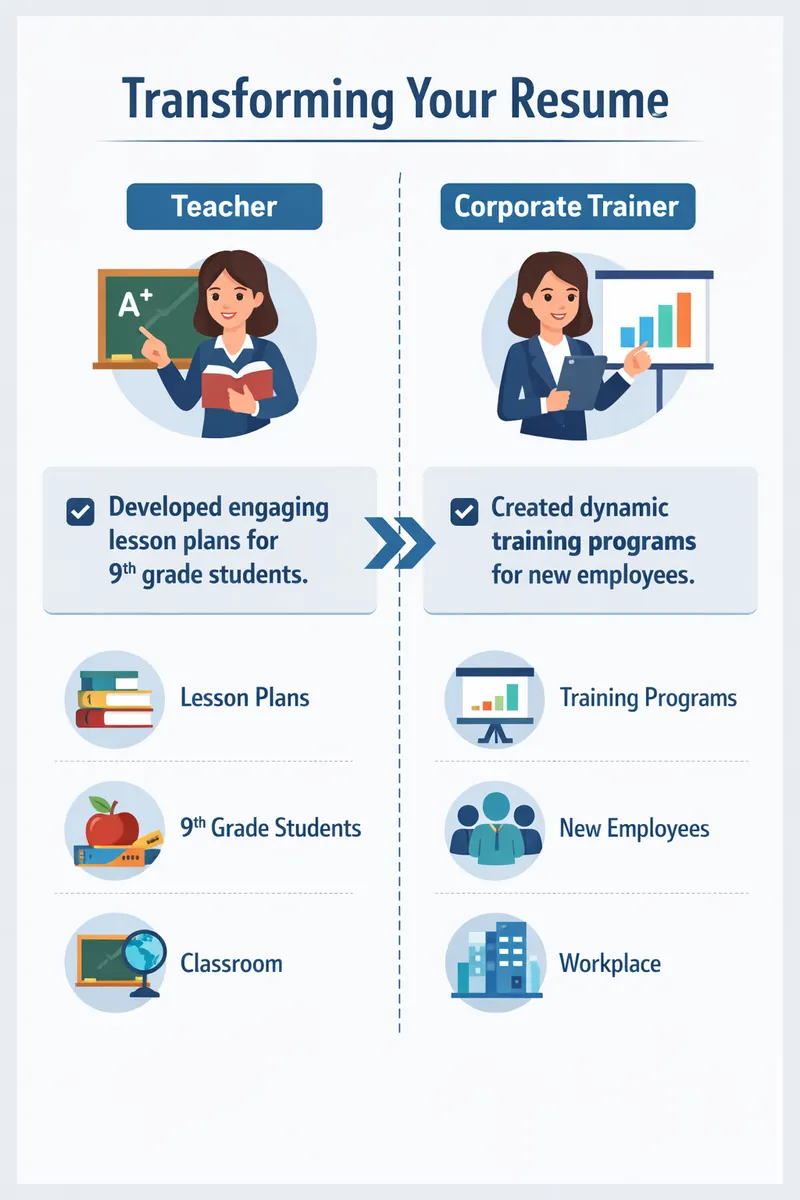
A split-screen visual showing a teacher's resume bullet point transforming into a corporate trainer bullet point by swapping out industry-specific keywords.
Grouping by theme
Don't just list twenty random skills. Group them into distinct buckets. Think "Project Management" or "Client Relations". This makes the information incredibly digestible for a rushed hiring manager.
How do you structure this document for maximum impact?
Building a hybrid resume means flipping the traditional layout completely upside down. You must dedicate the top half of your page entirely to your summary and grouped competencies.
Start with a heavy-hitting summary
Skip the objective statement. They're outdated and useless. Write a professional summary instead. This is a three-sentence pitch explaining exactly why your unique background makes you perfect for this specific role. If you are pulling your hair out trying to write this, our Resume Builder can help you format this section perfectly.
You want to hook the reader immediately. Tell them you are executing a career pivot on purpose.
Formatting the skills section
This is the meat of your resume. Create three or four bold subheadings for your top transferable skills. Under each subheading, write two or three bullet points detailing specific achievements.
And bring the numbers. "Increased sales" is weak. "Grew regional sales by 24% over 18 months" is undeniable proof.
Numbers are the universal language of business.
Here is a quick breakdown of how the hybrid stacks up against the old-school approach.
| Feature | Chronological Format | Hybrid Format |
|---|---|---|
| Primary Focus | Job titles and dates | Core competencies and themes |
| Best Used For | Linear career paths | Career change and pivots |
| Top Section | Most recent work experience | Professional summary and skills |
Surviving the automated filters
You've probably heard of Applicant Tracking Systems. These robotic gatekeepers scan your document for keywords before a human ever sees it. A hybrid format is great for sneaking past them. Why? Because you have a dedicated section just to pack in the right keywords.
But you still have to be careful. Some older systems get confused by complex layouts. Run your finished document through our Resume Checker to make sure it parses correctly. For more technical layout rules, the Indeed Career Guide: Choosing the Right Resume Format (Hybrid/Combination) has an excellent breakdown of formatting best practices.
Are you ready to make your career pivot?
Transitioning to a new field takes serious guts and a perfectly tailored application. Focus on what you bring to the table instead of the titles you lack.
Confidence is key
Truth is, imposter syndrome is going to hit you hard. Expect it. But remember that employers actually like hiring outsiders. You bring a fresh perspective. You are not bogged down by how things have always been done in their bubble.
Your non-traditional background is a feature. Not a bug.
The final polish
Before you send off that PDF, read it out loud. Does it sound like someone who belongs in the new industry? If you still sound like an accountant trying to be a graphic designer, you are screwed. You need another round of edits. You must fully embrace the language of your new home.
Key Takeaways
- A chronological resume actively hurts you when switching careers.
- Hybrid formats highlight your transferable skills over past job titles.
- Always translate your past experience into your new industry's specific vocabulary.
- Use strong numerical data to back up your achievements.
- Group your competencies into clear, easily scannable themes.
Switching industries is hard enough without fighting your word processor. Let OneTwo Resume handle the formatting so you can focus entirely on landing that dream job.