Changing careers is terrifying. You know you can do the job. You have the soft skills. You have the drive. But on paper? You look like a mismatch. It’s frustrating. You send out applications and hear nothing back. The problem usually isn't your experience. It is how you are presenting it.
Most people stick to what they know. They write a standard chronological resume. For a career changer, that is often a one-way ticket to the rejection pile. You need a different approach. You need a strategy that highlights your potential instead of your past timeline.
The best resume format for career changers is the hybrid or combination resume because it highlights transferable skills first while still verifying your work history.
Why is the standard chronological format dangerous for career changers?
A strict chronological format draws attention to your lack of recent industry experience rather than the relevant skills you bring from your previous roles.
Here is the cold hard truth. Recruiters spend about six seconds scanning a resume. If you use a standard chronological format, the first thing they see is your most recent job title. And if that title has nothing to do with the job you are applying for, they stop reading. You’re out.
The Chronological Trap
This format works great if you are climbing a ladder in the same industry. It shows progression. But when you are jumping to a new ladder, it highlights the gap. It screams "I have no experience here" before you even get a chance to explain yourself. You need a modern resume format that controls the narrative.
The Risk of Going "Functional"
Some advice suggests using a functional resume. This format removes dates entirely and focuses only on skills. Do not do this. Hiring managers hate it. They get suspicious. They wonder what you are hiding. Keep your dates. Just move them down the page. (For what a functional resume is and the few cases where it still fits, see functional resume.)
Instead, you want the best of both worlds. You want the hybrid format. It respects the timeline but prioritizes your abilities.
How do you structure a hybrid resume that gets interviews?
Structure your resume to open with a strong professional profile, follow with a categorical skills section, and conclude with a reverse-chronological work history.
This structure changes the conversation. You aren't asking them to guess if you can do the job. You are showing them exactly how your past applies to their future.
The Summary is Your Elevator Pitch
This is the most critical part of your document. You cannot just list an objective. You need a narrative. This is where you connect the dots for the hiring manager. You explain why your background in sales makes you a great project manager. Or why your time in teaching prepares you for corporate training.
Finding good resume summary examples can help you understand the tone. Here is the difference.
Weak: "Teacher looking to transition into corporate training roles."
Strong: "Former Educator with 7+ years of experience managing classrooms of 30+ students. Expert in curriculum development and public speaking. Pivoting to corporate training to leverage skills in engagement and complex information synthesis."
See the difference? The second one sells the skill, not just the history. When you look at resume summary examples, always look for the ones that bridge the gap between two industries.
The Skills Section
Right after your summary, you need a dedicated skills section. But don't just dump a list of keywords. Group them. If you are moving into marketing, create a bucket for "Communication" and another for "Analytics." Under these headers, list the specific things you did in your old job that apply here.
If you need help identifying which skills to highlight, you can use the CareerOneStop guide to compare different layout options. But remember that content is king. List the transferable wins. Did you manage a budget? Did you lead a team? Those apply everywhere.
If you are struggling to lay this out, our Resume Builder handles the formatting automatically. You just plug in your info. We handle the design.
What content mistakes must you avoid when pivoting?
Focus on achievements that demonstrate transferable skills rather than listing daily duties that are irrelevant to your new industry.
We see smart people make bad resumes every day. They try to include everything. They are proud of their past work. That is understandable. But if it doesn't help the hiring manager see you in the new role, it has to go.
Cutting the Fluff
One of the biggest resume mistakes to avoid is keeping industry-specific jargon from your old career. If you are leaving nursing to go into IT, nobody needs to know you are proficient in phlebotomy. It takes up space. It confuses the reader.
Be ruthless with your editing. If it doesn't serve your new goal, delete it.
Mastering the Keywords
You need to speak the language of your new industry. If the job description asks for "Client Relations" and you have "Customer Service" on your resume, change it. It means the same thing. But the Applicant Tracking System (ATS) might not know that.
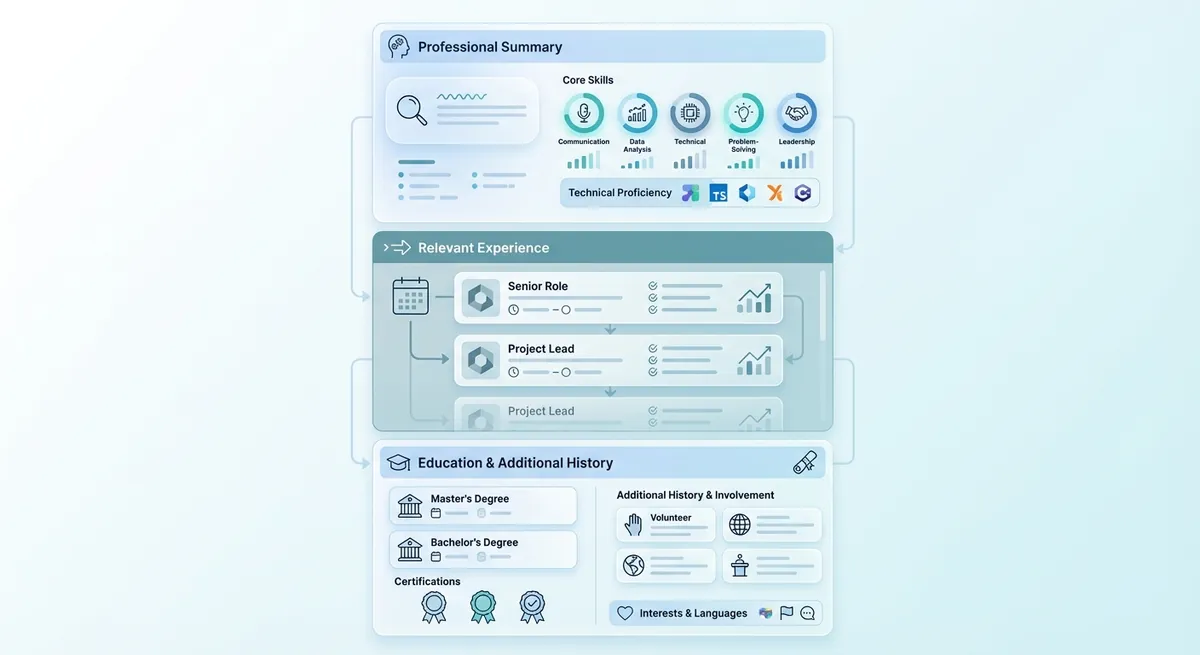
Visual breakdown of a Hybrid Resume showing the top third dedicated to Summary and Skills, the middle section for Relevant Experience, and the bottom for Education and additional history
Using the right keywords is essential. You can find more advice on tailoring your document in the Indeed Career Guide, which offers great tips for pivots. But simply copying keywords isn't enough. You have to weave them into your bullet points naturally.
And speaking of bullet points. Look at resume summary examples again. Notice how they use numbers? You should too. "Managed a budget of $50k" sounds better than "Responsible for budget."
| Resume Feature | Chronological | Functional | Hybrid (Best for Pivot) |
|---|---|---|---|
| Focus | Job History | Skills Only | Skills + Context |
| Dates | Prominent | Hidden/Gone | Visible but Secondary |
| ATS Friendly? | Yes | No | Yes |
| Best For | Same Industry | Employment Gaps | Career Changers |
The Final Check
Before you send anything, you need to be sure. You can't afford typos or formatting errors when you are already an unconventional candidate. You have to look polished. You have to look like you belong.
Run your document through our Resume Checker. It scans for issues that might get you auto-rejected. It gives you a score. It tells you exactly what to fix. It is faster than asking a friend and much more accurate.
Summary
Changing lanes is possible. People do it every day. But you cannot use the same map you used for your old path.
- Ditch the chronological format. It highlights your lack of experience.
- Avoid the functional format. It looks suspicious to recruiters.
- Use a Hybrid format. It balances skills with a clear work history.
- Study resume summary examples. Learn how to write a narrative that connects your past to your future.
- Filter your history. Only include details that prove you can do the new job.
You have the skills. You just need the right paper to prove it. Go get that new job.