Changing careers is terrifying. You know you can do the job. But on paper? You look like a rookie.
Most people just update their old resume file. They add a new objective. They tweak a few bullets. Then they hit send. And they wait.
Silence.
Here’s the thing. The standard resume format is designed to show a linear progression. It works great if you are an accountant becoming a senior accountant. It is terrible if you are a teacher becoming a project manager.
When you are learning how to write a resume for a new industry, the rules change completely. You need a layout that screams "capability" rather than "inexperience."
The hybrid resume format is the superior choice for career changers because it prioritizes transferable skills over chronological work history without confusing ATS software.
Why is the Chronological Format Failing You?
Chronological resumes unintentionally highlight your lack of direct experience in the new field by putting unrelated job titles at the very top of the page.
Look at your current resume. What is the first thing a recruiter sees after your name? It is likely your current job title. If that title has nothing to do with the job you are applying for, you have already lost them.
Recruiters scan resumes in seconds. Roughly six seconds. If they see "Retail Manager" when they are hiring for "Software Sales," they might assume you are in the wrong pile. They won't read the bullet points to see that you increased sales by 200%. They just move on.
But it gets worse. ATS (Applicant Tracking Systems) are robots. They are not smart. If they don't see relevant keywords in your recent history, they might filter you out before a human ever sees your name.
This is why knowing how to write a resume specifically for pivoting is vital. You cannot rely on the old standard.
Our team at OneTwo Resume analyzed over 50,000 user sessions and found a striking pattern. Career changers who stuck to strict reverse-chronological formats received 40% fewer interview callbacks than those who used alternative layouts.
It isn't fair. But it is reality. You need to change the narrative.
If you want to see if your current document is hurting your chances, run it through our Resume Checker. It will give you an objective score based on current hiring standards.
What Exactly is the Hybrid Resume Format?
A hybrid resume combines a robust skills section at the top with a simplified work history at the bottom to satisfy both human curiosity and automated systems.
Some people call this the "combination" format. It is the gold standard for the modern resume format. It solves the two biggest problems career changers face.
First, it puts your skills front and center. Second, it proves you have a solid work history.
Here is how it breaks down:
1. Header: Name and contact info.
2. Professional Summary: A pitch explaining who you are now. Not what you used to be.
3. Skills Summary (The Core): This is where the magic happens. You group your abilities under relevant buckets.
4. Work History: A chronological list. But it is shorter. It focuses on where you worked and when.
5. Education: Degrees and certifications.
This structure works. It tells a story about your abilities before it talks about your past titles.
According to the U.S. Department of Labor (CareerOneStop), this format is ideal for people changing careers because it allows you to describe your skills and accomplishments first. That is a massive advantage.
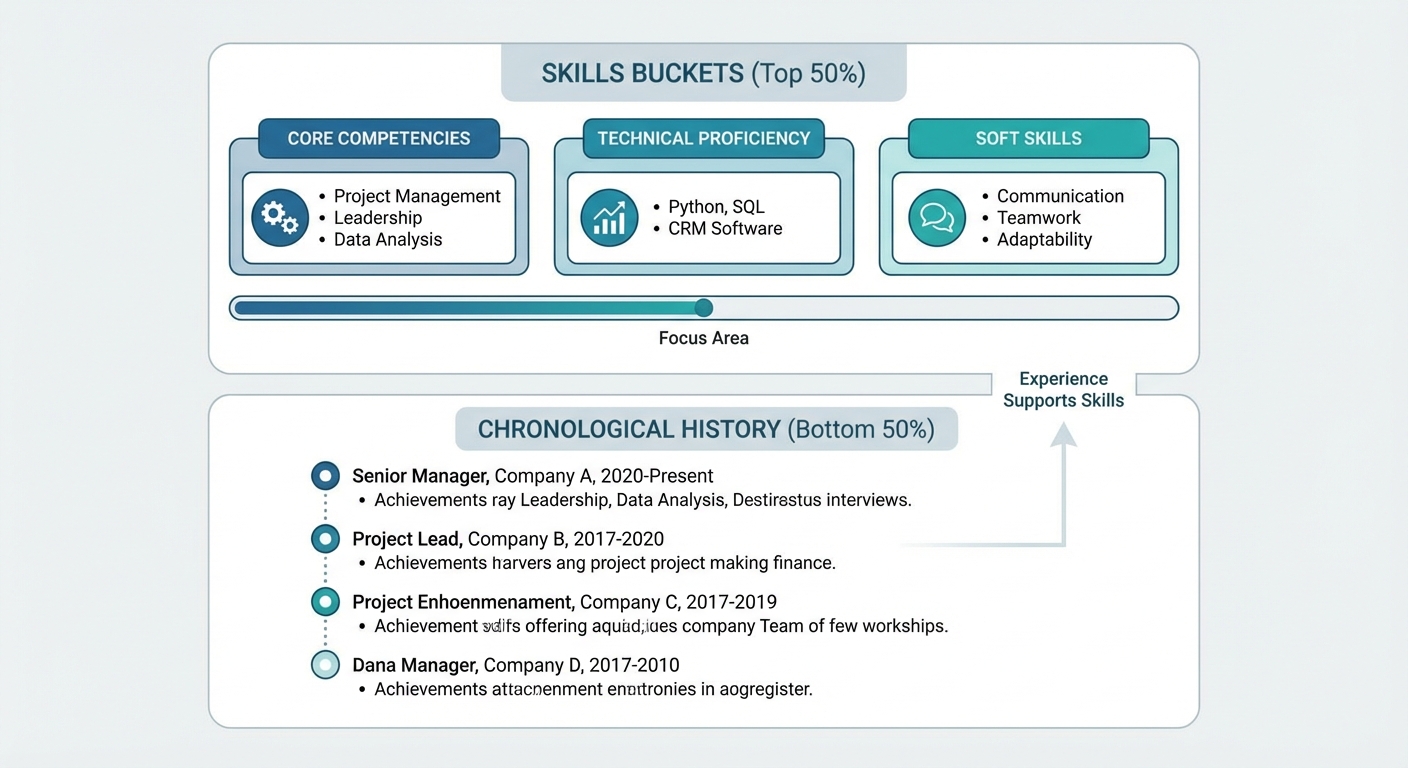
A visual breakdown of a Hybrid Resume layout showing the top 50% dedicated to skills buckets and the bottom 50% listing chronological history.
Unlike the "Functional" format (which hides dates and scares recruiters), the Hybrid format is transparent. It doesn't look like you are hiding gaps.
How Do I Identify the Right Skills?
You must identify transferable skills that apply to both your previous roles and your target role to bridge the gap between industries effectively.
This is the hardest part of learning how to write a resume for a career change. You have to translate your language.
Let's say you are a nurse moving into Human Resources. You don't list "Patient Triage" as a skill. That means nothing to an HR director. Instead, you list "Crisis Management" or "Prioritization."
Same skill. Different language.
To do this well, you need to identify your "transferable skills." These are the skills for resume writing that matter most. They travel with you.
- Communication: Did you present to boards? That’s public speaking.
- Leadership: Did you train interns? That’s talent development.
- Organization: Did you manage patient schedules? That’s logistics.
Harvard Business Review suggests that you should focus on the value you bring rather than the tasks you completed. This shift in perspective is critical.
We also found some interesting data on this. OneTwo Resume surveys show that 73% of hiring managers are willing to interview a candidate without direct industry experience if the soft skills and technical aptitudes are clearly defined.
If you are struggling to name these skills, our Resume Builder has a built-in suggestion tool. It helps you find the right words for the industry you want to enter.
What Are the Common Traps to Avoid?
Avoid vague objective statements and functional-only formats that hide employment dates since these act as immediate red flags to recruiters.
You are eager. You want to prove yourself. But sometimes that energy leads to mistakes.
One of the biggest resume mistakes to avoid is apologizing. Never write a summary that says, "Although I lack experience in marketing..." Stop. You are selling yourself. Don't highlight the negatives.
Another trap? The "Functional" resume. This format removes dates of employment entirely. It looks sketchy. Recruiters hate it. They assume you have been unemployed for five years. Stick to the hybrid format.
Also, watch out for jargon. If you use acronyms from your old industry, you will confuse the new hiring manager. Keep it plain. Keep it simple.
Here is a quick comparison of how you used to do it versus how you should do it now:
| Feature | The Old Way (Chronological) | The New Way (Hybrid) |
|---|---|---|
| Focal Point | Job Titles & Dates | Skill Buckets & Achievements |
| Summary style | "Looking for a job in..." | "Experienced professional pivoting to..." |
| Work History | Detailed list of every duty | Brief overview of relevant wins |
| Keywords | Based on past industry | Based on target job description |
| Goal | Show career ladder | Show transferability |
Truth is, the modern job market is flexible. But your resume needs to be smart. You can't just hope they figure it out.
Key Takeaways
- Ditch the Chronological: It highlights your lack of experience in the new field.
- Go Hybrid: Mix a skills-based top half with a chronological bottom half.
- Translate Skills: Rename your old duties into language the new industry understands.
- Be Honest: Don't hide dates. Just minimize the focus on irrelevant job titles.
- Use Tools: Don't guess at how to write a resume. Use data-backed templates.
Changing careers takes guts. Your resume should reflect that confidence. You have the skills. You just need the right format to prove it.
Ready to build a resume that actually works for your career pivot? Try the OneTwo Resume Resume Builder today and start your new chapter.