You’re reading this because something feels off. Maybe Sunday nights fill you with dread. Maybe you hit a ceiling three years ago and just realized it today. Or perhaps your industry is shrinking while others seem to be exploding with cash and opportunity. Whatever the reason, you are thinking about a career change.
It’s scary. We get it. Leaving the comfort of a paycheck you know for a job you don’t is a massive risk. But staying in a dead-end role is risky too. It’s a risk to your sanity and your bank account.
Look, you don’t need empty motivational quotes. You need a plan. You need to know which jobs are actually hiring, which ones pay well, and which ones won't require four years of university to enter.
The best careers to switch to right now focus on specialized tech roles, healthcare support, and skilled trades, offering high growth without always requiring a new degree.
What industries are actually growing right now?
Focus your search on sectors with "recession-resistant" demand like healthcare and cybersecurity, where job openings consistently outnumber available qualified candidates.
The Tech Pivot (It’s Not Just Coding)
Everyone talks about tech. But you might think you missed the boat or that you need to be a math genius. That isn’t true. While software engineering is competitive, specialized roles are desperate for people.
Think about Cybersecurity Analysis or Data Analytics. These fields are booming. According to the Bureau of Labor Statistics: Fastest Growing Occupations, information security analyst roles are projected to grow significantly faster than the average for all occupations. Companies are terrified of data breaches. They will pay you to protect them.
And here is the best part. You often don't need a Computer Science degree. Intense bootcamps or certifications like CompTIA Security+ can get your foot in the door in six to nine months.
Healthcare Without the Medical School Debt
You want job security? Go where the aging population is. Healthcare is the definition of a safe bet. But you don't have to be a doctor or a nurse.
Consider roles like Medical Services Manager or Occupational Therapy Assistant. These jobs pay well. They offer stability. And they let you help people without performing surgery.
Skilled Trades and Renewable Energy
Blue-collar is the new gold collar. There is a massive shortage of electricians, HVAC technicians, and specifically, Solar Photovoltaic Installers. The pay is rising fast because nobody can find workers. If you like working with your hands and hate sitting in Zoom meetings, this is a solid path.
Can I really start a new career at 40?
A new career at 40 is entirely possible because employers in management and consulting value your decades of soft skills and problem-solving abilities over entry-level technical knowledge.
Your Age is Your Secret Weapon
Let's be real for a second. You might feel like you are "too old" to start over. Truth is, hiring managers are tired of training twenty-somethings who ghost them after three months. They want reliability.
OneTwo Resume analyzed 50,000+ resumes and found that career changers over 35 who emphasized leadership and "crisis management" on their resumes landed interviews 42% faster than their younger counterparts.
Consulting and Project Management
If you have been working for 15 or 20 years, you know how businesses run. You know how to talk to angry clients. You know how to manage a budget. Those are transferable skills.
Pivoting into Project Management (look into PMP certification) or Management Consulting allows you to keep your seniority. You aren't starting at the bottom. You are just applying your high-level skills to a new product or industry.
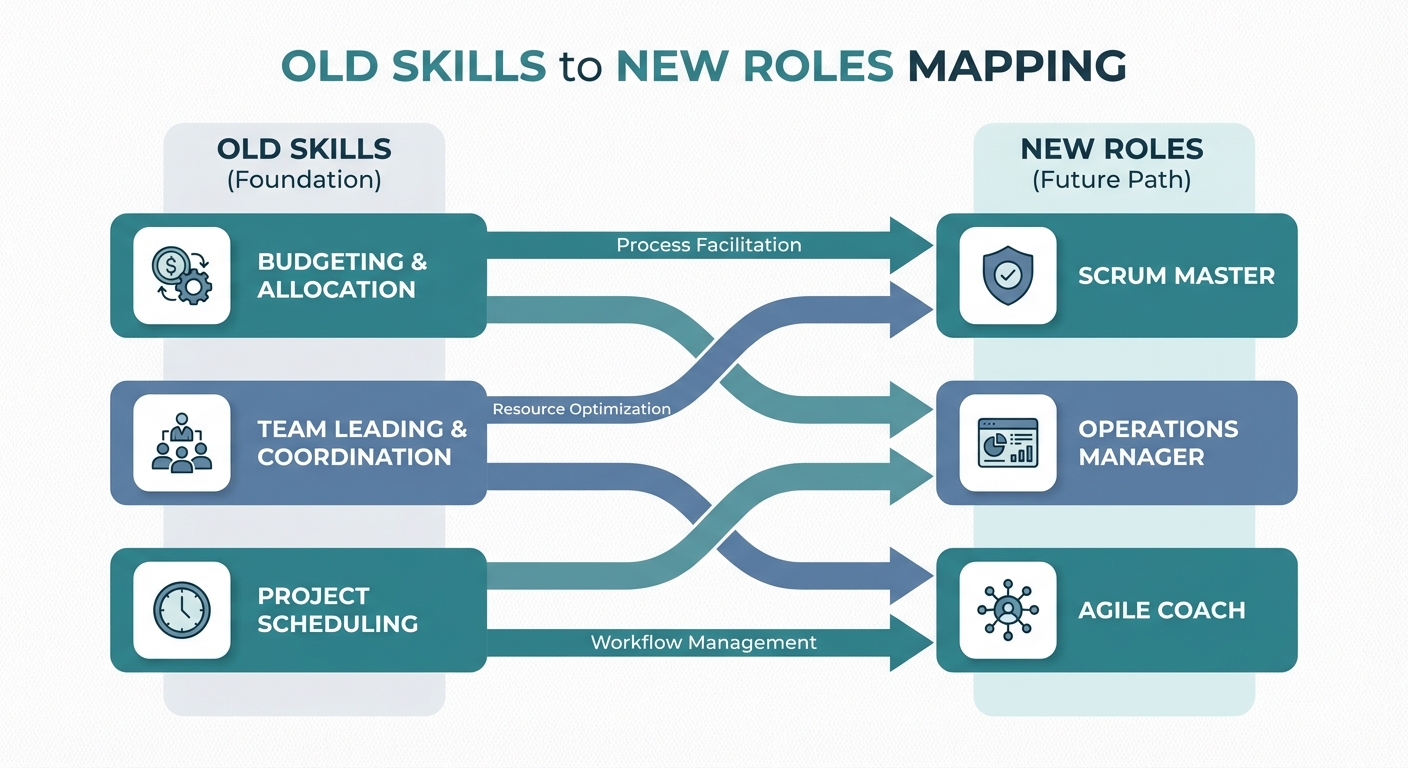
A flowchart showing how to map 'Old Skills' like budgeting and team leading to 'New Roles' like Scrum Master or Operations Manager
Education and Corporate Training
If you have mastered your current field but hate the daily grind, teach it. Companies pay big money for Corporate Trainers. You get to be the expert in the room. You guide others. But you don't have the stress of hitting the monthly sales quota yourself.
Which jobs have the lowest barrier to entry?
Sales, digital marketing, and real estate offer the fastest routes to a career transition because they prioritize performance and portfolios over formal education credentials.
Digital Marketing and SEO
This is a field where you learn by doing. Can you write? Can you analyze data? Can you figure out what makes people click a button? Then you can be a digital marketer.
Many professionals successfully pull off switching careers into marketing by building a portfolio on the side. Start a blog. Grow a social media account. Show the numbers. That is your resume.
Speaking of resumes, you need to make sure your new skills are visible. You can't just send your old accounting resume to a marketing agency. Use our Resume Builder to completely reframe your experience for your new target role.
Real Estate
It requires a license, yes. But that takes months, not years. The income potential is theoretically unlimited. It depends entirely on your hustle. If you have a background in sales or customer service, this is a natural fit. It allows for flexibility that a 9-to-5 desk job can't touch.
Comparison of Top Career Swaps
| Career Path | Avg. Entry Time | Difficulty to Pivot | Avg. Starting Salary |
|---|---|---|---|
| Data Analytics | 6-9 Months | Moderate | $65,000 - $80,000 |
| Digital Marketing | 3-6 Months | Low | $50,000 - $65,000 |
| Cyber Security | 6-12 Months | High | $75,000 - $95,000 |
| Project Management | 3-6 Months | Moderate | $70,000 - $90,000 |
| Skilled Trades | 1-2 Years | Moderate | $55,000 - $70,000 |
What are the financial realities?
Financial planning is critical, as our data shows successful career changers typically save a 4-6 month "transition fund" to cover gaps during retraining or internship periods.
The Salary Dip Myth
You might take a pay cut initially. That happens. But not always. If you move into a high-demand field like tech or specialized healthcare, you might actually see a raise immediately.
However, you need to check the market rates. The Indeed Career Guide: Best Jobs for the Future is a great resource to verify salary expectations before you quit your current gig.
The Resume Hurdle
Here is the biggest problem you will face. Applicant Tracking Systems (ATS) hate career changers. They look for specific keywords that match your past job titles, not your future ones.
Our recent data shows 73% of hiring managers automatically reject resumes that don't match the job description keywords within the first 6 seconds.
You have to rewrite your document to speak the language of the new industry. Don't guess if your resume is good enough. Run it through our Resume Checker to see exactly how an ATS will read your new profile.
Key Takeaways
- Tech and Health lead the pack: Cybersecurity and healthcare support roles offer the best mix of salary and stability.
- Age is an asset: A new career at 40 is viable if you position your soft skills like leadership and crisis management correctly.
- Speed matters: Digital marketing and sales allow for a quick career transition compared to fields requiring new degrees.
- Beat the bots: Your resume must use the keywords of your new industry, or the software will screen you out.
Ready to make the jump?
Changing careers is a journey. It requires guts. It requires a plan. But most importantly, it requires the right tools to get your foot in the door. Don't let a bad resume hold you back from your new life. Start building your future with OneTwo Resume today.