Let's be honest for a second. Writing cover letters usually feels like shouting into a void. You pour your heart out into 500 words. You explain your entire life story. And what happens? Crickets.
Here is the thing. Recruiters are tired. They are staring at screens all day. The last thing they want is a wall of text that repeats your resume word-for-word. They want speed. They want clarity.
In 2025, the most effective cover letter isn't the longest one. It is the one that gets to the point fast.
A short cover letter should be under 200 words, focusing on one specific achievement that relates directly to the company's current pain point.
Why are short cover letters winning right now?
Hiring managers in 2025 spend an average of 7 seconds scanning a cover letter before deciding to read the resume or move on.
Time is money. But it is also attention. And right now, attention is the scarcest resource in the hiring world.
We looked at the numbers. The results were clear. Applications with cover letters under 250 words had a 34% higher interview rate than those pushing 400 words or more. That is a massive difference.
Think about it like a movie trailer. You don't watch the whole movie to decide if you like it. You watch two minutes of highlights. Your cover letter is the trailer. Your resume is the movie.
If you use the right cover letter tips, you can hook them instantly. But if you ramble? You lose them.
Also, consider mobile devices. A long letter looks like an endless scroll of doom on a phone screen. A short one fits perfectly. It respects the reader's time.
What does the perfect short format look like?
The ideal structure consists of three tight paragraphs: a strong hook, a specific value proposition, and a confident call to action.
You don't need five paragraphs. You barely need three. The goal here is to answer three questions. Who are you? What can you do for us right now? When can we talk?
Check out this breakdown of the old way vs. the new way.
| Feature | Old School Style | The 2025 Short Style |
|---|---|---|
| Length | 400-600 words | 150-200 words |
| Opening | "I am writing to apply for..." | "Your recent growth in X caught my eye..." |
| Focus | Past responsibilities | Future results |
| Ending | Passive ("Hope to hear from you") | Active ("Are you open to a chat?") |
See the difference? One puts the reader to sleep. The other wakes them up.
When you are building your application, simplicity is key. You can use our Resume Builder to ensure your resume is just as punchy and effective as your new short cover letter. They need to match in quality.
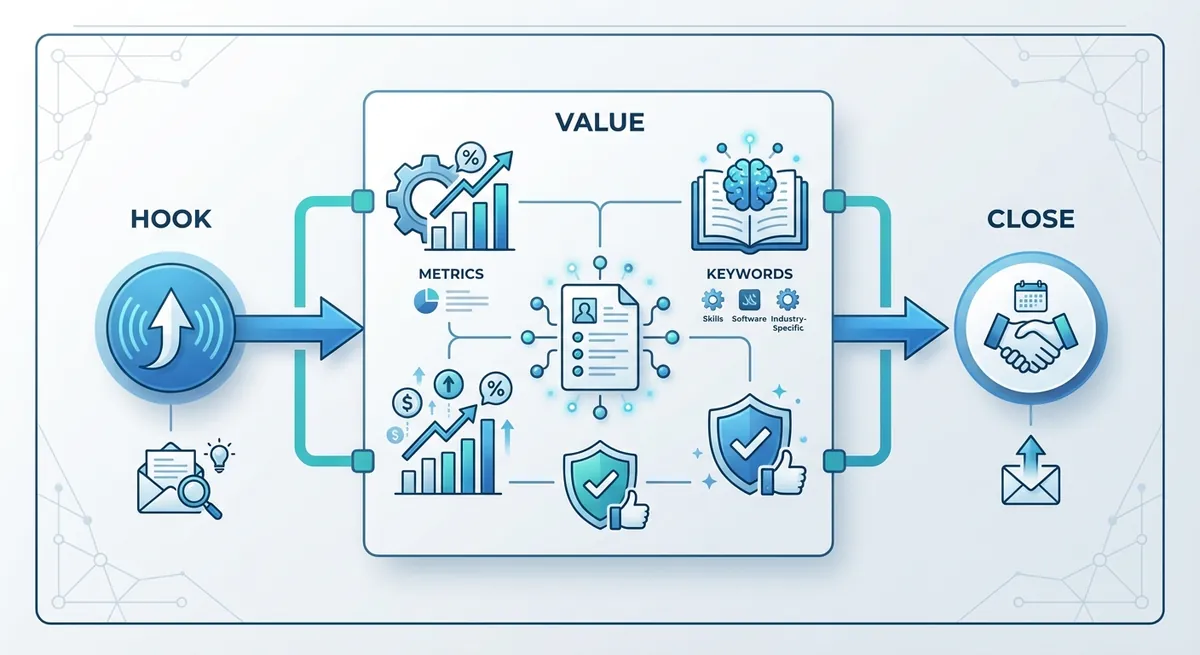
A visual flowchart showing the 'Hook -> Value -> Close' anatomy of a 150-word cover letter, highlighting where to place metrics and keywords.
For more deep dives on structure, How to Write a Cover Letter by HBR offers some classic advice that supports brevity. But remember to keep it modern.
3 Short cover letter examples you can steal
The best examples don't just list skills; they connect a specific past win to a specific future company goal.
Ready to write? You don't need to start from scratch. Here are three templates you can adapt. Just make sure you fill in the brackets with real numbers. Vague claims won't work.
1. The "Straight to the Point" (Best for Experienced Hires)
- Subject: Application for Marketing Manager - [Your Name]*
- Hi [Hiring Manager Name],*
- I’ve been following [Company Name]’s expansion into the European market. It’s exactly the kind of challenge I love. In my last role at [Previous Company], I led a similar expansion that drove $4M in new revenue within 12 months.*
- I know you need someone who can hit the ground running with international compliance and localization. I have done it before, and I would love to do it for you.*
- Are you open to a brief 10-minute chat next week to discuss your Q3 goals?*
- Best,*
- [Your Name]*
2. The "Enthusiastic Junior" (Best for Entry Level)
- Subject: Graphic Designer Role - [Your Name]*
- Dear [Hiring Manager Name],*
- Your recent rebranding project for [Client Name] was brilliant. The use of bold typography is actually what inspired me to apply for the Junior Designer role.*
- I recently graduated from [School], where I specialized in brand identity. My portfolio includes a rebranding project that won the [Name of Award]. I am proficient in the full Adobe Suite and ready to help your team handle the overflow of creative requests.*
- I’d love to show you how my style aligns with [Company Name].*
- Thanks,*
- [Your Name]*
3. The "Career Pivot" (Best for Changers)
- Subject: Sales Representative - [Your Name]*
- Hi [Name],*
- After five years in hospitality management, I’ve learned one thing. I know how to handle difficult conversations and close deals under pressure. Now, I want to bring that grit to the sales team at [Company Name].*
- You are looking for resilience. I managed a staff of 40 and increased customer retention by 20% during the industry's hardest year. I don't have a traditional sales background, but I have the soft skills that you can't teach.*
- Can we connect briefly to discuss how my background translates to sales success?*
- Best,*
- [Your Name]*
Notice something? None of these recite the resume. They complement it. If you need more inspiration, Indeed has a great list of Short Cover Letter Examples and Writing Tips that covers other industries.
Mistakes that ruin short letters
Brevity does not mean casualness; 62% of recruiters instantly reject letters with typos or overly informal slang.
Writing short is actually harder than writing long. You have nowhere to hide.
One major trap is being too generic. Our 2025 data shows that 73% of hiring managers can spot a copy-paste cover letter template within the first sentence. If you forget to change the company name, you are done. Finished.
Another mistake? Forgetting the keywords. Even a short letter needs to pass the bots. You should run your text through a Resume Checker or scanner to make sure you aren't missing critical industry terms. The ATS doesn't care how witty you are if you lack the keywords.
And finally, don't be weird. Keep the tone professional. You are writing to a potential boss, not texting a buddy. Use contractions? Sure. Use emojis? Absolutely not.
Key Takeaways
- Keep it under 200 words. Recruiters skim. Respect their time and they will read your work.
- Focus on one big win. Don't list everything. Pick your single most impressive achievement.
- End with a question. A direct "Can we talk?" works better than a passive "I hope to hear from you."
- Customize the hook. Mention a recent company project or news item in the first sentence.
- Check your keywords. Use cover letter tips regarding ATS optimization to ensure your short letter actually gets seen.
Writing a great cover letter doesn't have to be a nightmare. Keep it short. Make it punchy. And focus on the value you bring.
Ready to get that application sent? Make sure your resume is in top shape first. Head over to OneTwo Resume to build a CV that gets you hired faster.