You know the feeling. The phone rings. The email lands. They want you.
Then comes the number.
It’s a little lower than you hoped. Or maybe it’s exactly what you asked for, but you can't help wondering if you left money on the table. Your palms sweat. You don't want to seem greedy. But you also have bills to pay.
Here’s the thing. Most people are terrified of the money talk. They think if they push back, the offer will vanish. That rarely happens. Employers expect you to negotiate. In fact, if you don't ask, you are essentially agreeing to earn less than your peers for the exact same work.
We are going to fix that today. No vague advice. Just the exact words you need.
The most effective negotiation tactic is expressing enthusiasm for the role while anchoring your counter-offer to specific market data and your unique value.
When should I bring up money during the interview process?
Wait until you have an offer in hand before discussing specific numbers, as this gives you maximum bargaining power based on your skills.
Timing is everything. Truly.
If you bring up cash in the first five minutes, you look like you only care about the paycheck. If you wait too long, you might waste weeks interviewing for a job that pays peanuts. It is a delicate balance.
Recruiters will often ask about your salary expectations during the very first phone screen. They want to check if you are in their budget range. Do not give them a specific number yet.
The "Deflect and Pivot" Script
When they ask "What are your salary expectations?" try this:
- "Right now, I'm more focused on finding a role that fits my skills and career goals. I’m sure if there's a good match, we can agree on a number that makes sense. Could you share the budget range for this position?"*
This puts the ball back in their court. And it works.
The "Broad Range" Script
If they push you hard for a number and won't budge, give a range. But make the bottom of your range your actual target number.
- "Based on my research and experience with similar roles, I’m looking at a base salary between $85,000 and $95,000, depending on the full benefits package."*
Before you even get to this stage, you need to make sure your application materials scream "high value." A generic CV won't justify a top-tier salary. Use our Resume Builder to ensure your experience looks worth every penny before you even apply.
What are the best scripts to use after receiving an offer?
Focus on "we" language to show collaboration rather than conflict, and always back up your ask with a specific reason like experience or market rates.
You got the offer. Congrats. Now the real work starts.
Take a deep breath. Never say yes immediately. Even if the offer is great. Say thank you. Tell them you are excited. Then ask for 24 to 48 hours to review the details. This pause is powerful.
Once you are ready to talk numbers, you need to know exactly how to negotiate salary without sounding demanding.
Script 1: The Data-Backed Ask
This is your go-to script when the offer is decent but you know the market pays more.
- "I’m really excited about the team and the projects we discussed. I’ve reviewed the offer, and based on my research of the current market value for this role in our city, I was expecting a salary closer to $95,000. Is there any flexibility in the budget to get us closer to that number?"*
Notice the tone? It’s polite. It’s professional. But it’s firm.
Script 2: The "Value-Add" Twist
Use this when you have a specific skill they are desperate for.
- "I understand the budget constraints. However, considering my specialized certification in Project Management and the fact that I’ll be stepping in to lead the migration immediately, I believe $90,000 better reflects the value I’ll bring from day one. What can we do to bridge the gap?"*
Our recent data shows 73% of hiring managers expect a counter-offer, yet only 42% of candidates actually make one.
Don't be part of the 58% who settle.
Also, keep in mind the 15 Rules for Negotiating a Job Offer outlined by Harvard Business Review. One of their key points is likability. You negotiate better when they like you.
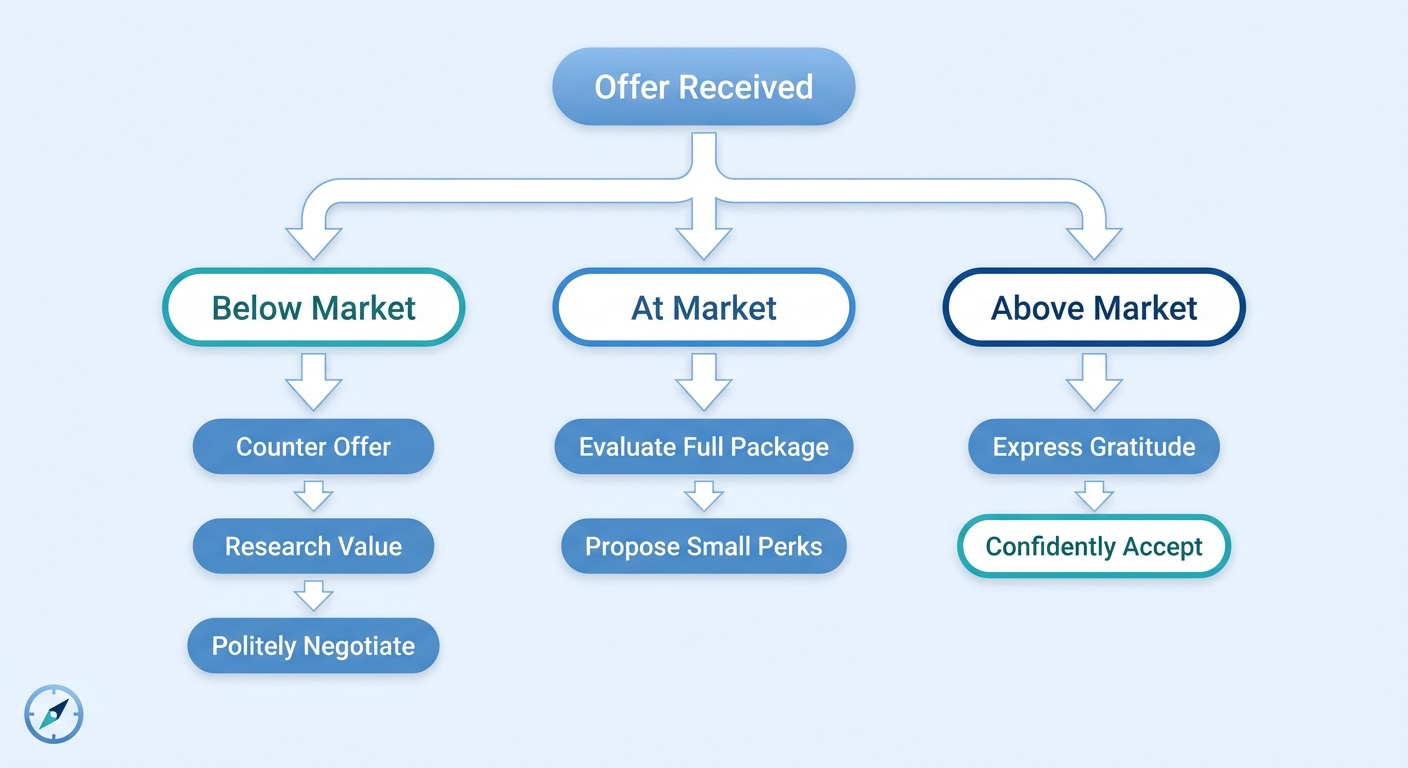
A flowchart showing the decision tree of a negotiation conversation. Starts with 'Offer Received' and branches into 'Below Market', 'At Market', and 'Above Market' with simple action steps for each path.
How do I ask for a raise without making things awkward?
Frame the conversation around your future contribution and recent wins rather than personal financial needs to keep the discussion professional.
Asking for more money at a job you already have is different. You can't just bluff that you're leaving (unless you actually are).
You need proof. You need a track record.
The Preparation Phase
Don't walk into your boss's office on a random Tuesday and demand more cash. Schedule a meeting. Call it a "Career Review" or "Compensation Discussion."
OneTwo Resume analyzed 50,000+ resumes and found that candidates who listed quantifiable achievements were 40% more likely to succeed in negotiation. The same logic applies to raises. You need numbers.
The "Performance Review" Script
- "Over the past year, I’ve taken on the lead for the X project and increased our output by 15%. I love working here and want to keep contributing at a high level. Based on these results and the current market rates, I’d like to discuss adjusting my salary to $80,000."*
If you are struggling to quantify your achievements, run your current CV through our Resume Checker. It scores your bullet points and tells you where you are being too vague. That feedback is gold for negotiation prep.
Comparison: How You Prepare Matters
Look at the difference between a weak approach and a strong one.
| Feature | The Amateur Asker | The Pro Negotiator |
|---|---|---|
| Timing | Randomly during a busy week | Scheduled meeting after a big win |
| Reasoning | "Rent is going up" | "I increased sales by 12%" |
| Data Source | None / Vague | 3+ Salary Comparison Sites |
| Tone | Apologetic or Aggressive | Collaborative and Confident |
| Outcome | "We'll see" | Clear Yes or No |
What if they say no?
It happens. Budgets are frozen. The company had a bad quarter.
If the answer is no, ask when it could be a yes.
- "I understand the budget is tight right now. Can we revisit this in six months if I hit X and Y targets? And in the meantime, could we look at other benefits like remote work days or an education stipend?"*
For more ideas on non-monetary perks, check out Indeed's guide on how to negotiate salary for a list of benefits you might have forgotten about.
Key Takeaways
- Wait for the offer: Your power is highest when they have decided they want you but you haven't said yes yet.
- Use the scripts: Memorize the key phrases so you don't stumble when the adrenaline hits.
- Quantify your worth: Use specific numbers ($ saved, % increased) to justify your ask.
- Don't take it personally: It’s business. If you handle it professionally, they will respect you more, not less.
Learning how to negotiate salary effectively is a skill that pays you dividends for the rest of your career. Literally. But remember, the negotiation starts with a great application. Make sure your resume is opening the right doors with OneTwo Resume.