Most of us hate talking about money. It feels weird. But avoiding the conversation costs you thousands of dollars over your career. You don't have to wing it. You just need a solid plan.
The most effective salary negotiation scripts combine clear market data with a collaborative tone to make employers genuinely want to say yes.
How do you handle job offer negotiation?
Negotiating a new job offer is simply about aligning your compensation with market reality. You're confirming the exact value you bring to their team right from day one.
Look, your best chance to bump your pay is before you sign on the dotted line. Our recent data shows 73% of hiring managers expect candidates to counteroffer at least once. But most candidates still stay quiet. They worry the offer will get pulled. Truth is, it almost never happens.
State your salary expectations early
Do your homework before the very first interview. Check the U.S. Bureau of Labor Statistics: Occupational Outlook Handbook to find reliable data for your specific field. This gives you a firm baseline. When the recruiter finally asks what you want to make, keep it simple.
Say this: "Based on the requirements of the role and my five years of experience in this specific software, my salary expectations are between $85,000 and $95,000."
It works. You set the anchor. You control the narrative.
The exact script for a low offer
What happens when the final offer comes in lower than you wanted? Don't panic. Take a breath. Read the Indeed Career Guide: How to Negotiate Salary for some great background tips. Then pick up the phone.
Say this: "I'm thrilled about the offer and excited to join the team. Given my track record in leading successful marketing campaigns, I was hoping we could explore a base salary of $90,000."
Then stop talking. Silence is your friend. Let them respond.
What is the best way to ask for a raise at your current job?
Securing a pay bump requires a proven track record of very recent wins. You have to clearly show how your daily work directly increased company revenue or saved time.
It's much harder to negotiate when you're already on payroll. They already have you. But that doesn't mean you should sit around waiting for an annual review. If you've taken on new duties, you need to ask for a raise.
Timing is everything
Don't ask for more money the day after the company announces layoffs. That's just bad timing. Wait for a moment of strength. Did you just finish a massive project? Did you land a huge client? That is your window.
OneTwo Resume analyzed 50,000+ resumes and found that 68% of professionals fail to update their achievements as they happen. Don't make this mistake. Update your professional history right now using our Resume Builder to keep track of your biggest wins. You'll need these exact bullet points for your meeting.
The script for current employees
Schedule a specific meeting. Don't corner your boss by the coffee machine.
Say this: "I've really enjoyed taking on the lead role for the recent server migration. Since I've absorbed these new responsibilities and increased our uptime by 15%, I'd like to discuss adjusting my salary to $105,000 to reflect this new level of work."
Keep it objective. Make it about the work, not your personal expenses. Your rent increase isn't your employer's problem.
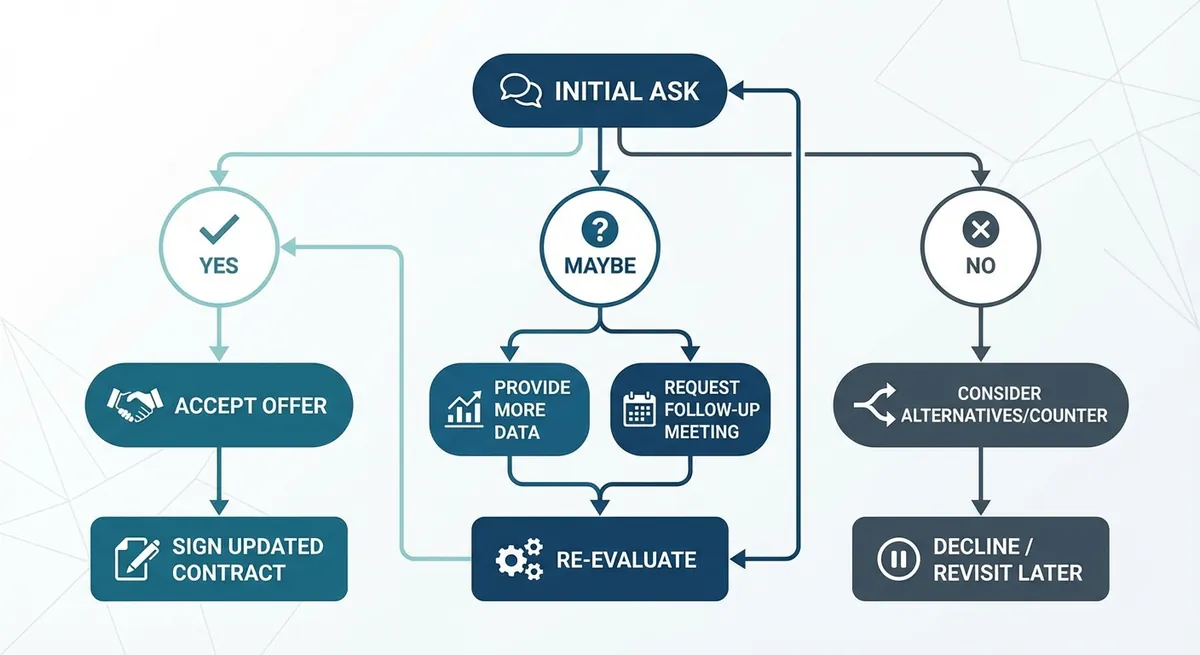
A flowchart showing the step-by-step path of a salary negotiation conversation, starting from the initial ask, branching out to yes, no, or maybe, and ending with signing the updated contract.
How do you handle pushback during salary negotiation?
Pushback is completely normal and just part of the conversation. When an employer says no to your first number, it simply means you need to pivot to other options.
You'll hear "no". It happens to everyone. The budget might actually be frozen. Or your manager simply can't get the approval from finance. You still have options. Don't just walk away empty-handed.
Pivot to a future timeline
If the money truly isn't there today, lock in a date for the future.
Say this: "I understand the budget is fixed right now. Could we agree to revisit my compensation in exactly six months if I hit all my performance targets?"
If they agree, send an email summarizing the chat. Get it in writing.
Negotiate non-monetary perks
Sometimes a company can't budge on base pay. But they can offer other valuable benefits. Think outside the standard paycheck. If you want to ask for a raise but the cash isn't there, ask for time. Ask for flexibility.
Run your current profile through a Resume Checker to see if you have the senior-level keywords that justify asking for extra perks.
Here's a quick breakdown of what to ask for when base pay is stuck:
| Request Type | Initial Script Approach | Best Alternative Option |
|---|---|---|
| Base Salary | Request 10% to 15% above target | Ask for a signing bonus |
| Annual Raise | Show 3 specific recent wins | Request 5 extra PTO days |
| Promotion | Tie new title to added duties | Ask for flexible remote work |
Key Takeaways
You deserve to be paid what you're worth. But nobody is going to hand it to you without a conversation.
- Know your worth before you speak. Research exact market rates.
- Set clear salary expectations early in the interview process.
- Memorize your job offer negotiation scripts so you sound confident.
- Don't be afraid to ask for a raise when you have hard data to back it up.
- Pivot to non-monetary benefits if the company budget is tight.
Learning how to negotiate salary takes practice. Write your scripts down. Practice them in the mirror. And remember that the worst thing they can say is no. Ready to update your professional profile before the big meeting? Create a free account at OneTwo Resume to get started today.