Let’s be real for a second. Talking about money makes most people uncomfortable. Your palms sweat. Your heart races. You worry that if you push too hard, the offer might vanish into thin air.
But avoiding the money talk is expensive. Literally.
Accepting the first number given to you can cost you over $500,000 throughout your career. That is a house. Or a very nice retirement fund. Truth is, hiring managers expect you to negotiate. They usually hold back some budget specifically for this back-and-forth dance.
So you need to be ready. You need the right words.
The most effective scripts combine data-backed market research with enthusiasm for the role, framing your request as a win-win solution rather than a demand.
How do you handle the initial offer?
Never say yes immediately. Express gratitude for the offer, reiterate your excitement, and ask for 24 to 48 hours to review the full compensation package in detail.
Here’s the thing. When you get that phone call, the adrenaline hits. You want to say yes just to relieve the tension. Don't do it. A pause gives you power.
The "Pause and Pivot" Script
Use this when they first drop the number. It buys you time to do your salary research and keeps the vibe positive.
The Script:
"Thank you so much. I'm incredibly excited about the potential of joining the team. I’d love to take a day or two to look over the details of the offer and the benefits package so I can give you a thoughtful answer. Can we reconnect on Thursday morning?"
See what happened there? You didn't reject it. You didn't accept it. You just slowed the train down.
The Counter-Offer Script
Once you've done your homework and know your salary expectations, you need to come back with a number. Be specific. Don't just say "more money."
The Script:
"I’m really thrilled about this opportunity. I’ve looked at the total package, and based on the requirements of this role and the market value for someone with my experience in [Skill A] and [Skill B], I was targeting a salary closer to $85,000. Is there any flexibility to get us closer to that number?"
This works because it isn't about what you want. It is about what the market says the job is worth. For more examples on how to phrase this via email, check out Indeed's guide on salary negotiation templates.
And before you even get to this stage, make sure your resume screams "value." Our Resume Builder helps you highlight the specific metrics that justify a higher pay grade.
When is the right time to ask for a raise?
The best time to negotiate a pay increase is right after a significant win or completed project, not just because a year has passed since your last review.
Existing jobs are trickier. You can't just threaten to leave every Tuesday. You have to build a case. It is like a mini-trial where you are the lawyer and the client.
The "Performance-Based" Script
This is for when you want to ask for a raise outside of the standard review cycle.
The Script:
"I've really enjoyed taking on the lead for the [Project Name] over the last six months. Since I took that over, we’ve seen revenue increase by 14%. Given that my responsibilities have grown significantly since I was hired, I’d like to discuss adjusting my salary to reflect this new level of contribution."
OneTwo Resume analyzed 50,000+ resumes and found that candidates who tracked and listed quantifiable achievements were 40% more likely to negotiate successfully than those who listed generic duties. Numbers talk. Vague promises walk.
The "Market Correction" Script
Sometimes you are just underpaid compared to the market. Inflation happens. Demand for your skills goes up.
The Script:
"I've been doing some research on the current market rates for my role in our industry. It looks like the average is currently around $90,000, while I'm sitting at $75,000. I love working here and want to stay long-term. Can we sit down to discuss a plan to bring my compensation in line with the market?"
When you ask for a raise this way, you remove the emotion. It’s just business.
If you aren't sure if your achievements are strong enough to justify the hike, run your current CV through our Resume Checker. It will score your impact and tell you if you're selling yourself short.
What if they say no?
A rejection of your number isn't the end of the conversation. Pivot immediately to negotiating non-monetary benefits or setting a timeline for a future salary review.
They might say there is no budget. They might say corporate has a freeze. That’s okay. It happens.
The "Not Right Now" Pivot
If the money is a hard no, don't just walk away. Get something else.
The Script:
"I understand that the budget is tight right now. Since we can't move on the base salary, could we discuss a signing bonus, additional vacation days, or a flexible work schedule? Also, could we agree to revisit the salary conversation in six months if I hit [Specific Goal]?"
This approach aligns with advice from the Harvard Business Review, which suggests looking at the deal as a whole rather than just a paycheck.
Our recent data shows 73% of hiring managers expect a counter-offer, yet only 42% of candidates actually make one. Most managers are relieved you asked for a compromise rather than just quitting.
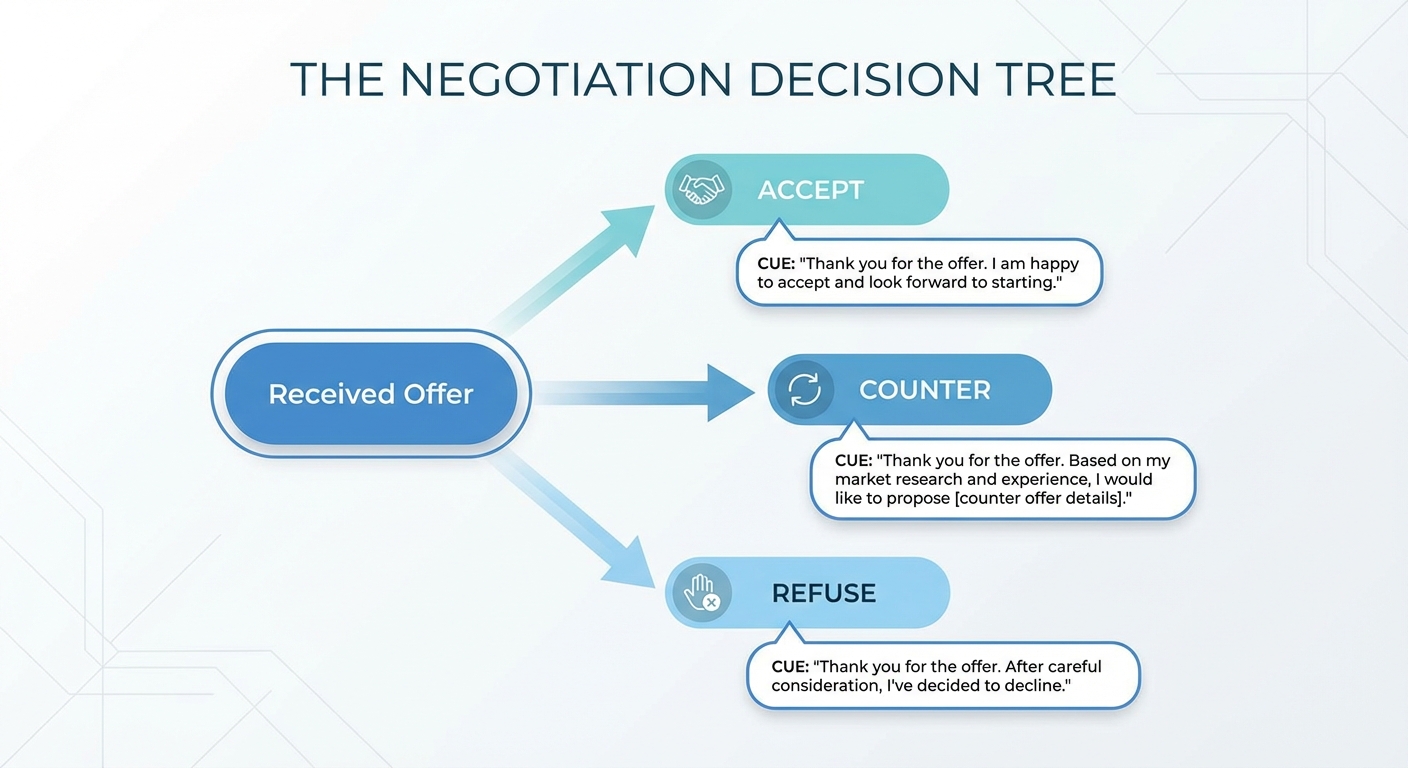
A flowchart titled 'The Negotiation Decision Tree' starting with 'Received Offer' leading to branches for 'Accept,' 'Counter,' and 'Refuse,' with specific script cues at each decision point.
Comparison: Weak vs. Strong Negotiation
Look at the difference in how you frame the request.
| Feature | Weak Ask (Don't do this) | Strong Ask (Do this) |
|---|---|---|
| Focus | Personal needs ("I need more for rent") | Business value ("I increased sales by 20%") |
| Tone | Apologetic or demanding | Collaborative and confident |
| Data | Vague ("I think I deserve more") | Specific ("Market rate is $X") |
| Flexibility | Rigid ("Take it or leave it") | Open ("Is there flexibility here?") |
Making the final call
Learning how to negotiate salary is a skill you keep forever. It gets easier. The first time you ask for a raise, you might stutter. The second time, you’ll be calmer. The third time, you’ll be a pro.
Remember these key points:
- Pause first. Never accept the first number on the spot.
- Do the math. Use data to back up your request, not feelings.
- Be nice. You are negotiating with your future boss. Keep it friendly.
- Pivot. If money is off the table, ask for time or perks.
You have value. Make sure you get paid for it.