Look. We need to talk about your next paycheck. Let's be brutally honest here. Talking about money makes most of us sweat. But avoiding the conversation means you leave thousands of dollars on the table over the course of your career. You did the hard work. You passed the grueling interviews. Now comes the final hurdle. Going into a job offer negotiation without a script is like taking a final exam without studying.
The most effective salary negotiation scripts use confident, collaborative language to secure the pay you actually deserve.
Truth is, hiring managers expect you to push back. They rarely lead with their absolute best number. So if you just smile and say yes immediately, you are missing out. Here is how to navigate the conversation like a pro.
How do you handle salary expectations early on?
Discussing compensation early saves everyone time. You want to anchor your target number while remaining open to the total package.
The initial phone screen script
Recruiters almost always ask about your salary expectations during the very first call. It feels like a trap. It really isn't. They just want to know if you are playing in the same ballpark. But you don't want to box yourself into a tiny corner.
Try saying this.
"Based on my initial research and experience, I'm looking for a base salary in the $90,000 to $105,000 range. But I am absolutely open to discussing the entire compensation package once I learn more about the role."
See what happened there? You gave a realistic range. You showed flexibility. You kept the door wide open for benefits like bonuses or stock options.
Deflecting the premature number trap
Sometimes you want them to throw out the first number. This is a classic tactic for how to negotiate salary effectively. If they press you before you are ready, pivot politely.
"I'd love to learn more about the specific day-to-day responsibilities of the role before throwing out a firm number. Do you have a budgeted range for this position you can share?"
It all starts with a strong foundation before you even reach the interview stage. You might want to run your current document through a reliable Resume Checker to make sure your value is blindingly obvious.
What is the best job offer negotiation script?
The key to a successful counteroffer is expressing gratitude first. Then you state your researched number with clear business justification.
The gratitude and pivot
They made an offer. That is amazing news. Celebrate for a minute. But don't accept it on the spot. Your job offer negotiation officially begins the second they extend the verbal offer.
Always say thank you first.
"Thank you so much for this offer. I'm thrilled about the opportunity to join the team and help drive your Q3 initiatives."
Stating your counteroffer
Now you pivot to the business side of things. You need to present your case logically rather than emotionally. If you want to read more about the psychology behind this approach, check out this brilliant piece from Harvard Business Review: 15 Rules for Negotiating a Job Offer.
"I'm very excited about the role. However, I was expecting a base salary closer to $115,000. My track record of reducing operational costs by 15% aligns perfectly with the goals you outlined for this position. Is there flexibility to get closer to that number?"
And then you stop talking. Silence is incredibly powerful here. Do not fill the quiet space with nervous chatter. Let them process and respond.
The psychology of phrasing
How you phrase your request matters just as much as the number itself. Here is a quick breakdown of what to say and what to avoid.
| Bad Negotiation Phrase | Good Negotiation Phrase | Why It Works Better |
|---|---|---|
| "I need more money." | "Based on market data..." | Relies on facts rather than personal financial need. |
| "I was hoping for..." | "I'm looking for..." | Projects confidence and absolute certainty. |
| "Is that your best offer?" | "Is there flexibility to reach $X?" | Creates a collaborative tone instead of a combative one. |
When they push back
Sometimes they simply say no. The budget is locked. That is completely fine. A successful job offer negotiation often includes secondary perks instead of just base pay.
"I understand $105,000 is the hard cap for this pay band. If we can agree on an extra week of paid time off and a remote work allowance, I'd be ready to sign the paperwork today."
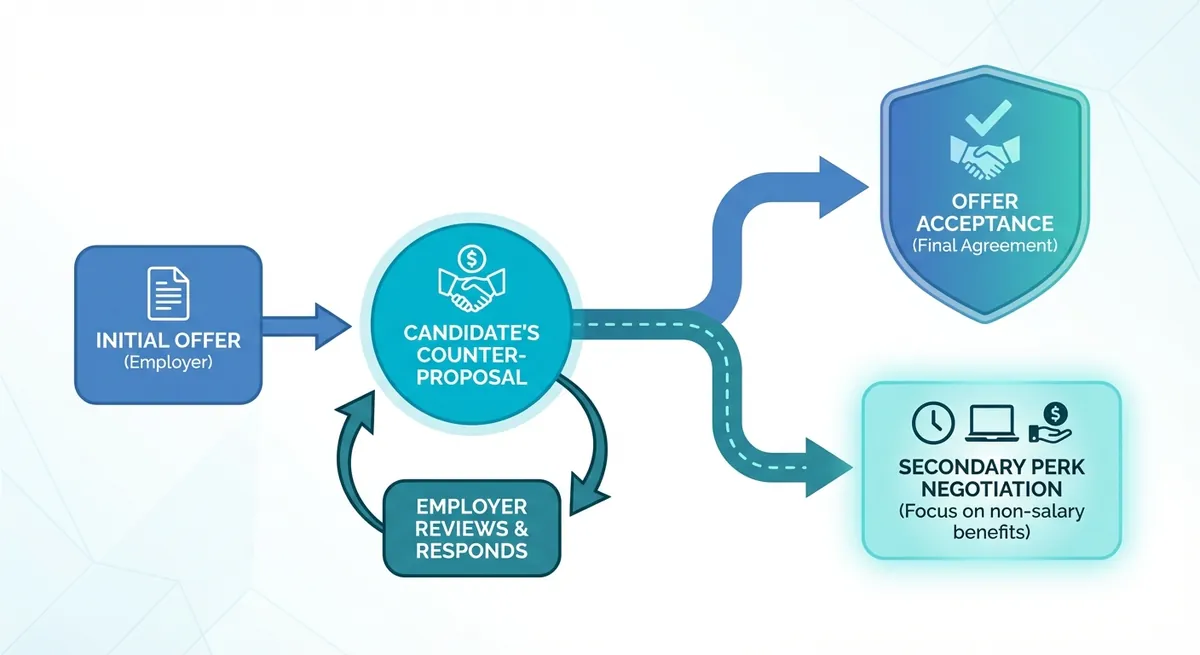
A flowchart showing the back-and-forth stages of a job offer negotiation, starting from the initial offer, moving to the candidate's counter-proposal, and ending in either acceptance or a secondary perk negotiation.
How do you ask for a raise using a script?
Asking for a bump in pay requires a solid business case. You must show exactly how your recent work added measurable value to the company.
The setup meeting
Asking for more money at your current job requires a totally different approach. You can't just demand it. You have to earn it and prove it. First, schedule a dedicated meeting. Don't spring this on your boss during a casual coffee chat in the breakroom.
So bring your receipts.
The "show me the value" script
You need to bring hard facts to this meeting. Look up current industry standards in the U.S. Bureau of Labor Statistics: Occupational Outlook Handbook to verify your exact market worth.
"I've really enjoyed my last two years here. Over the past six months, I took over the XYZ project and increased our client retention rate by 22%. Given these new responsibilities and my recent results, I'd like to discuss adjusting my salary to $85,000 to better reflect my current market value."
Preparing for the worst
If they flat out refuse to ask for a raise on your behalf, don't panic. Maintain your professionalism. Ask them a direct question.
"What specific metrics do I need to hit in the next six months to make this salary adjustment happen?"
Get those goals in writing. But if they still stall or give you vague promises, your time there might be up. It might be time to fire up a LinkedIn Optimizer and start quietly looking for a company that respects your worth.
Key Takeaways
- Never accept immediately. Always express gratitude and ask for time to review the details.
- Do your homework. Base your salary expectations on real market data, not just personal desires.
- Silence is your friend. State your counteroffer clearly and wait for their response.
- Pivot to perks. If the base salary is inflexible, negotiate for more vacation time, signing bonuses, or remote work days.
- Keep your emotions in check. Treat every job offer negotiation as a collaborative business discussion.
Here's the thing. Negotiating your pay is a skill. Like any skill, it gets easier the more you practice. If you want to set yourself up for higher initial offers from the start, your resume needs to shine. Let OneTwo Resume help you craft a standout professional profile that commands the salary you truly deserve.