You want out. Maybe you realized your current path is a dead end. Or maybe you just want a new career at 40 because you have changed as a person. It happens. It is scary. But here is the good news.
People switch industries every single day. And they succeed.
The biggest hurdle isn't your lack of experience. It is the piece of paper you send to recruiters. Most resumes are written as a history report. They look backward. For a career change, you need a marketing brochure that looks forward.
To successfully pivot, your resume must translate your past achievements into the language of your new industry immediately without making the hiring manager guess your intent.
How do I sell my experience if I haven't worked in the field?
You must move away from a chronological list of duties and instead group your achievements by the specific competencies required in the new role.
Focus on the bridge, not the gap
Recruiters are busy. They spend about six seconds scanning a document. If they see job titles that don't match the opening, they move on. You have to stop them. You do this by highlighting transferable skills.
Transferable skills are the abilities you take with you from job to job. Think communication. Project management. Data analysis.
Truth is, you probably have more of these than you think. Did you manage a busy retail store? That is operations management. Did you teach high school English? That is corporate training and public speaking. You aren't starting from zero. You are starting from experience.
The Hybrid Format
Don't use a functional resume. Recruiters hate them because they hide dates. It looks like you have something to hide. Instead, use a hybrid format.
This style puts a "Skills Summary" or "Core Competencies" section at the very top. You list your relevant skills there. Then you list your work history below it. This way, the first thing they see is what you can do. Not just what you did.
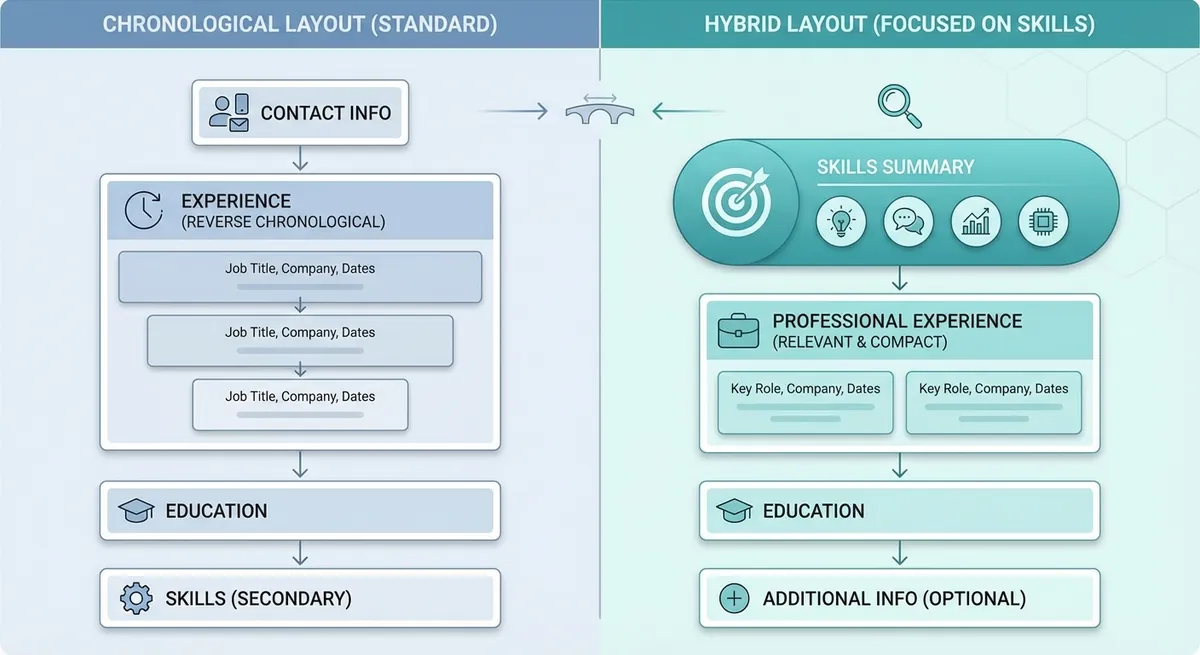
A visual split-screen comparison showing a standard chronological resume vs. a hybrid resume layout highlighting the 'Skills Summary' section at the top
That is a huge difference. If you are struggling to structure this, our Resume Builder has templates specifically designed to push those skills to the forefront.
What should my summary statement say?
Your summary acts as the narrative bridge that explicitly connects your past background to your future goals in two or three punchy sentences.
Ditch the objective
Never write an "Objective" statement. Saying "I want a job in marketing" wastes space. They know you want the job. You applied for it.
Write a "Summary" instead. This is your elevator pitch. It needs to answer one question. Why are you here?
For a career transition, you need to connect the dots.
- Bad:* "Teacher looking to switch into corporate sales."
- Good:* "Educator with 10 years of experience managing classrooms of 30+ students, now seeking to apply persuasion and public speaking skills to Client Success Manager roles."
See the difference? One asks for a favor. The other offers a solution.
Speak their language
Every industry has its own slang. Its own acronyms. If you want to be an insider, you have to talk like one.
Look at three job descriptions for the role you want. Highlight the recurring words. If they keep saying "stakeholder management," put that on your resume. Don't say "I talked to bosses." Say "stakeholder management."
According to the Harvard Business Review, framing your narrative around the employer's needs rather than your own history is critical. It shows you understand their problems. And that you can fix them.
How do I handle my work history section?
You should selectively edit your bullet points to emphasize only the tasks and results that are relevant to the job you are trying to get.
Curate your bullets
Here is a secret. You don't have to list everything you did at your last job.
If you are switching careers from nursing to software sales, nobody cares that you are good at drawing blood. They care that you updated patient records in a complex database. They care that you handled high-pressure situations.
Delete the bullet points that don't matter. Expand the ones that do. This is where your transferable skills really shine. You are rewriting your history to fit your future.
Here is how that looks in practice:
| Old Bullet (The "Doer") | New Bullet (The "Achiever") | Interpretation |
|---|---|---|
| Managed a team of 5 retail associates. | Led a team of 5 to exceed quarterly sales targets by 15%. | Shows leadership & results. |
| Handled customer complaints. | Resolved high-volume conflict situations, retaining 95% of at-risk clients. | Shows problem-solving. |
| Wrote weekly reports. | Analyzed weekly data sets to identify efficiency gaps. | Shows analytical ability. |
The ATS factor
Applicant Tracking Systems (ATS) are robots that read your resume before a human does. If you are switching careers, you might lack the exact job titles the robot looks for.
This makes keywords essential. You need to pack your resume with the right terms from the job description. But don't stuff them in randomly. Weaving them into your bullet points feels natural.
Not sure if you hit the mark? You can run your draft through our Resume Checker. It scores your resume against the job description to see if you are missing critical keywords.
You have to catch their eye fast.
Is it okay to leave things off?
Yes. Absolutely.
If a job from 15 years ago has nothing to do with your new path, cut it. Or just list the title and company without bullet points. You are crafting a narrative. Anything that distracts from that narrative is just noise.
Also, check out the U.S. Department of Labor for basic formatting guidelines if you feel rusty. Just remember to break the rules when it helps your story.
Look, switching careers is hard work. It takes guts. But if you focus on your transferable skills and speak the language of your new industry, you will get that interview.
Key Takeaways
- Use a Hybrid Format: Place a skills summary at the top to highlight what you can do, not just where you worked.
- Identify Transferable Skills: Find the overlap between your old job and the new one. Focus heavily on those points.
- Translate Your Experience: Rewrite your bullet points using the terminology of the new industry.
- Quantify Everything: Numbers are universal. They prove you delivered results, regardless of the field.
- Own Your Narrative: Use your summary statement to explain the "why" behind your career change.
Ready to build a resume that opens new doors? OneTwo Resume helps you craft the perfect document for your next chapter.