You sit down at your computer. The blinking cursor mocks you. Figuring out how to write a resume is frustrating enough on its own. Now you have to decide how to start the actual document. Do you use an objective? A summary? Does it even matter? Truth is, it matters a whole lot.
You should almost always use a resume summary instead of an objective because hiring managers care about what you can do for them.
Let's settle this debate once and for all. You have a few precious seconds to grab a recruiter's attention. If you start with the wrong opening, they will toss your application in the trash. Here is exactly what you need to know about starting your resume off right.
What is a resume objective and is it really dead?
A resume objective states your personal career goals and exactly what you want from the company. It focuses entirely on your needs rather than the problems you can solve for the employer.
The old school approach
Let's go back in time. Ten or fifteen years ago, everyone started their document with an objective statement. It usually sounded something like this. "Seeking a challenging role in marketing where I can utilize my skills and grow with a dynamic company." Yawn.
That sentence tells the employer absolutely nothing. One of the biggest resume mistakes to avoid is making your application all about you. When a recruiter is staring at a mountain of applications, they simply do not have the patience to decode vague statements about your personal aspirations.
They just do not care what you want. They care about filling an open role with someone competent.
Are objectives ever useful?
People often ask if objectives still have a place in the modern hiring process. The short answer is rarely.
The experts over at the Indeed Career Guide note that objectives are largely a thing of the past. There is one small exception. If you are a high school student with absolutely zero work experience, an objective might make sense. But for everyone else? Skip it.
Why do hiring managers prefer a resume summary?
A summary acts as your professional highlight reel. It grabs attention immediately by showcasing your top achievements and most relevant skills right at the top of the page.
Pitching your actual value
Think of a summary as a movie trailer. It is short. It is punchy. It shows the very best parts of your career so far without giving the whole plot away.
When people ask me how to write a resume that gets noticed, I always tell them to start with a summary. A professional resume needs to sell your value in seconds. Instead of saying what you want, a summary boldly states what you have already accomplished. It sets a confident tone for the rest of the page.
Candidates who used a punchy, data-driven summary landed interviews 41% faster than those who relied on traditional objectives.
Crafting a hook that works
You do not need to write a novel. Three or four sentences is the sweet spot. You want to include your current job title, a major achievement with numbers, and your top hard skills.
And you need to keep it incredibly relevant. The U.S. Bureau of Labor Statistics offers solid foundational advice on application documents. The golden rule is always tailoring your content. Your summary proves you are the right fit immediately.
If you are worried about hitting the right keywords, you can run your draft through a Resume Checker. It will score your summary and tell you exactly what the tracking systems are seeing.
How do you choose which one fits your specific situation?
Choose a summary if you have more than two years of experience or clear professional achievements. Choose an objective only if you are entering the workforce for the very first time.
The clear winner for professionals
Look, the summary wins 99 times out of 100. If you have had even one professional job, you have enough material for a summary.
But what if you are changing careers? You still want a summary. You just need to focus on transferable skills. If you were a teacher moving into corporate training, do not write an objective saying you want to change careers. Write a summary highlighting your decade of experience managing complex instructional projects.
If you struggle with formatting this section, you are not alone. Getting the margins and fonts right is annoying. Try using a smart Resume Builder to handle the design work so you can focus entirely on writing great content.
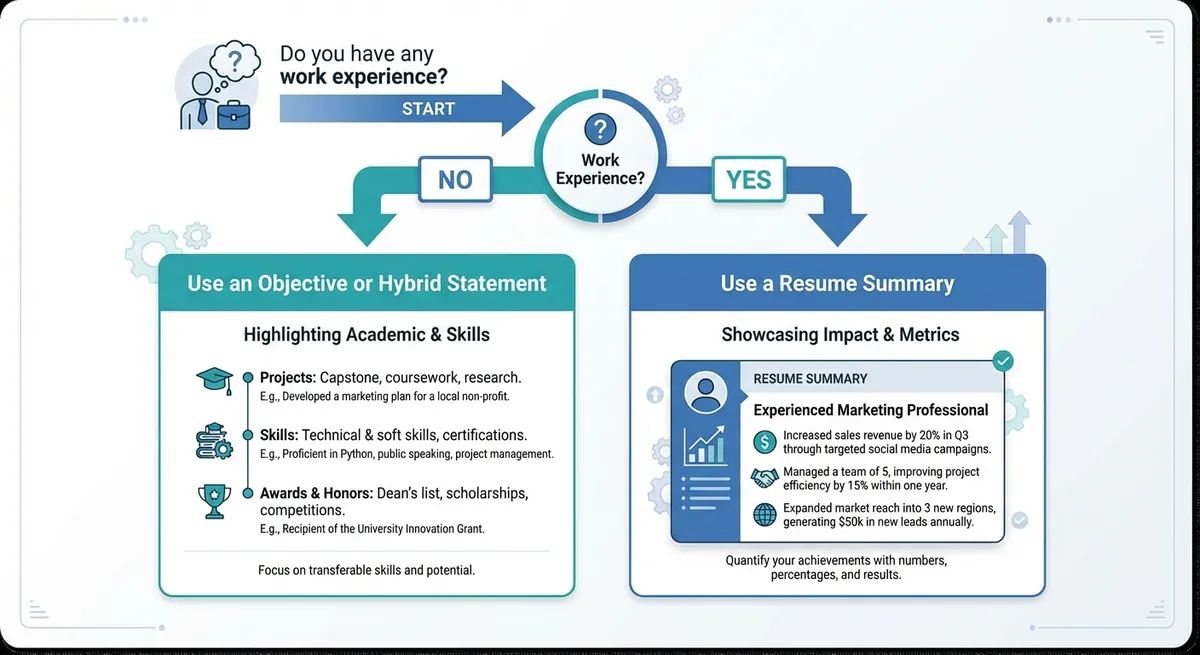
A simple, two-path flowchart. The starting question asks 'Do you have any work experience?' The 'Yes' path points to 'Use a Resume Summary' with a brief example showing metrics. The 'No' path points to 'Use an Objective or Hybrid Statement' with tips on highlighting academic achievements.
Checking out some real examples
Theory is great. But seeing it in action helps a lot more. Here are a few resume summary examples to show you what works.
Bad (The outdated objective):
"Looking for a job in customer service where I can help people and grow my communication skills over time."
Good (The modern summary):
"Bilingual Customer Success Specialist with 4 years of experience managing high-volume enterprise accounts. Maintained a 98% customer retention rate in 2023 by resolving technical escalations rapidly. Skilled in Salesforce, Zendesk, and proactive client onboarding."
See the difference? The first one begs for a chance. The second one proves value.
Comparing the two formats
Still confused about the differences? Let's break it down simply.
| Feature | Resume Objective | Resume Summary |
|---|---|---|
| Primary Focus | What you want from the employer | What you can offer the employer |
| Best Used By | High school students only | Professionals and career changers |
| Impact Level | Low. Often ignored by recruiters. | High. Acts as a strong sales pitch. |
| Tone | Passive and needy | Confident and data-driven |
The secret to getting it right
The best opening statements are highly specific to the job description. Generic statements tell the recruiter you are spamming your application to hundreds of companies.
Tailor every single time
Here's the thing. You cannot write one summary and use it for fifty different jobs. It won't work.
If you are applying for a management role, your summary needs to highlight leadership metrics. If you are applying for an analytical role, that exact same summary needs to be rewritten to highlight your data processing skills.
Figuring out how to write a resume is really about learning how to market yourself. You are the product. The hiring manager is the buyer.
Metrics matter most
Numbers jump off the page. Words blend together.
Do not say you are "good at sales." Say you "exceeded quarterly sales targets by 15% for three consecutive years." Do not claim you are a "hard worker." Prove it by stating you "managed a team of 12 people while cutting operational costs by $40,000."
Key Takeaways
- Resume objectives are outdated. They focus on your needs, but employers only care about their own needs.
- A resume summary is the modern standard. It acts as a quick highlight reel of your best professional moments.
- Always include specific numbers and metrics in your summary to prove your capabilities.
- Only use an objective if you are a student with absolutely zero professional experience.
- Tailor your summary for every single job application to match the specific keywords in the job description.
Learning how to write a resume does not have to be a miserable experience. By ditching the outdated objective and leading with a powerful summary, you immediately position yourself as a strong candidate. Ready to put this into practice? Let OneTwo Resume help you craft the perfect opening statement that actually gets you hired.