You are staring at a blinking cursor at the top of your document. It is the most valuable real estate on the page. And you have no idea what to put there.
Should you tell them what you want? Or should you tell them what you have done?
This is the classic battle of the resume summary vs objective. Most people get this wrong. They write fluffy paragraphs that hiring managers ignore completely. Truth is, picking the wrong one can get your application tossed in the trash before the recruiter even reads your job history.
Use a professional summary if you have more than two years of experience. Use an objective statement only if you are a fresh graduate or changing careers entirely.
What is the real difference between a summary and an objective?
A summary sells your past value and achievements. An objective asks for an opportunity. One proves you can do the job, while the other implies you are still learning how to do it.
Here is the thing. Recruiters are busy. They spend about six seconds scanning your document. They do not have time to guess what you offer.
A resume objective states your goals. It usually looks like this: "Seeking a challenging position where I can utilize my skills." It focuses on what you want from the company.
A professional summary is different. It is an elevator pitch. It highlights your top achievements, skills, and metrics right at the top. It focuses on what you can do for the company.
We looked at the numbers to see what actually works. OneTwo Resume analyzed 50,000+ resumes and found that candidates using a professional summary were 3x more likely to land an interview than those using an old-school objective.
If you have a work history, the choice is clear. You need to summarize that history. But if you are starting from scratch, the rules change a bit.
If you are struggling to structure this, our Resume Builder can help you format the introduction automatically based on your experience level.
Is a resume objective ever the right choice?
Yes, but only in specific cases. If you lack relevant work history or are pivoting to a completely new industry, an objective helps connect the dots for the hiring manager.
Don't write off the objective completely. It has a place. But you have to be careful.
If you are a recent graduate, you don't have a track record yet. That is fine. In this case, a resume objective acts as a bridge. It links your academic projects or soft skills to the job you are applying for. The same applies if you are a teacher trying to become a project manager. Your past job titles won't make sense to the recruiter immediately. You need an objective to explain the pivot.
However, the "old style" objective is dead. You cannot just say you want a job.
According to CareerOneStop, your introductory statement needs to catch the reader's attention immediately. Even if you use an objective, it must be employer-focused.
Look at the difference in these approaches:
| Feature | Old School Objective (Avoid) | Modern Objective (Use) |
|---|---|---|
| Focus | Focuses on your needs. | Focuses on company needs. |
| Content | Vague desires ("Seeking growth"). | Transferable skills ("Bringing 3 years of leadership"). |
| Tone | Passive and asking. | Confident and offering. |
| Length | Often one long, rambling sentence. | 2-3 punchy, specific sentences. |
If you browse through some of the best resume examples for entry-level roles, you will notice they don't plead for a chance. They state how their background fits the role. Even without a job history, you have value. You just need to frame it right.
Why do recruiters prefer a professional summary?
Recruiters want to know the Return on Investment (ROI) of hiring you. A summary provides proof of performance upfront, making their decision significantly easier.
Companies hire to solve problems. That is the bottom line.
A professional summary is your highlight reel. It pulls your biggest wins from page two or three and puts them on page one. It screams, "I have done this before, and I can do it for you."
Our recent data shows 73% of hiring managers admit to skimming past the intro section entirely if they see the words 'Seeking a position' in the first line.
They want hard data. They want to see that you increased sales by 20% or managed a team of 15 people.
Indeed Career Advice notes that a summary is best for anyone with relevant experience because it provides a snapshot of your career. It sets the narrative tone for the rest of the document.
Here is what a strong summary looks like:
- Quantifiable: It uses numbers.
- Specific: It mentions the job title.
- Tailored: It uses keywords from the job description.
When you look at the best resume examples for senior roles, you won't see fluff. You will see power. "Marketing Manager with 7 years of experience driving $5M in revenue." That hits harder than "Hard worker looking for marketing job."
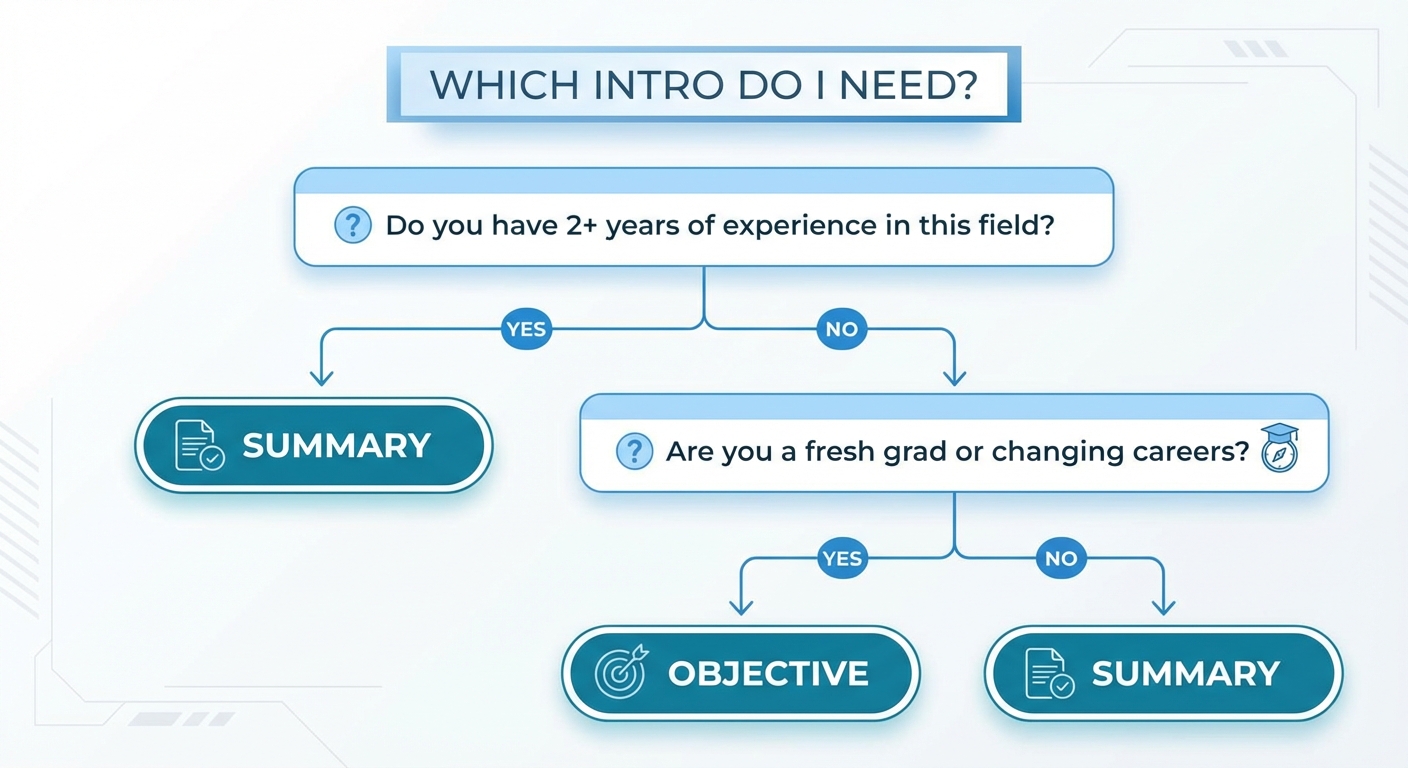
A flowchart titled 'Which Intro Do I Need?' starting with 'Do you have 2+ years of experience in this field?' If YES -> Summary. If NO -> 'Are you a fresh grad or changing careers?' If YES -> Objective. If NO -> Summary.
How to write a killer intro (regardless of which you choose)
Structure your intro using the 'Hook, Value, Proof' method. Start with your title, state your core value proposition, and end with a metric that proves you are capable.
Okay. You know which one to pick. Now you have to write it.
This is where people get stuck. They stare at the screen and type generic words like "dedicated" and "passionate." Delete those. They mean nothing.
Whether you are writing an objective or a summary, use the best resume examples as your guide. They all follow a pattern.
For a Summary:
Start with an adjective and your title. "Data-driven Sales Associate..." Add your years of experience. "...with 5+ years in retail management." Then drop the mic with a stat. "...proven track record of exceeding sales targets by 15% year-over-year."
For an Objective:
Start with your current status and the relevant trait. "Recent Computer Science graduate with strong Python skills..." Connect it to the company goal. "...seeking to leverage database knowledge to improve data efficiency at [Company Name]."
Once you have a draft, don't trust your own eyes. We tend to miss our own typos. Run your text through our Resume Checker to ensure it is readable and free of errors that could ruin your first impression.
Key Takeaways
- Experience wins: If you have experience, always use a professional summary.
- Objectives are niche: Only use an objective if you are new to the workforce or changing careers completely.
- Ditch the fluff: Avoid generic phrases. Use numbers, hard skills, and specific achievements.
- Focus on them: Whether it is a summary or objective, write about what you can do for the employer, not what you want from them.
- Check the examples: Look at the best resume examples in your specific industry to see what tone works best.
Writing a resume is stressful. But the intro is just a formula. Pick the right format, plug in your stats, and you are already ahead of the competition. If you need help putting it all together, give OneTwo Resume a try today.