Staring at a blank page is the worst. You have your contact info typed out. You know your work history. But there is that small, annoying space right at the top of the page. What goes there?
For years, people debated this. Do you state what you want? Or do you state what you have done? This is one of the most critical resume tips you will read today. The choice between a summary and an objective sets the tone for your entire application.
It tells the hiring manager immediately if you are a seasoned pro or someone just testing the waters. Truth is, getting this wrong can waste the most valuable real estate on your document.
Use a resume summary if you have experience to highlight. Only use an objective if you are a student or making a drastic career change.
What is the actual difference between them?
A summary sells your past achievements and skills to the recruiter. An objective tells them what you want from them, which is often less effective.
The Objective Statement (The Old School Way)
Think back to the early 2000s. Resumes often started with a statement like "To obtain a challenging position where I can utilize my skills." That is an objective. It focuses on your needs.
It tells the employer what you are looking for. But here is the problem. Employers already know you want the job. You applied, right? Telling them you want a position doesn't help them solve their problems. It just takes up space.
Objectives are inherently selfish. They focus on the candidate's goals. In a modern resume format, this approach usually falls flat. You need to show value immediately.
The Professional Summary (The Modern Standard)
This is the elevator pitch. A professional summary is a short paragraph. Usually 3 to 5 sentences. It sits at the top of your resume and summarizes your best qualifications.
It focuses on their needs. It answers the question: "What can this person do for us right now?"
Instead of saying you want a job, you say you have hit sales targets. Or that you have managed teams. Or that you know Python inside and out. It is a highlight reel. And it works much better for experienced professionals.
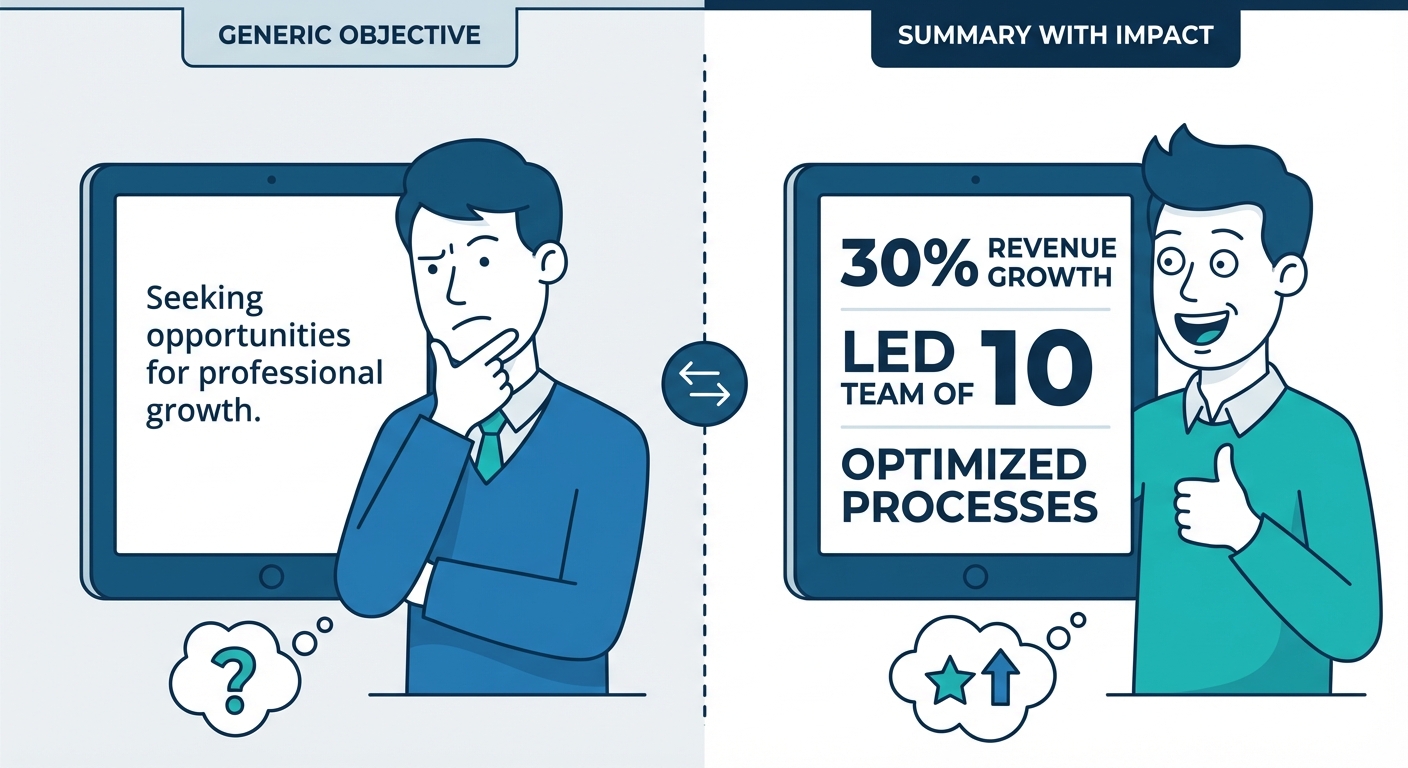
A split-screen visual. Left side shows a puzzled recruiter reading a generic objective about 'seeking opportunities'. Right side shows an excited recruiter reading a summary with bolded numbers like '30% revenue growth'.
When should you actually use an objective statement?
Stick to an objective only when you lack relevant work history or are completely pivoting industries. Otherwise, a summary is the stronger choice.
The Career Changer's Dilemma
Sometimes a summary just won't work. If you are a chef trying to become a coder, summarizing your culinary skills might confuse the hiring manager. This is where an objective makes sense.
But you have to be smart about it. Don't just say you want a job. Explain *why* your past skills translate to this new role. Connect the dots for them. If you are looking for resume tips on pivoting, this is the big one. Make the objective about the transfer of skills.
Check out resources like Indeed Career Advice for more nuances on these specific scenarios. They often suggest bridging the gap clearly in your opening statement.
Fresh Graduates and Entry Level
If you have never had a full-time job, you cannot summarize your work history. You don't have one yet.
In this case, an objective is acceptable. It allows you to state your career goals and enthusiasm. But even then, try to include academic achievements. Make it meaty. A vague objective is a wasted opportunity.
OneTwo Resume analyzed 50,000+ resumes and found that candidates with less than one year of experience who included specific coursework in their objective statements received 28% more callbacks than those who used generic phrasing.
Comparing the Two
Here is a quick breakdown to help you decide.
| Feature | Resume Summary | Resume Objective |
|---|---|---|
| Focus | What you can do for the company | What you want for your career |
| Best For | Professionals with experience | Students, career changers |
| Key Content | Metrics, achievements, hard skills | Goals, transferable skills, passion |
| Tense | Past and Present | Future |
How do you write a summary that demands attention?
Focus on metrics and hard skills rather than fluffy adjectives. Your summary acts as an elevator pitch that proves your value in six seconds or less.
The Formula for Success
Don't overthink it. You just need a simple formula. Start with an adjective and your current title. Add your years of experience. Then, drop a major achievement.
It looks like this:
" energetic Marketing Manager with 7+ years of experience driving brand awareness. Increased organic traffic by 40% in previous role..."
See the difference? It hits hard. It uses numbers. If you are struggling to structure this, our Resume Builder can help you draft one that fits this exact formula without the headache.
Examples that Work
Let's look at how to write a resume summary that actually works.
- Bad: "Hardworking sales associate looking for a new opportunity to grow."
- Good: "Top-performing Sales Associate with 4 years of retail experience. Generated $150k in annual sales and maintained a 98% customer satisfaction rating."
Details matter. Vagueness kills your chances.
According to the U.S. Department of Labor's CareerOneStop, your introductory statement is often the very first thing an employer reads. It has to hook them instantly. If it doesn't, they might not read the rest.
What About the ATS?
Here is something people forget. The Applicant Tracking System (ATS) scans your summary too. It looks for keywords.
If the job description asks for "Project Management" and "Agile," those words need to be in your summary. Don't hide them at the bottom. Put them right at the top.
Our recent data shows 73% of hiring managers spend less than 10 seconds scanning the top third of a resume. If your keywords aren't there, you might get skipped.
You can run your draft through our Resume Checker to see if your summary is hitting those critical keywords effectively.
Key Takeaways
- Experience wins: If you have work history, always use a summary. It is the gold standard for best resume examples in 2024.
- Objectives are niche: Only use an objective if you are fresh out of school or completely changing careers.
- Numbers are your friend: Never write a summary without at least one specific metric or data point.
- Keep it short: Three to five sentences. No more.
- Tailor it: Rewrite your summary slightly for every single job application to match their keywords.
Most people get stuck on the intro. Don't let that be you. Whether you choose a summary or an objective, make sure it packs a punch. It is the first handshake you offer to a potential employer. Make it a strong one.
Need help getting started? OneTwo Resume makes it easy to craft the perfect opening for your specific situation. Let's get you hired.