Look. You finally sit down at your computer. You have a solid ten years of great experience, but your text spills right onto page two. Should you cut it down?
Most professionals with over five years of experience should use a two-page resume, while entry-level candidates should stick to a single page.
Here's the thing. People stress over resume length constantly. They think a second page is a total kiss of death. It is not. Truth is, the rules changed about ten years ago.
One of the oldest resume tips in the book is to keep everything to a single page. But that advice comes from a time when people physically mailed their applications. Today, things are different. Learning how to write a resume is stressful enough without agonizing over page counts. You just need to know what hiring managers actually want to see right now.
One page resume: when is one page enough, and when is two fine?
A one page resume is the right choice when everything that proves you can do the target job fits on one page at a readable size. That is usually the case for students, recent graduates, early-career applicants and career changers. Two pages is fine once you have more relevant, recent results than one page can hold, which is common for experienced, senior and technical candidates. If you are in between, cut what does not support the job you are applying for before you touch the font size or margins.
The question is not "how many years have I worked?" but "how much of my history is evidence for this specific job?" Ten years in one field can justify two pages; ten years spread across unrelated jobs often fits better on one.
Use one page when:
- You are a student, a recent graduate or in your first few jobs, and your education, internships and projects are the main evidence.
- You are changing careers and most of your past roles are unrelated to the new one.
- The job posting or the recruiter asks for one page. Follow the instruction; it overrides every general rule, including this one.
Two pages is fine when:
- You have several relevant roles, each with results worth a bullet of its own.
- The role is technical and the reader needs the context of your stack, projects or certifications.
- You are applying for a senior role where budgets, teams and scope need explaining.
- You are applying for a US federal job: USAJOBS now accepts resumes of up to two pages, so two is the ceiling there, not a starting point (see the federal note below).
If you go to two pages, fill most of the second page and keep your strongest, most recent results on page one. A second page with three lines on it reads like a formatting accident.
What to cut to get to one page:
1.The objective statement. Replace it with a two-line summary aimed at the job, or drop it.
2.Old or unrelated roles. Keep the title, employer and dates, remove the bullets, or group them under a single "Earlier experience" line.
3.Duty-only bullets. "Responsible for scheduling" says less than a bullet with an outcome. Keep the ones that show a result; cut the rest.
4.Repeats. If three bullets prove the same skill, keep the strongest one.
5.Filler lines. "References available upon request", a full street address, and generic skills such as email or word processing (unless the posting lists them).
6.Coursework and GPA once you have relevant work experience.
Do not get to one page by shrinking the font below 10 points or squeezing the margins. If the content does not fit at a readable size, that is your answer: use two pages.
When is a one-page resume the right choice?
A single page works best when you are fresh out of college or have less than five years of relevant experience. It forces you to highlight only your absolute best achievements and keep things punchy.
Sometimes less really is more. If you can tell your professional story in 400 words, do it. Recruiters love a concise document.
You have less than five years of experience
If you just graduated or only have one major job under your belt, stick to one page. You simply do not have enough relevant history to justify a second page. Stretching out your college internships with huge margins just looks desperate. Keep it tight. Focus on your potential and your most recent wins.
You are making a major career change
Career changers face a unique hurdle. You might have fifteen years of work history. But if you are moving from retail management to software engineering, those retail years do not need endless bullet points. Keep the focus on your new coding bootcamp, your portfolio projects, and your technical skills. A single page keeps the recruiter focused on where you are going, not just where you have been.
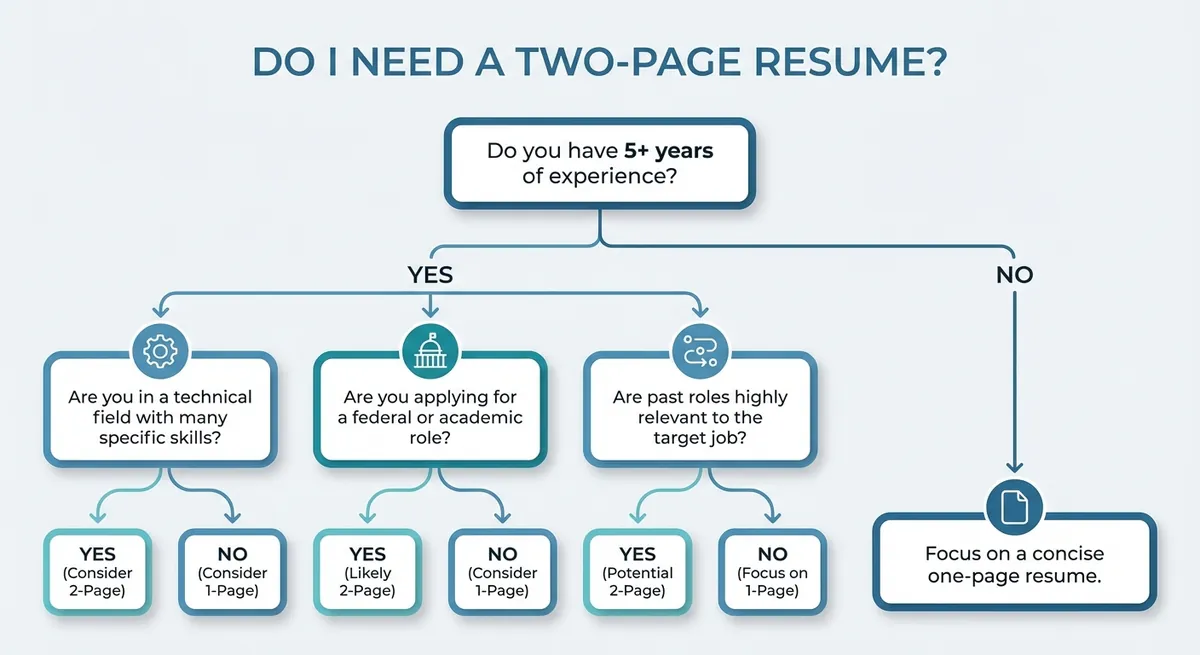
A flowchart titled 'Do I Need a Two-Page Resume?'. It starts with 'Do you have 5+ years of experience?' and branches into questions about technical skills, federal applications, and the relevancy of past roles.
When should you actually use two pages?
Two pages are perfect when you have an extensive track record of results and leadership. Hiring managers want to see your full impact if you are applying for senior or highly technical roles.
Let me give you one of the most important resume tips right now. Never shrink your font to a microscopic size just to cram everything onto one sheet. It ruins your readability.
You are a senior professional
When you hit that five to seven-year mark in your career, your responsibilities grow. You manage budgets. You lead teams. You drive major company initiatives. You cannot accurately describe that level of impact in two bullet points.
And if you read Indeed Career Advice: How Long Should a Resume Be?, you will notice the exact same theme. Your experience dictates your length. Do not shortchange your career history to appease an outdated rule.
You need to show specific technical skills
Tech jobs, engineering roles, and academic positions require heavy detail. Recruiters need to see the exact software stack you used on specific projects. They need the context. (Early-career engineers are the exception: the popular one-page Jake's Resume template exists because a student's projects and internships fit on a single page.) A modern resume format gives you the breathing room to list those technical proficiencies without making the page look like a cluttered mess.
And let's not forget government jobs. Federal resumes used to run three or four pages, but that changed: since September 27, 2025, USAJOBS restricts resumes to two pages, and agencies review only resumes of two pages or less (see OPM: Agency Guidance on the Two-Page Limit on Resume Length). For a federal job, two pages is the maximum.
Does the modern hiring process care about page count?
Applicant tracking systems do not count your pages or penalize you for going over one sheet. They only scan for text readability and keywords to match you with the job description.
People worry about the robot filters. Do recruiters actually care if you use two pages? Will the software reject you?
No. The software just reads text.
How bots read your file
When you upload your PDF, the ATS strips away your formatting. It reads the raw text from top to bottom. It does not know or care where page one ends and page two begins. It only cares about finding the right keywords and matching your skills to the open job.
They want white space. They want bullet points they can actually read on a phone screen.
Formatting matters more than page count
This brings us to the most practical of our resume tips today. The layout is your best friend.
If your draft feels too long, you can easily run it through a good Resume Checker. It will score your content and tell you exactly what works. You might find that you can cut out some fluff and easily fit it onto one page.
But if you truly need two pages, just make sure the format is clean. Put your strongest accomplishments on page one. Make the recruiter want to scroll down. If you need a template that handles all this pagination beautifully, our Resume Builder does the heavy lifting for you.
Here is a quick breakdown to help you decide:
| Experience Level | Recommended Length | Primary Focus |
|---|---|---|
| Entry-Level (0-5 years) | One Page | Education, internships, and potential |
| Mid-Level (5-10 years) | One or Two Pages | Key achievements and leadership roles |
| Senior (10+ years) | Two Pages | Strategic impact and career progression |
Key Takeaways
- Experience rules all. Entry-level job seekers should stick to one page. Mid-level and senior professionals should confidently use two pages.
- Readability is critical. Never shrink your font below 10 points just to fit an arbitrary page limit.
- The robots don't care. Applicant Tracking Systems scan for keywords, not page counts.
- Federal jobs have a hard cap. USAJOBS accepts resumes of up to two pages (OPM, since September 27, 2025).
At the end of the day, your resume is just a marketing document. It needs to be exactly as long as it takes to sell your skills effectively. Nothing more, nothing less. If you need help getting that perfect balance, OneTwo Resume has the tools and templates to make your next application stand out.