You are staring at your screen. The cursor is blinking at the bottom of page two. You have a few lines spilling over, and you are panicking. Do you cut your proudest achievements to fit everything on a single sheet? Or do you expand it and risk boring the recruiter?
It is the classic debate. Everyone seems to have a different opinion. Your college career center probably told you to never exceed one page. But then your senior colleague says a professional resume needs two pages to look serious. It is confusing.
Here is the thing. The rules have changed. The modern resume format isn't about following a strict law from 1999. It is about relevance. It is about impact. And most importantly, it is about respecting the reader's time.
Stick to one page if you have less than 10 years of experience. Go for two pages only if you have extensive, relevant work history that demands the extra space.
Who actually needs a two-page resume?
Experience is the main factor here. Senior professionals need space to prove their value, while early career seekers should prioritize brevity and impact.
Let's be real for a second. If you just graduated last year, you do not need two pages. You just don't. Expanding your font size to fill space looks sloppy. But if you have been in the workforce for a decade, trying to cram everything onto one page is a mistake. It forces you to cut critical details.
We looked at the numbers to give you a concrete answer. OneTwo Resume analyzed 50,000+ resumes and found that candidates with over 7 years of experience were 40% more likely to get an interview when they used a two-page format.
Why? Because at that level, you have a story to tell. You have metrics. You have history.
However, length alone doesn't save a bad resume. You need the right content. This is where many people mess up. They waste valuable real estate on a fluffy resume objective. You know the kind. "Seeking a challenging position to utilize my skills." That tells the hiring manager absolutely nothing.
Instead of a vague resume objective, write a punchy summary. Then use the rest of that space for your actual work history. If you are applying for a senior role, the recruiter wants to see the progression of your career. They want to see that you didn't just exist in a job. You grew.
Check out this breakdown of when to use which length:
| Candidate Level | Recommended Length | Why? |
|---|---|---|
| Entry-Level (0-2 Years) | 1 Page | You need to show potential without fluff. |
| Mid-Level (3-7 Years) | 1 Page (usually) | Focus on your biggest wins. Cut the college jobs. |
| Senior (7-15+ Years) | 2 Pages | You need space for metrics and leadership history. |
| Academic / C-Suite | 2+ Pages | CVs and executive bios follow different rules. |
Can a one-page resume really hold everything?
A single page forces you to highlight your best achievements. It prevents fluff and ensures recruiters see your most impressive stats immediately.
Yes, it can. And often, it should. Writing a one-page document is actually harder than writing two pages. It forces you to edit. You have to look at every bullet point and ask, "Does this actually matter?"
Think about the hiring manager. They are reviewing hundreds of applications. According to research from the Harvard Business Review, recruiters spend very little time on the initial screen. If your best points are buried on page two, they might never see them.
So how do you fit it all?
First, ditch the resume objective. I mentioned this before, but it bears repeating. It is the biggest waste of space on modern resumes. Unless you are making a massive career pivot, no one needs to know what you want. They care about what they get.
Second, look at your skills section. You need specific skills for resume scanning, but you don't need to list Microsoft Word. Everyone knows Word. Focus on hard skills, software, and languages that set you apart.
If you are struggling to make things fit, you might need a better layout. Our Resume Builder is designed to maximize space without making the page look cluttered. It handles the margins and spacing so you can focus on the words.
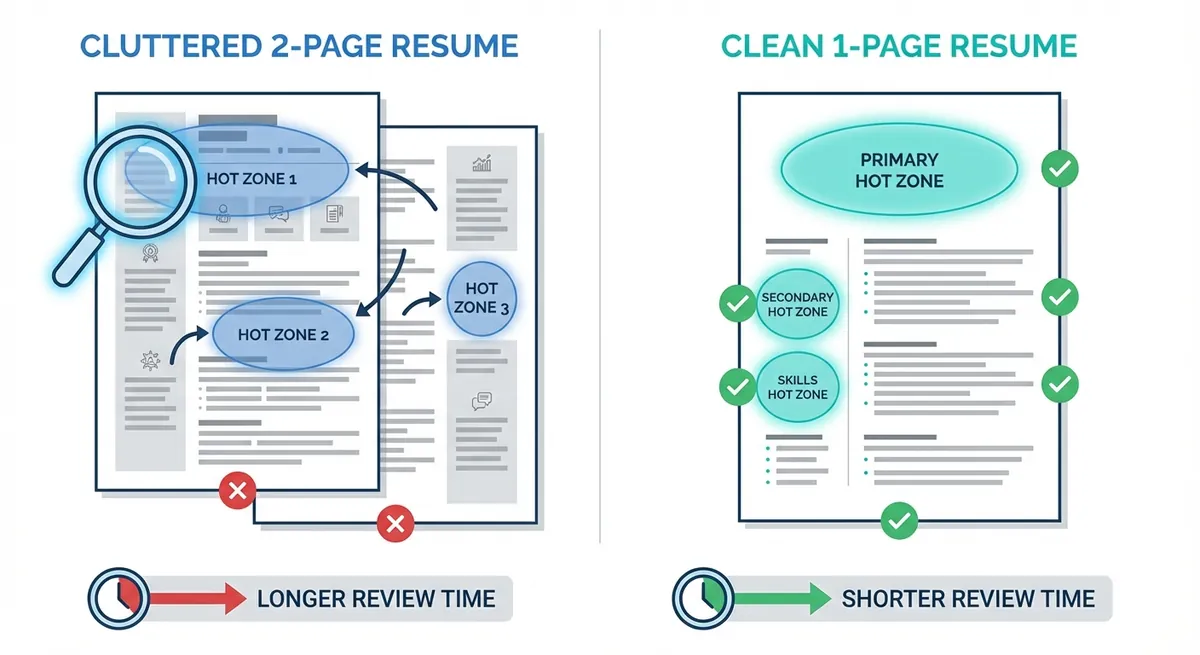
Visual comparison of a cluttered 2-page resume vs. a clean 1-page resume, highlighting 'Hot Zones' where recruiters look first
What about the modern job market standards?
ATS systems read both lengths easily, but human attention spans are short. Focus on readability and relevance over hitting a specific page count.
There is a myth that Applicant Tracking Systems (ATS) hate two-page resumes. That is false. Robots scroll infinitely. They don't care about page breaks. But eventually, a human will read it.
Our recent data shows 73% of hiring managers prefer a two-page resume for senior roles, but 86% prefer one page for entry-level jobs. The preference shifts based on the role complexity.
Truth is, the modern resume format is flexible. But it must be readable. If you choose two pages, ensure the second page is at least half full. A resume that spills over by three lines looks like an accident. Edit it down. Or expand on a key project to fill the space.
Also, consider your "real estate." The top third of the first page is your prime territory. This is where your contact info, summary, and key skills for resume scanning must live. Even if you have a second page, the hook must be on page one.
If you are unsure if your resume is readable, you can't just guess. You need objective feedback. Run your document through our Resume Checker. It scans for length, keyword density, and formatting issues that might trip up the ATS or annoy a human reader.
Sometimes, people use a resume objective to fill space on a second page. Don't do that. If you have to fluff it up, you don't have enough content for two pages. Go back to one.
For more perspective, the Indeed Career Guide notes that relevance is always more important than length. If the information on page two doesn't help you get the interview, cut it.
Key Takeaways
- Experience dictates length. Under 7-10 years? Stick to one page. Senior level? Two pages is standard.
- Kill the objective. Replace the outdated resume objective with a professional summary to save space and add value.
- Quality over quantity. Never add fluff just to reach page two. If you have 1.2 pages of content, edit down to one.
- Optimize the top third. Put your most critical skills for resume filtering and your biggest wins at the very top.
- Check your formatting. Margins and font sizes can often solve your length problems better than deleting content.
Final thoughts
There is no resume police. You won't go to jail for a 1.5-page resume. But you might miss an interview. The goal is to make it easy for the hiring manager to say "yes." Usually, that means keeping it short, sweet, and to the point.
Ready to build a resume that fits perfectly? Try OneTwo Resume today.