You are staring at the blinking cursor. It’s mocking you. You have cut every adjective. You have tweaked the margins until they are dangerously thin. But your resume is still spilling over onto a second page by exactly three lines.
It is incredibly frustrating.
Should you delete that internship from five years ago? Should you just leave it at a page and a half? This debate has been raging for decades. And everyone seems to have a different opinion.
Look. The rules have changed. The old school advice doesn't always apply to the modern job market. We need to look at what actually works today. Truth is, there is no single right answer for everyone. But there is definitely a right answer for you.
Here are the resume tips you actually need to decide on the perfect length.
Most candidates with under 10 years of experience should stick to one page. However, senior professionals or those in technical fields often need two pages to tell their full story.
Who should stick to a single page?
Entry-level candidates, recent graduates, and those with less than 7 to 10 years of experience should almost always stick to one page to maximize impact.
The "less is more" rule
Recruiters are busy people. They spend about six to seven seconds on their initial scan of your application. If you can’t hook them in that brief window, a second page won't save you. It might actually hurt you.
OneTwo Resume analyzed 50,000+ resumes and found that for entry to mid-level roles, one-page resumes had a 38% higher callback rate than two-page versions. The data is clear. Brevity wins.
If you have fewer than 10 years of experience, forcing a second page usually means you are including fluff. You don't need to list the daily duties of a job you held in college. Focus on achievements. Keep it tight.
Students and career changers
For students or recent grads, there is rarely a justification for a second page. Your academic projects are cool. But they aren't two pages cool. The same goes for career changers.
If you are pivoting industries, your modern resume format should focus on transferable skills. Irrelevant history just takes up valuable real estate. You want the hiring manager to see your potential immediately. You don't want them digging through a history lesson.
Cutting the fat
Start by looking at your "resume objective". Do you really need it? Unless you are making a massive career pivot, probably not. Most recruiters skip right over them anyway. Replacing a vague objective with a punchy summary or just diving straight into experience can save you three or four lines instantly.
And if you are struggling to cut content, try running your draft through our Resume Checker. It helps identify weak words and spacing issues that might be bloating your document.
When is a two-page resume actually better?
Senior executives, academics, and specialists with extensive technical skills often require two pages to showcase relevant projects and leadership history without selling themselves short.
The senior professional
If you are applying for a Director or VP level role, a one-page resume might actually look suspicious. It might look like you haven't done enough. Senior leaders need space to detail complex wins. They need to show P&L responsibility. They need to list board memberships.
According to Harvard Business Review: How Long Should Your Resume Be?, recruiters were 2.3 times more likely to prefer two-page resumes when hiring for management-level roles. The depth matters here.
Technical roles and comprehensive histories
Software engineers. Architects. Federal employees. These roles are different. You often need to list specific tech stacks, certifications, and detailed project scopes. That takes up room.
But here is the catch. The content on page two must be just as strong as page one. If page two is just a list of hobbies and references, delete it. And remember that relevance is key. Our recent data shows 73% of hiring managers stop reading if the second page feels like "filler" content.
The 1.5 page disaster
This is a specific pet peeve for many recruiters. Do not submit a resume that is one and a half pages long. It looks unfinished. It looks like you didn't know how to edit. You have two choices here. Cut it down to one. or expand it to two full pages.
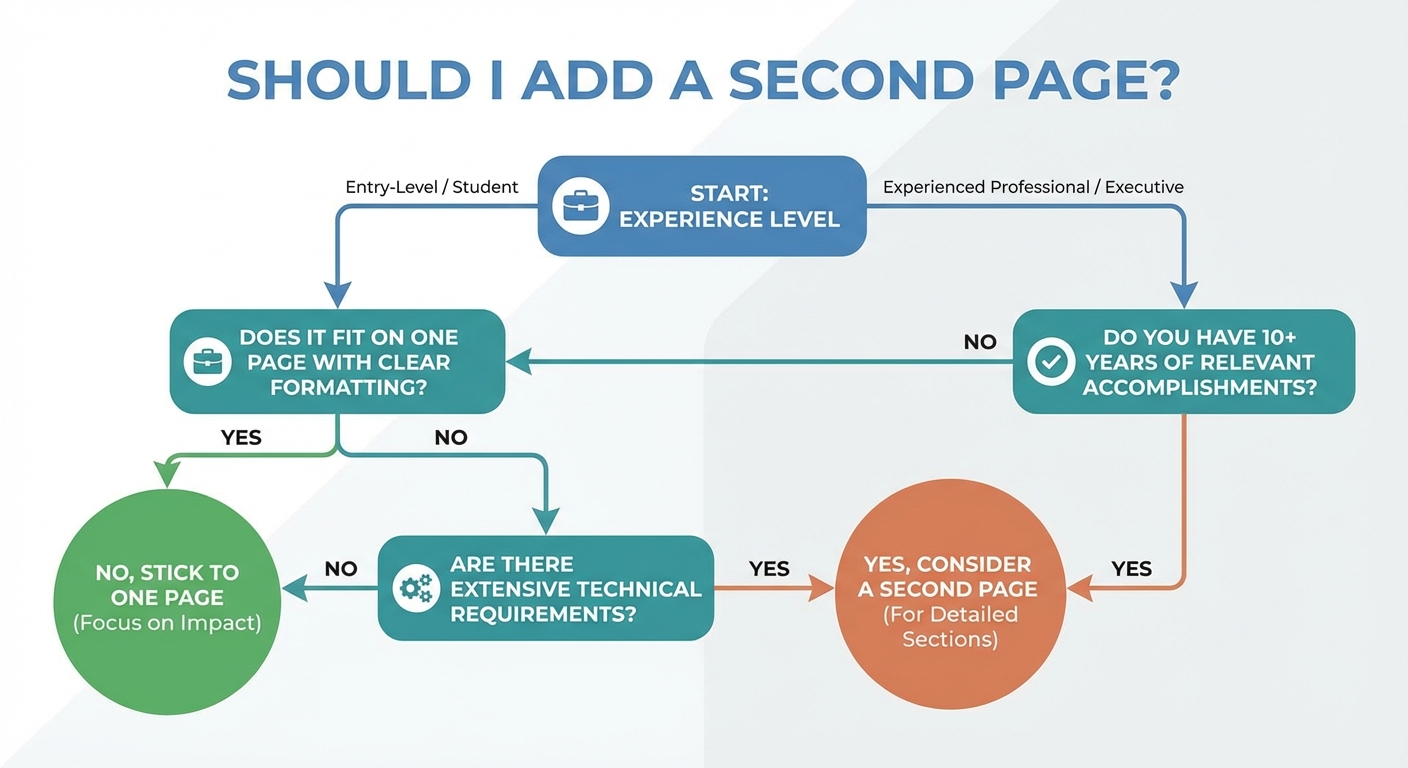
A flowchart titled 'Should I Add a Second Page?' starting with experience level, branching into technical requirements, and ending with a clear Yes/No decision
How to format for length (without cheating)
Proper formatting with strategic white space is better than tiny margins and size 8 font. If it is not readable, the length doesn't matter.
Margins and font size
You might be tempted to shrink your margins to 0.2 inches. Don't do it. Printers will cut off the text. It looks cramped on a screen. And it makes you look desperate.
Keep your font size between 10 and 12 points. If you have to squint to read it, the recruiter won't bother reading it at all. It is better to have a clean, two-page resume than a cluttered, unreadable one-page mess.
Using a modern resume format
The structure matters as much as the word count. A modern resume format utilizes columns and clean headers to maximize space. This allows you to fit more information on a single page without it feeling overwhelming.
If you aren't a design pro, don't sweat it. You can use our Resume Builder to automatically format your content. It adjusts the spacing perfectly so you don't have to fight with a word processor for hours.
Comparison: When to cut vs. keep
| Scenario | Verdict | Why? |
|---|---|---|
| 5 years experience, 1.2 pages | Cut to 1 | You likely have verbose bullets that can be tightened. |
| 15 years experience, 1.8 pages | Expand to 2 | Add more detail to recent wins to fill the space effectively. |
| Federal or Academic CV | 2+ Pages | These formats have strict requirements for comprehensive history. |
| Applying to a startup | 1 Page | Startups value brevity and the ability to prioritize information. |
Final thoughts on resume length
Resumes are marketing documents. They are not autobiographies. You do not need to tell the story of your entire life. You just need to tell the story that gets you the interview.
Check out this advice from Indeed Career Guide: How Long Should a Resume Be? (Tips and Examples) which reinforces the idea that relevance always trumps length. If a piece of information doesn't prove you can do the job you are applying for right now, it needs to go.
Here's the bottom line. If you are early in your career, keep it to one page. If you are seasoned, two is fine. But never, ever sacrifice readability just to hit a specific page count.
Key Takeaways
- Experience rules: Under 10 years? Stick to one page. Over 10 years? Two is acceptable.
- Relevance is king: Only include details relevant to the specific job you want.
- Avoid the void: Don't leave your resume at 1.5 pages. Edit down or flesh it out.
- Ditch the objective: Replace the old resume objective with a summary or remove it to save space.
- Readability first: Never shrink fonts below 10pt just to fit everything on one page.
Still not sure if your resume is hitting the mark? Stop guessing. OneTwo Resume can help you build a professional, perfectly formatted resume in minutes.