You want to work from home. So does everyone else. The competition for these roles is stiff. But here is the good news. Most people are terrible at rewriting their resumes for the virtual world. They use the same old templates. They list duties instead of results. And they completely forget to mention the specific tools that make remote teams function.
To find remote jobs that actually pay well, you have to prove you are trustworthy. You have to prove you can communicate without a manager breathing down your neck. It requires a different approach. Let’s look at exactly how to fix your resume.
To land a remote role, clearly label past remote experience in your header and highlight soft skills like digital communication and time management.
Not sure which employers to target first? Start with our list of the best companies for remote work and tailor your resume for each one.
Where exactly should I list my remote experience?
Don't make recruiters guess where you worked. Add "Remote" clearly next to job titles or within the location field to immediately signal your capability to work independently.
The location field strategy
Here is the thing. Applicant Tracking Systems (ATS) are picky. If a recruiter searches for candidates in "Remote" or "United States," you want to show up. Look at your work history. Did you work from home during 2020? Have you done freelance work?
Don't hide it in the bullet points.
Put it right next to the city and state. For example: "San Francisco, CA (Remote)." Or simply "Remote." This is the fastest way to signal you have done this before. It reduces risk for the hiring manager. They know you won't flake out after two weeks of sitting alone in your home office.
Being honest about hybrid work
Maybe you didn't work from home full-time. That is okay. Hybrid work counts. It shows you can handle a flexible schedule. Be specific about it.
You can write "Hybrid (3 days remote)" next to the location. This transparency builds trust. Plus, it helps you match with remote jobs that might occasionally require an onsite presence.
According to a helpful guide on listing remote work by Indeed, clarity in your header prevents confusion later in the interview process. You don't want to waste time explaining logistics in the first phone screen.
The skills section overhaul
Your skills section needs a refresh. Remove generic fluff. "Hard worker" means nothing. Instead, list the collaboration tools you use daily.
We recently pulled some numbers to see what works.
What specific skills prove I can work from home?
Technical skills get you the interview, but asynchronous communication skills get you the job. Prove you can deliver results without a manager hovering over your shoulder.
Async communication is king
In an office, you can tap someone on the shoulder. You can't do that on a distributed team. You have to write everything down.
Recruiters are looking for "asynchronous communication." It sounds fancy. It just means you can document your work so people can read it later. Mention how you wrote documentation. Mention how you updated tickets.
Don't just say "Good communicator." Say "Reduced meeting times by 20% through detailed weekly written updates."
Tech stack proficiency
If you want to find remote jobs, you need to speak the language. And the language is software.
Listing Microsoft Word isn't enough anymore. Do you use Slack? Microsoft Teams? Zoom? Trello? Salesforce? Put them on the page. If you are struggling to format this section, you can check our Resume Builder to drag and drop these skills into a clean layout.
Here is a breakdown of how to translate office skills into remote-ready skills:
| Traditional Skill | Remote-Ready Equivalent |
|---|---|
| Verbal Communication | Asynchronous Documentation & Written Updates |
| Team Player | Cross-functional Collaboration via Slack/Zoom |
| Self-Starter | Independent Project Management & Time Boxing |
| Punctual | Managed Deadlines Across 3 Time Zones |
Time zone management
This is huge. Companies hire globally now. If you have worked with teams in Europe or Asia, put that on your resume.
It shows you respect boundaries. It shows you are organized. You can handle the math of scheduling a meeting when it is 5 PM for you and 9 AM for them. It’s a subtle flex. But it works.
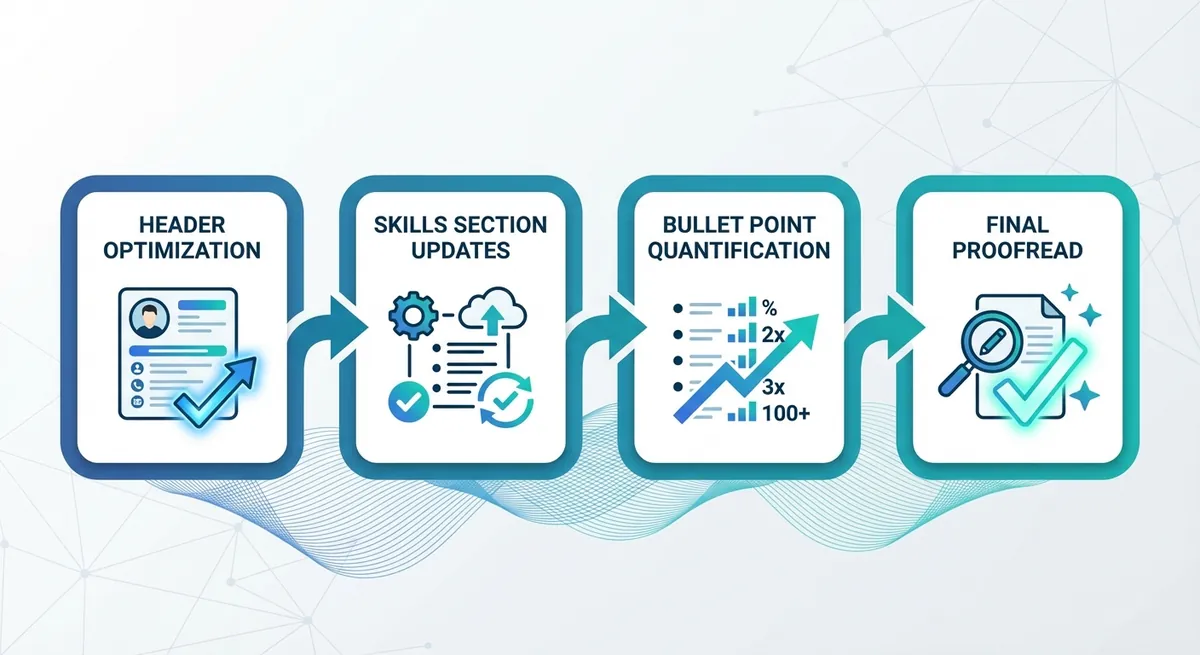
Visual flow chart showing the 'Remote Resume Checklist' - starting from Header optimization -> Skills Section updates -> Bullet point quantification -> Final Proofread
How do I quantify my impact without being in the office?
Optimization is about specific keywords and hard numbers. Use terms like "Zoom," "Slack," and "Asynchronous" to prove you are already comfortable in a digital-first environment.
Focus on output, not hours
In a physical office, showing up is half the battle. Your boss sees you at your desk. They assume you are working.
Remote work is different. Nobody sees you. They only see what you produce. Your resume must reflect this. Stop listing duties. Start listing outcomes.
Did you close 50 tickets a week? Did you write 10 blog posts? Did you manage a budget of $50,000? Numbers jump off the page. They prove you were busy.
Highlighting autonomy
Managers of remote teams have a secret fear. They worry they will have to babysit you. Your resume needs to kill that fear immediately.
Use words like "Lead," "Created," "Managed," and "Owned."
For example: "Owned the monthly reporting process for the marketing team, reducing error rates by 15%." This sentence tells a story. It says you took charge. You didn't wait for instructions.
Research from Harvard Business Review suggests that demonstrating this kind of "proactive autonomy" is the single biggest factor in getting noticed by remote recruiters.
The OneTwo data on soft skills
We looked at the data again.
This means a junior candidate with a modern, digital-first resume can beat a senior candidate who looks like they are stuck in 2015.
If you aren't sure if your resume is hitting these notes, run it through our Resume Checker. It will score your content against modern standards. It finds the weak spots you might miss.
Key Takeaways
- Label it clearly: Add "Remote" or "Hybrid" next to your job titles to stop the guessing game.
- List the tools: Slack, Zoom, Jira, and Asana are keywords you need to include.
- Quantify results: Focus on output and completed projects, not just daily tasks.
- Show autonomy: Prove you can work alone without constant supervision.
- Highlight async skills: Emphasize your ability to communicate clearly in writing.
The market is shifting. To find remote jobs, you have to shift with it. It’s not just about doing the work. It’s about showing you can do the work from anywhere. Good luck out there. You’ve got this.
- Ready to build a resume that lands interviews? Try OneTwo Resume today.*