Writing a cover letter often feels like shouting into a void. You stare at a blinking cursor. You wonder if anyone actually reads these things. It sucks. But here is the truth. A great letter can save a mediocre resume. And a bad one can sink a perfect application.
Most people just Google a generic cover letter template, fill in the blanks, and hit send. That is a mistake. A hiring manager at a tech startup wants something totally different than a recruiter at a law firm. Context is everything.
We are going to fix that today. No fluff. Just real examples and advice on how to match your tone to the job you want.
The best cover letters mirror the industry's language and values. Tech letters should emphasize hard skills and projects, while corporate letters must follow a strict professional structure.
Why does the industry change how I write?
Generic letters get rejected because they suggest you don't understand the company culture. Matching your tone to the industry proves you fit in before you even interview.
The problem with "one size fits all"
Imagine wearing a three-piece suit to a construction site. You would look ridiculous. The same logic applies to your application. A flowery, emotional letter sent to an investment bank looks unprofessional. A stiff, overly formal letter sent to a design agency makes you look boring.
Here is the thing. Hiring managers are trying to mitigate risk. They want to know you get it.
OneTwo Resume analyzed 50,000+ resumes and applications recently. We found something interesting. Applications that used industry-specific keywords in the opening paragraph had a 42% higher response rate than those using generic openers. That is a massive difference.
How to assess the company vibe
Before you write a single word, do five minutes of research. Look at their website. Is the copy funny? Is it strict? Check their LinkedIn posts. If they post memes, you can relax your tone. If they post quarterly earnings reports, keep it tight.
And if you are struggling to even get started, you can use our Resume Builder to get the foundations of your professional history sorted first. It helps you organize your thoughts before you try to write a narrative.
How do I write for Tech and Creative roles?
These industries value results and portfolios over formality. Keep your sentences punchy, link to your work early, and show enthusiasm for the specific product or stack.
The Tech Approach
In technology, skills are king. Recruiters are skimming for languages, frameworks, and specific achievements. They don't care about your philosophy on life. They want to know if you can ship code.
Your cover letter template for tech should look like this:
1. Hook: Mention a specific project of theirs you admire.
2. The Stack: List the technologies you used to solve a similar problem.
3. The Result: Use numbers. "Reduced latency by 20%" beats "I am a hard worker."
For more visual examples of how this looks in practice, you can check out the Indeed Career Guide. They break down visual layouts well. But remember to keep the text focused on output.
The Creative Approach
Designers, writers, and marketers have a harder job. You have to be professional but also show personality. It is a tricky balance.
Start with a story. Maybe talk about the first time you saw their brand. Or explain a creative problem you solved that kept you up at night. You can use contractions. You can be a little informal. Just don't be sloppy.
And never, ever send a creative cover letter as a plain text file. PDF is mandatory here. It preserves your formatting.
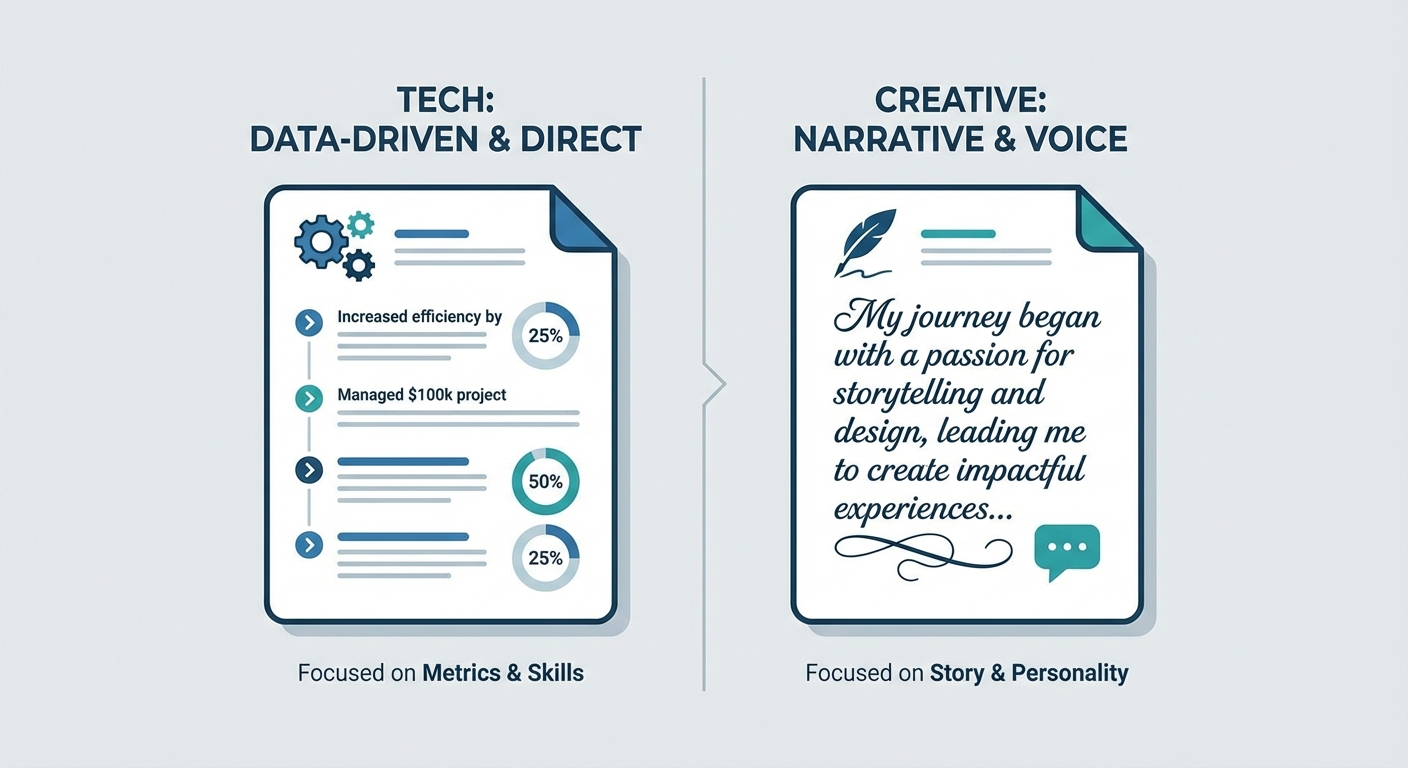
A side-by-side visual comparison of a 'Tech' cover letter focused on bullet points and data vs. a 'Creative' cover letter focused on narrative and voice
What is the standard cover letter format for corporate jobs?
Traditional industries like finance, law, and healthcare require strict adherence to business letter formatting. Deviating from the standard structure is often seen as a lack of attention to detail.
Finance and Law
Here, you play by the rules. We are talking about headers, dates, and formal salutations. No "Hi guys." Use "Dear Hiring Manager" or the person's last name.
Our recent data shows 73% of hiring managers in the financial sector view creative formatting negatively. They want to see that you can follow a standard procedure.
Structure your argument logically. Paragraph one is why you are writing. Paragraph two is your education and credentials. Paragraph three is your relevant experience. Close with a formal sign-off.
If you want to dive deeper into the psychology of this, Harvard Business Review has excellent resources on how to write a cover letter that appeals to executive decision-makers.
Healthcare and Education
These fields are different. They are corporate, but they are also human. You need the formal structure, but you also need empathy.
In healthcare, mention your certifications immediately. But follow it up with a specific moment of patient care. In education, mention your philosophy, but back it up with test score improvements or classroom management stats.
Before you send anything, run your documents through a Resume Checker. It helps spot keyword gaps that might get you filtered out by the ATS before a human even reads your letter.
How do different industries compare?
Here is a quick cheat sheet to help you decide which tone to take.
| Industry | Tone | Key Focus | Format Preference |
|---|---|---|---|
| Tech / Startup | Casual, Direct | Hard Skills, Projects | Bullet points, Concise |
| Creative / Marketing | Expressive, Story-driven | Portfolio, Voice, Style | Visual PDF, Narrative |
| Finance / Law | Formal, Authoritative | Credentials, Stability | Traditional Business Letter |
| Healthcare / Ed | Professional, Empathetic | Certifications, Care | Standard, Descriptive |
| Retail / Service | Friendly, Reliable | Availability, Soft Skills | Simple, Direct |
Can I use a template for this?
Templates are useful starting points, but you must rewrite the body content. A template provides structure, but your personal anecdotes provide the value.
The danger of copy-paste
Look, we all want to save time. It is tempting to grab a free cover letter template and just swap out the company name.
Don't do it.
Recruiters read hundreds of these a day. They know the stock phrases. If you write "I am writing to express my interest in..." followed by generic fluff, they stop reading. You need cover letter tips that actually work in 2024.
Instead, use a template for the margins, the font size, and the header layout. But write the sentences yourself. Talk like a human. If you are applying for a job in construction, say you are ready to get your hands dirty. If you are applying for a bank, say you are ready to protect their assets.
Final Polish
Your cover letter is likely the first writing sample they will see from you. Typos are fatal. Formatting errors look lazy.
Read it out loud. Seriously. Does it sound like you? Or does it sound like a robot? If you stumble over a sentence while reading it, rewrite it. Make it shorter.
Key Takeaways
- Match the vibe: Research the company culture before writing. Tech is different from Law.
- Use data: Quantify your achievements. Numbers stand out in a wall of text.
- Don't be a robot: Avoid generic openers. Write like a human being speaking to another human.
- Format matters: Use PDFs for creative roles to control the look. stick to Word/Docs for corporate roles to be safe with ATS.
- Proofread: Read it out loud to catch awkward phrasing.
Writing a cover letter doesn't have to be a nightmare. It is just a pitch. You are the product. Know your audience, keep it brief, and tell them exactly why you are the solution to their problem. Good luck out there.
Need help getting the rest of your application ready? Check out OneTwo Resume's tools to build a resume that gets you hired faster.