Phone interviews are weird. You sit alone in your room staring at a wall while trying to sound incredibly enthusiastic. It feels awkward. But this first step is crucial to your job search. Look, companies use these calls to weed people out fast. If you mess up here, you're out of the running. No second chances.
Prepare a quiet space, stand up to boost vocal energy, and use a structured formula like the STAR method to answer confidently and clearly.
How do you prepare your space for the call?
The best phone interview preparation removes all physical distractions. Treat the call as seriously as an in-person meeting by clearing your desk, printing your materials, and finding a totally silent room.
Control your environment
Background noise kills your chances fast. Find a quiet room. Lock the door. Tell your roommates or family to stay away for an hour. You want zero interruptions. If your dog barks in the background, it distracts the recruiter. And it breaks your concentration.
You need to control what you can.
Keep your materials in front of you
This is the one huge advantage of a phone interview over a traditional meeting. It's an open-book test. Print out the job description. Print out your work history. Spread them out on your desk.
But don't read from a script. You'll sound like a robot. Just keep bullet points nearby to jog your memory. If you aren't sure if your materials are actually up to par before the call, run your document through our Resume Checker. It helps you catch errors before the recruiter does.
Understanding the different types of interviews is important. A phone screen is usually brief. They want to verify your basic qualifications. Keep your notes organized so you can find answers in seconds.
How do you answer tough questions without rambling?
Rambling is the number one mistake candidates make on the phone. You avoid this by using specific frameworks to structure your thoughts and keep your answers under two minutes.
Use the STAR method for every story
Here's the thing. When a recruiter asks a behavioral interview question, they want proof you can handle the job. They don't want vague theories. They want facts.
This is exactly where you need the STAR method. It stands for Situation, Task, Action, and Result. You describe the background. You explain what you had to do. You detail the exact steps you took. Finally, you share the positive outcome.
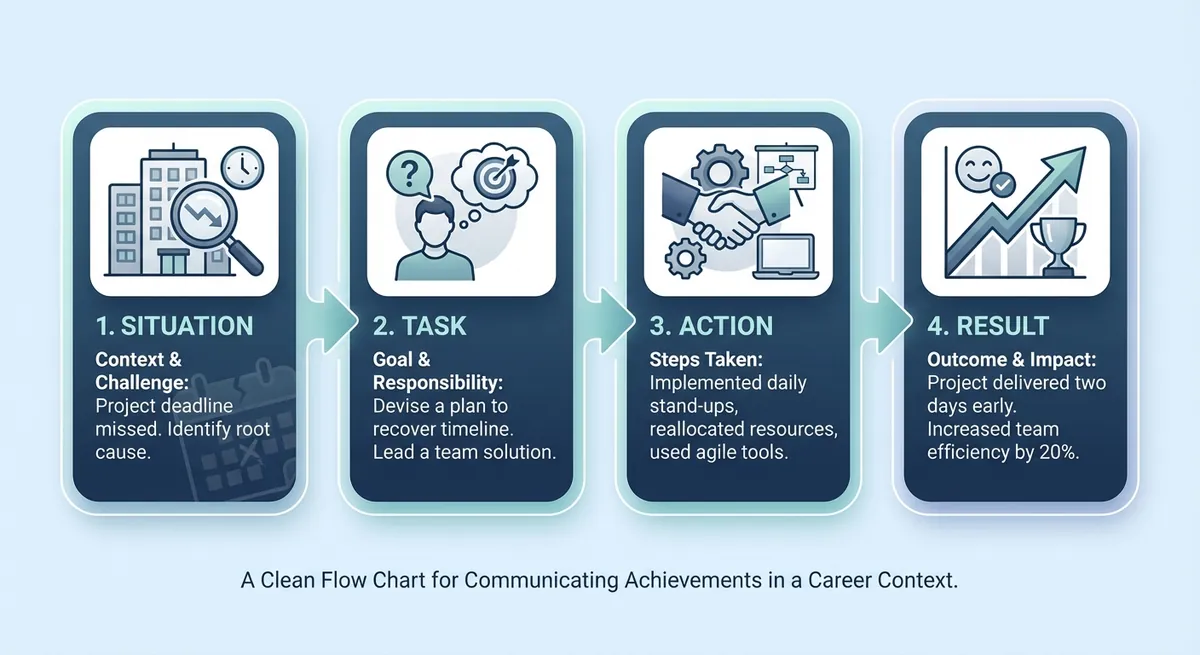
A four-step flow chart illustrating the Situation, Task, Action, and Result framework with a short example for each step
Using the STAR method forces you to stay on track. It stops you from going off on tangents. We see this work constantly. That same logic applies perfectly to your verbal answers.
Master the art of the pause
Silence on the phone feels terrifying. You finish your sentence. The recruiter says nothing. Your instinct is to fill the void. Don't do it.
Stop talking. Take a breath. Let them process what you just said. They might be taking notes. Rambling to fill the silence makes you sound nervous. Practice answering a question using the STAR method, and then literally mute your microphone for two seconds to force a stop.
What etiquette rules actually matter on the phone?
Good phone etiquette means actively showing enthusiasm through your voice and eliminating conversational bad habits. You must compensate for the total lack of visual body language.
Your voice is your only tool
You can't smile at the interviewer. They can't see you nodding. Truth is, that makes building rapport incredibly hard.
You have to inject more energy into your voice than usual. Stand up while you talk. Standing opens up your diaphragm. It makes you sound more confident. Walk around your room if it helps you think. A great resource from Harvard Business Review explains exactly how to ace a phone interview by focusing heavily on vocal tone and pacing.
If you transition to a video interview later in the process, you can rely on facial expressions. But for now, your voice has to do all the heavy lifting.
Ask questions and take notes
A good interview is a two-way street. You need to ask them questions too. It shows you care about the role. Write down the recruiter's name immediately when they introduce themselves. Use it once or twice during the call. It builds a quick connection.
Here's a quick breakdown of bad versus good etiquette on these calls.
| Bad Etiquette | Good Etiquette | Why It Matters |
|---|---|---|
| Interrupting the speaker | Waiting two seconds before replying | Prevents awkward talking over each other due to phone lag |
| Eating or chewing gum | Drinking only room temperature water | Keeps your voice clear and prevents gross mouth sounds |
| Saying "uh" and "um" | Using brief pauses of silence | Makes you sound confident and thoughtful |
You might be sweating bullets before the call. That's completely normal. Preparation fixes that anxiety. Figuring out how to ace an interview is entirely about reducing the unknown variables. Before you even apply for your next role, you should probably build a solid foundation using a tool like our Resume Builder.
Key Takeaways
- Stand up during your call to project more confidence and energy.
- Keep a printed cheat sheet with your job history and bullet points on your desk.
- Use the STAR method to keep your stories concise and completely focused on results.
- Embrace short silences instead of filling the gap with nervous rambling.
- Treat the call with the exact same professional respect as a final round in-person meeting.
A phone screen doesn't have to be intimidating. You just need a strategy. Get your environment right. Master your talking points. And remember to breathe. If you need a hand getting those initial calls in the first place, OneTwo Resume has the tools to make your application stand out. Now go crush that interview.