You know the feeling. It’s the classic Catch-22 of the job market. You need a job to get experience. But you need experience to get a job. It feels rigged. It’s frustrating enough to make you want to close your laptop and walk away.
But here is the truth. Every single professional you admire started exactly where you are right now. With zero experience. They didn't magically appear with a ten-year work history. They built a bridge from where they were to where they wanted to go. You can do that too.
Writing a resume without a job history isn't about faking it. It is about translation. You have skills. You have done things. You just need to speak the language hiring managers understand.
Focus your resume on transferable skills, education, and volunteer work rather than chronological work history to prove your potential value.
Which resume format is best for beginners?
Use a functional or hybrid resume structure that highlights your skills and projects at the top while moving dates and timelines to the bottom.
Most people use a chronological resume. That lists your last job first. But if your last job doesn't exist, that format highlights your biggest weakness. Don't do that.
Instead, you want a modern resume format that focuses on what you can do, not what you have done. We call this a functional or hybrid format. It puts your skills section and education right at the top. It screams "Look at my potential" rather than "Look at my empty employment dates."
Here is why this matters. Recruiters scan resumes in about 6 or 7 seconds. If the first thing they see is a blank work history, you're out. If the first thing they see is "Python Proficiency" or "Leadership Experience," you have their attention.
If you are struggling to lay this out, you don't have to fight with a word processor. You can use our Resume Builder to automatically structure your layout. It does the heavy lifting on formatting so you can focus on the words.
What should I include if I haven't held a real job?
Treat your volunteer work, academic projects, and extracurricular leadership roles exactly like paid employment by using professional bullet points.
Look. You have done work. It just wasn't paid work. That doesn't mean it holds no value.
Did you organize a charity run? That is event management. Did you build a website for your uncle's bakery? That is web development and client relations. Did you lead a study group? That is team leadership.
OneTwo Resume analyzed 50,000+ resumes and found that entry-level candidates who included detailed academic projects saw a 42% higher interview rate than those who only listed their degree.
That is a massive difference.
When you are looking for resume tips, this is the big one. Dig for gold in your history. Here is what to mine for content:
- Volunteer Work: This counts as work experience. Period.
- Class Projects: Describe the scope, the tools you used, and the grade you received.
- Extracurriculars: Sports captain? Club treasurer? These show discipline and responsibility.
- Freelance Work: Even if it was just mowing lawns. If you managed a schedule and collected payment, you ran a business.
For more ideas on how to frame these activities, check out this guide from Indeed Career Advice on leveraging unpaid experience. They break down the nuance of volunteer descriptions perfectly.
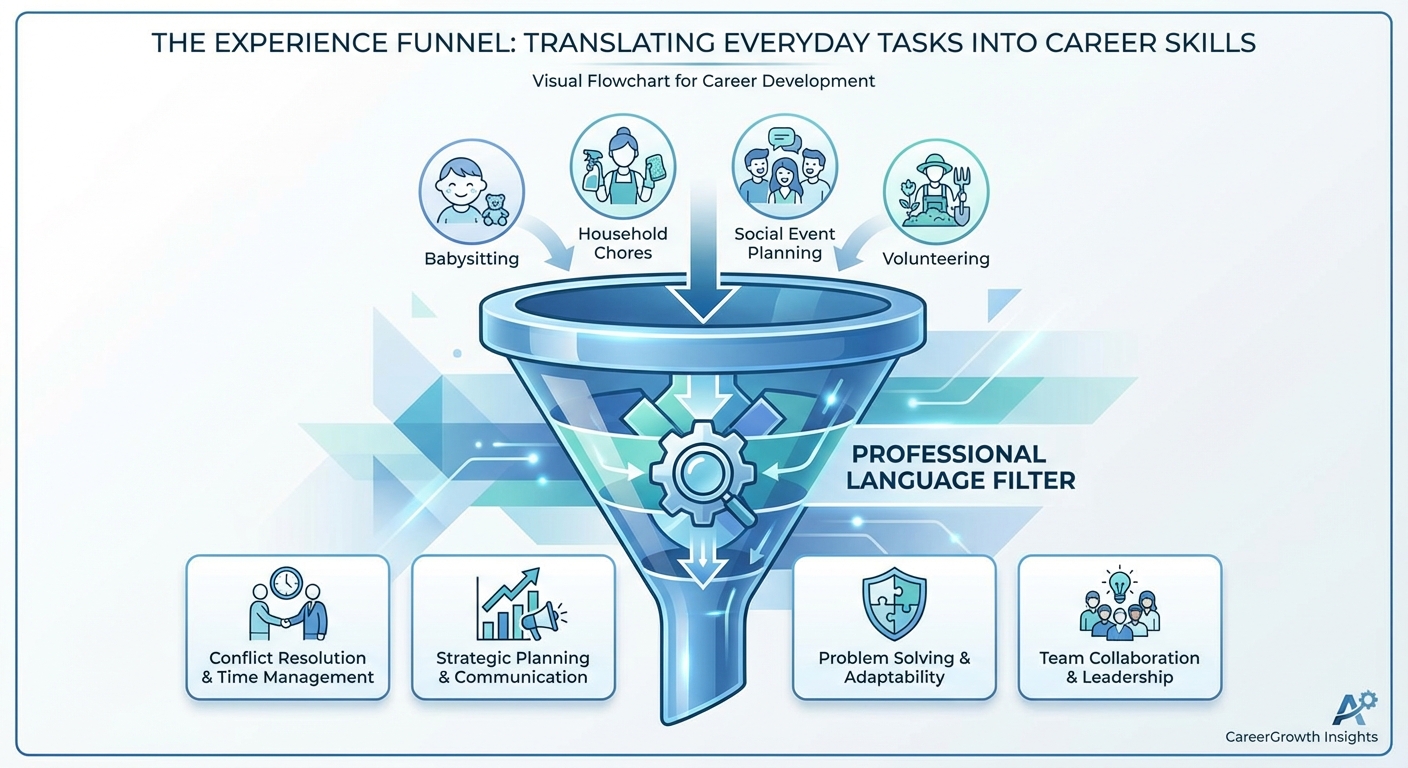
A visual flowchart showing 'The Experience Funnel' , taking raw activities like 'Babysitting' and filtering them through 'Professional Language' to output 'Conflict Resolution & Time Management'
How do I prove my value without a track record?
Use a strong objective statement and a dedicated skills section to bridge the gap between your raw potential and the specific job requirements.
This is where you make your sales pitch. Since you can't point to past wins at a company, you have to point to your toolkit.
You need a mix of hard skills (teachable abilities like coding or foreign languages) and soft skills (people skills).
But be careful. Everyone says they are a "hard worker." That is fluff. It means nothing. You need to substantiate your claims.
Our recent data shows 73% of hiring managers prioritize adaptability and problem-solving over technical prowess for entry-level roles. They know they can train you on the software. They can't train you to have a good attitude.
Here is how to translate your life into a professional resume language:
| Your Activity | The Resume Skill | How to Phrase It |
|---|---|---|
| Playing video games competitively | Strategic Planning | "Collaborated with a team of 5 to execute real-time strategies under high-pressure conditions." |
| Babysitting neighbors' kids | Crisis Management | "Managed daily schedules and resolved conflicts for three children while ensuring safety protocols." |
| Writing a personal blog | Content Creation | "Researched and produced weekly articles focused on niche topics, growing readership by 20%." |
| Planning a family reunion | Logistics & Budgeting | "Coordinated travel and accommodation for 40+ attendees while adhering to a strict financial budget." |
See the difference? It isn't lying. It is reframing.
You should also consult the U.S. Department of Labor resources for accurate descriptions of skills required for different industries. It helps you use the right buzzwords.
What are the biggest rookie mistakes to avoid?
Avoid padding your resume with fluff or irrelevant hobbies just to fill space; clean white space is always better than nonsense.
When you feel insecure about your experience, the temptation is to clutter the page. You might try to make the font size 14. Or list "watching Netflix" as a hobby.
Please don't.
One of the biggest resume mistakes to avoid is failing to proofread. If you have no experience, your resume is your only work sample. If it has a typo, you are telling the manager that your best work is sloppy.
Also, avoid generic email addresses. `skaterboi2002@hotmail.com` won't cut it. Get a fresh Gmail account with your name.
And finally, customize it. We know it is a pain. But sending the exact same document to 50 companies rarely works. Read the job description. If they ask for "organization," make sure that word appears in your profile.
Not sure if you hit the mark? Run your draft through our Resume Checker. It scans your document like an Applicant Tracking System (ATS) would and tells you exactly what is missing.
Key Takeaways
- Format matters: Use a hybrid or functional format to hide gaps and highlight skills.
- Mine your life: School projects, volunteering, and odd jobs are valid experience if you describe them professionally.
- Quantify everything: Use numbers (budget sizes, hours worked, grades) to make your achievements real.
- Proofread obsessively: A resume with no experience must be technically perfect to show attention to detail.
- Use the right keywords: tailored resume tips only work if you match the language of the job description.
Starting from zero is scary. But remember that every CEO, Director, and Manager started with a blank page too. You have the raw materials. Now go build the resume.