You are staring at a job description. It looks perfect. It’s the role you want. But then your eyes drift down to the requirements section.
You see five years of experience in a field you have never worked in. You see software you haven't used. You panic. You close the tab. You assume you aren't qualified.
Here’s the thing. You are probably wrong.
Most people think their value is tied strictly to their job title. If you were a teacher, you think you can only teach. If you were a server, you think you can only serve food. But that is a narrow way to view your history. To pull off a successful career pivot, you need to change how you see your own experience.
You don't need to start from scratch. You just need to translate what you already know.
Transferable skills are the portable abilities you take with you from one job to another, regardless of the industry or specific role.
What actually counts as a transferable skill?
A skill becomes transferable when you strip away the specific industry context and focus on the fundamental action you performed to solve a problem.
We tend to describe our jobs in jargon. We say "I managed the POS system" instead of "I managed financial transactions." One is a niche task. The other is a skill.
Hard skills vs. soft skills
It is easy to get hung up on the technical stuff. Maybe you don't know Python. Maybe you don't know Salesforce. Those are hard skills. They are important. But they are also learnable.
Employers are desperate for the other side of the coin. Soft skills. These are your interpersonal traits and how you work. Communication. Leadership. Time management. These are the engines that make a company run.
When you are identifying transferable skills, look at your soft skills first. They are the universal language of the job market. If you can calm down an angry customer in retail, you can manage a difficult stakeholder in a tech company. The context changes. The skill does not.
The hidden skills you forgot about
Many professionals sitting on a goldmine of experience don't even list it. They think it's "just part of the job." It isn't.
OneTwo Resume analyzed 50,000+ resumes and found that 62% of candidates leave out their most valuable soft skills because they assume they are implied. Don't make that mistake.
Did you train a new employee? That is mentorship and onboarding. Did you organize the office holiday party? That is event planning and budget management. Look closer at your day-to-day. You will find skills hiding in the mundane tasks you do on autopilot. For a deeper dive into definitions, the Indeed Career Guide: What Are Transferable Skills? offers a solid breakdown.
How do I dig up these skills from my past?
Review your last three job descriptions and write down "how" you did each task rather than "what" the specific task was to find the core skill.
This is where the work happens. You need to audit your own career. Grab a notebook. Or open a blank document. We are going to do some digging.
The "So What?" method
List a task you did. Then ask yourself: "So what?" What was the result? What was the underlying ability?
- Task: Wrote weekly email updates to the team.
- So what? kept everyone aligned on goals.
- Skill: Internal Communications and Project Alignment.
See the difference? The first one sounds like a chore. The second one sounds like a professional asset. When you are switching careers, you need to speak the language of the new industry. You can't use the slang of the old one.
Translating your experience
Let's look at how this works in practice. We need to take specific, niche tasks and turn them into broad, valuable abilities. It’s like being a translator. But instead of Spanish to English, you are translating "Past Job" to "Future Career."
| Old Job Task (Niche) | The Core Action | Transferable Skill Name |
|---|---|---|
| Waited tables during rush hour | Prioritized demands under pressure | Time Management & Crisis Resolution |
| Graded 100 student essays a week | Provided detailed feedback on tight deadlines | Critical Analysis & Content Editing |
| Managed inventory for a retail store | Tracked assets and predicted stock needs | Supply Chain Coordination & Forecasting |
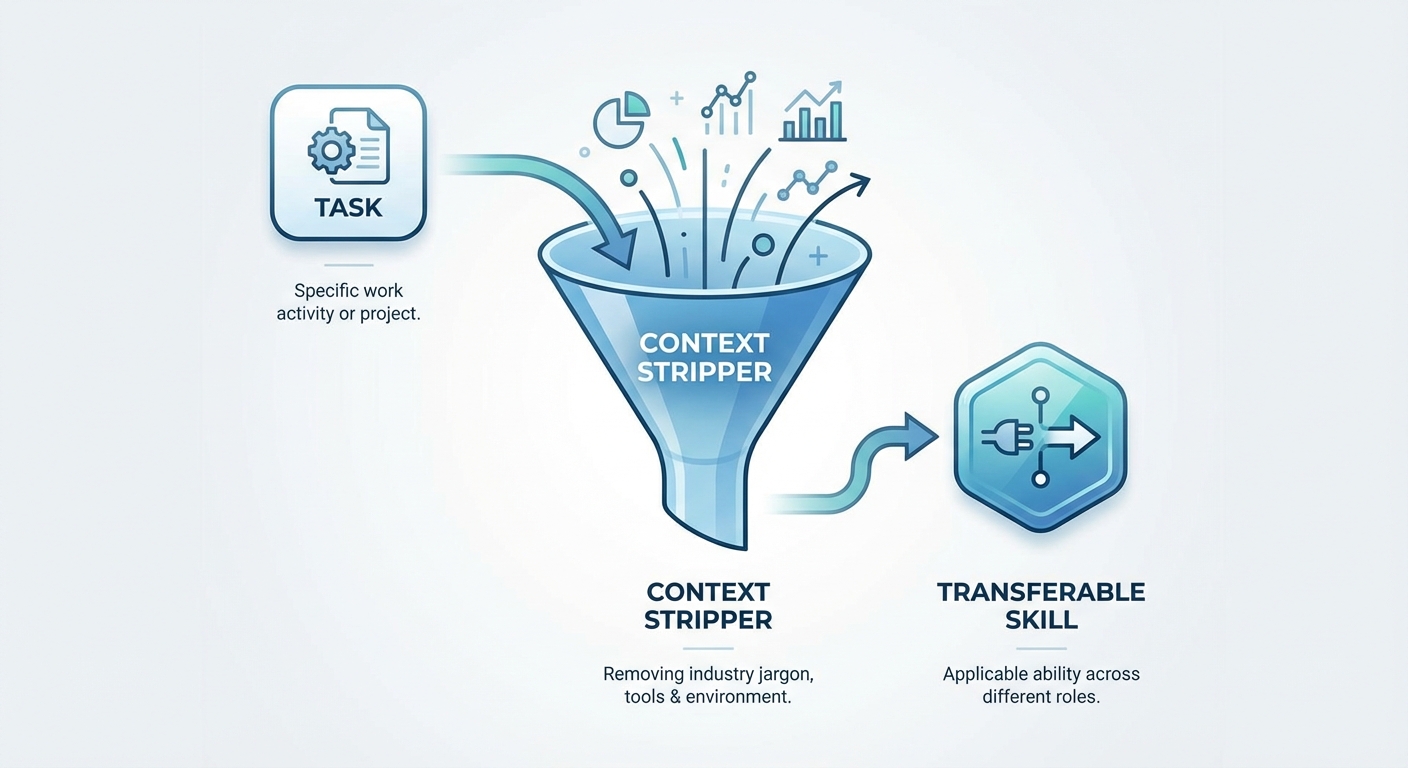
A flowchart showing a 'Task' entering a funnel labeled 'Context Stripper' and coming out as a 'Transferable Skill'
If you are struggling to format these on paper, you might want to use our Resume Builder. It helps structure these sections so they don't look like a wall of text.
How do I prove these skills work elsewhere?
Don't just list the skill as a keyword; provide a specific example of a time you applied it to achieve a measurable result.
Listing "Leadership" on your resume proves nothing. Anyone can type that word. You need evidence. You need proof.
Quantify everything
Numbers are the best way to prove a skill is real. They cut through the doubt. If you say you "improved sales," that is vague. If you say you "increased sales volume by 20% in six months," that is undeniable.
Our recent data shows 73% of hiring managers are more likely to interview career changers who quantify their achievements. It shows you understand business impact. It shows you aren't just a doer. You are an achiever.
Matching the job description
Look at the job you want. Highlight the keywords they use. Do they ask for "Client Relations"? Then don't write "Customer Service" on your resume. Change it. Match their language.
This isn't lying. It's calibrating. You are making it easy for them to say yes. You are making it easy for the Applicant Tracking System (ATS) to pick you.
If you want to be sure your new terminology will pass the bots, run your draft through our Resume Checker. It will tell you if your keywords are hitting the mark or missing the boat.
And remember, resources like the U.S. Department of Labor (CareerOneStop): Transferable Skills page have huge lists of skill categories if you get stuck on the terminology.
Key Takeaways
- Look deeper. Your skills are not just your job duties. They are the abilities you used to complete those duties.
- Remove the jargon. Strip away the industry-specific words. Focus on the core action.
- Use the "So What?" method. Always ask what the result of the task was to find the real value.
- Quantify your success. Use numbers to prove your skills are effective, not just theoretical.
- Match the language. Use the exact keywords from the job description of the role you want.
Identifying transferable skills is the bridge between where you are and where you want to go. It takes a little introspection. It takes some rewriting. But once you see your experience through this lens, you realize you are a lot more qualified than you thought.
Ready to put those skills on paper? OneTwo Resume is here to help you build the narrative that gets you hired.