Look, switching jobs is terrifying. It gets even scarier when you feel like you are starting from scratch. But you aren't. You have a massive toolkit of abilities you just haven't labeled correctly yet — and learning the label is most of the work.
In short: transferable skills are abilities you build in one job that hold their value in any other — communication, leadership, analysis, planning, client handling — as opposed to job-specific skills like operating one company's software. Employers screen for them because tools can be taught in weeks while judgment takes years. You find yours by breaking past roles into the underlying actions, and you present them by translating old-industry language into the target field's vocabulary.
What exactly are transferable skills?
Transferable skills are portable abilities — like communication, leadership, and problem-solving — that travel with you from job to job regardless of your specific title.
Hard skills versus soft skills
Think about your skills in two buckets. Hard skills are technical: coding in Python, operating a forklift, reconciling ledgers. Soft skills are how you operate as a human: managing time, handling an angry client, leading a team through a crisis. Both kinds transfer — data analysis follows you as surely as diplomacy does — but the soft bucket transfers furthest, because technical stacks change every few years and good communication never goes out of style.
Why employers care so much
Employers are tired of hiring technical experts who cannot work on a team. They know they can teach you the software; they cannot teach you work ethic or emotional intelligence. If you can prove you possess these core traits, you immediately become a top-tier candidate — this is what the shift toward skills-based hiring means in practice.
What are examples of transferable skills? The list
Forty commonly requested transferable skills, grouped the way job postings actually ask for them.
| Category | Transferable skills |
|---|---|
| Communication | Writing, presenting, active listening, plain-language explanation, negotiation, giving feedback, cross-team translation |
| Leadership & people | Team leadership, mentoring, delegation, conflict resolution, performance conversations, onboarding others |
| Analysis & problem-solving | Data analysis, research, root-cause analysis, prioritization under constraints, forecasting, process troubleshooting |
| Organization & delivery | Project management, scheduling, budgeting, vendor coordination, documentation, meeting deadlines repeatedly |
| Client & stakeholder | Client relations, de-escalation, expectation management, stakeholder mapping, retention, service recovery |
| Adaptability | Learning new tools fast, working through ambiguity, handling change, cross-training, working across cultures |
| Technical (portable) | Spreadsheets, SQL basics, CRM systems, reporting dashboards, basic automation, record-keeping compliance |
Nobody claims all forty. Pick the six to eight where you have stories with results, and build your materials around those.
How do you uncover your hidden abilities?
You find your hidden talents by breaking your daily tasks down into the fundamental actions required to complete them.
Do a deep audit of your past roles
Grab a blank piece of paper. Write down your last three jobs. Under each, list every annoying, tedious, or complex task you handled every week — then ask what it actually took to do that task well.
Did you answer phones at a busy clinic? You were not just answering phones. You were practicing rapid triage, de-escalating frustrated patients, and managing a complex, fast-paced schedule. That is crisis management. That is client relations.
Ask your coworkers for honest feedback
We are notoriously bad at judging our own strengths. What feels easy to you might feel impossible to someone else. Take a former coworker out for coffee and ask what you were naturally best at. They might point out that you were always the one who calmed the boss down — that is stakeholder management. They might mention you always fixed the broken spreadsheets — that is data analysis.
Use professional assessment tools
Sometimes you need a totally objective opinion. A great free starting point is the CareerOneStop Skills Matcher (U.S. Department of Labor), which rates your current skill levels and matches them to potential career paths.
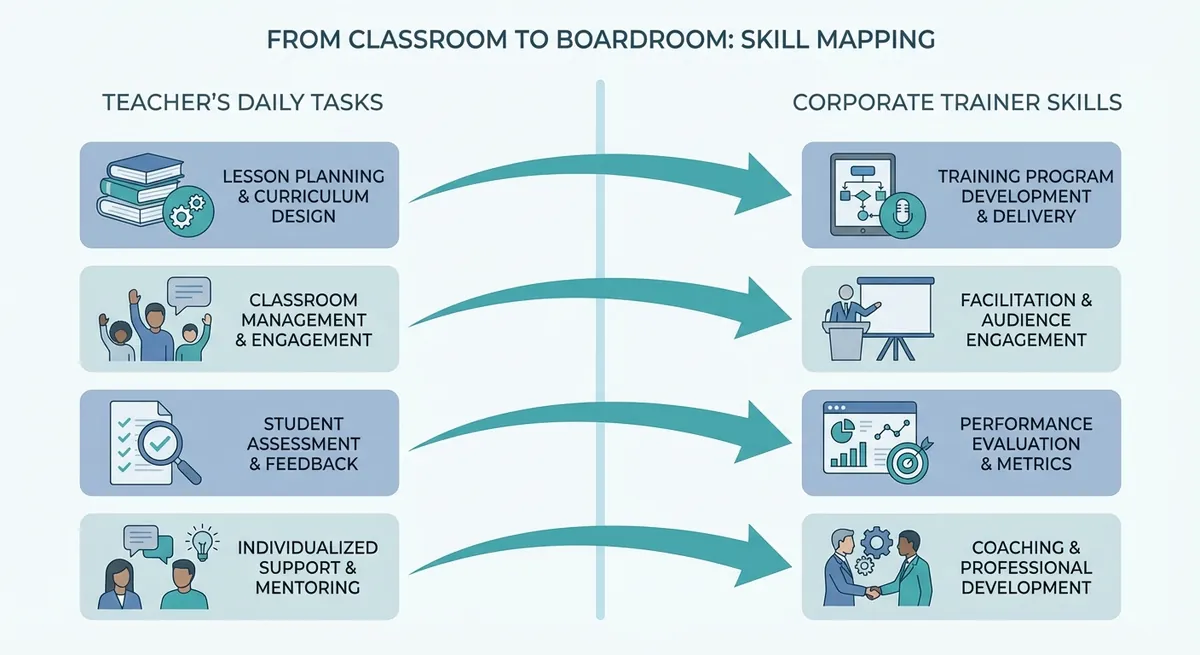
A split-screen visual showing a teacher's daily tasks on the left, mapping directly to corporate trainer skills on the right using connecting arrows.
How do you put transferable skills on a resume?
Your resume must translate your past experience into the language of your future employer. Connect the dots so they do not have to guess.
Rewrite your bullet points completely
Your resume is a marketing document, not a legal biography. When assembling it in a resume builder, focus on results, and swap old-industry jargon for the transferable action underneath:
| Old industry phrase | Transferable skill | New industry translation |
|---|---|---|
| Managed classroom of 30 kids | Leadership | Led daily instruction and assessment for a 30-person group |
| Balanced cash register | Attention to detail | Reconciled daily financial records with zero-discrepancy standard |
| Handled customer complaints | Conflict resolution | Managed client escalations through to documented resolution |
The bullet point rewriter automates exactly this translation, line by line — and never let a skills section do the work alone: a skill without a story is a keyword, and interviewers ask for the story.
Test your new vocabulary
Run the updated document through a resume checker to confirm you hit the target industry's keywords. If you do not change your words, you will not get the interview.
Remember that age and experience are advantages
Worried about pursuing a change at 40 or later? You bring professional maturity a fresh graduate cannot: navigating office politics, showing up reliably, sending the email that defuses instead of ignites. Companies pay for that stability — the age-specific mechanics are in career change at 40 and career change at 50.
Key takeaways
- Transferable skills are portable abilities that hold value in almost any industry; soft skills transfer furthest.
- Use the category list above to name yours — then keep the six to eight with result-backed stories.
- Break daily tasks down to find the root skills; ask former coworkers what you were best at.
- Translate old jargon into the target field's language and verify it with a checker.
- Experience is an advantage to be marketed, not an obstacle to be excused.
Changing paths is never simple, but it is entirely possible when you market yourself correctly — the full playbook is in how to change careers without starting over. And when you are ready to put it all together, OneTwo Resume can help you craft the document for your next act.