Staring at a blank screen is the worst. You want a job. But the job wants experience. It's the classic catch-22. How do you get experience without a job? Take a deep breath. You don't need to sweat it. Truth is, you already have plenty of material. You just need to know how to package it into a professional resume.
Focus your resume on academic projects, volunteer work, and specific hard skills instead of traditional employment history to prove your value to an employer.
How do you write a first job resume?
A first job resume puts what you have done in place of the work history you don't have yet. Start with your contact details and a two-line objective naming the job you want, then put education at the top, followed by skills the job posting asks for, and then projects, volunteer work, school activities and part-time or informal jobs written as bullets with results. Keep it to one page. Temple University's career center makes the same point for students building their first resume: skills are gained in all types of jobs, so don't restrict the resume to work that matches your studies (Temple University Career Center, checked October 5, 2026).
A first job resume, top to bottom:
JORDAN LEE
City, State · (555) 555-0100 · jordan.lee@email.com

OBJECTIVE
High school senior seeking a part-time retail associate role; reliable
weekend availability and two years of cash-handling experience at school events.

EDUCATION
Lincoln High School, City, State — Expected June 2027

SKILLS
Cash handling · Customer service · Microsoft Excel · Spanish (conversational)

EXPERIENCE AND ACTIVITIES
Treasurer, Lincoln High Student Council — 2025–present
- Tracked ticket sales and counted the cash box for six school events
Volunteer, City Food Bank — Summer 2025
- Sorted and shelved donations for weekly distribution days
Every name and number above is a placeholder; use your own. If you are still in school, write your expected graduation date on the education line, and see what to put on a resume for the full list of sections.
What should a zero-experience resume actually look like?
The best layout for beginners puts education and core skills at the very top of the page. This immediately draws attention to your potential and training instead of a lack of formal work history.
Picking your structure
A blank page is intimidating. But choosing a modern resume format makes everything easier. Standard chronological layouts fail when you have no work history. They just highlight empty space. You need a functional or hybrid format instead. These structures let you group your abilities by category.
Put your education section right at the top. Follow it with a dedicated skills section. It changes the conversation entirely. You force the hiring manager to look at what you can do rather than what you haven't done yet. Keep the fonts clean and readable. Use standard margins.
Nailing your introduction
Your summary sits at the very top. It's your elevator pitch. Please don't write an outdated objective statement about what you want from the company. Write about what you offer them. You can find plenty of great resume summary examples online to guide you.
A strong summary for a beginner might look like this. "Detail-oriented marketing graduate with hands-on experience running social media campaigns for university organizations. Certified in Google Analytics with a proven ability to increase engagement rates."
See the difference? It sounds exactly like a professional resume. It's confident and specific.
How do you prove you can do the job?
You must treat your academic assignments, personal hobbies, and unpaid volunteer roles exactly like real jobs. Give them measurable results and outline specific outcomes.
Redefining experience
Experience doesn't just mean paid work. Not by a long shot. Did you build a website for fun? That counts. Did you manage the budget for your fraternity or sorority? That counts too. You need to think entirely outside the box.
And you need to match your skills to the real world. A great trick is to look up your target job in the Occupational Outlook Handbook. Read the exact daily duties required for that career. Then match your school projects or hobbies to those specific duties.
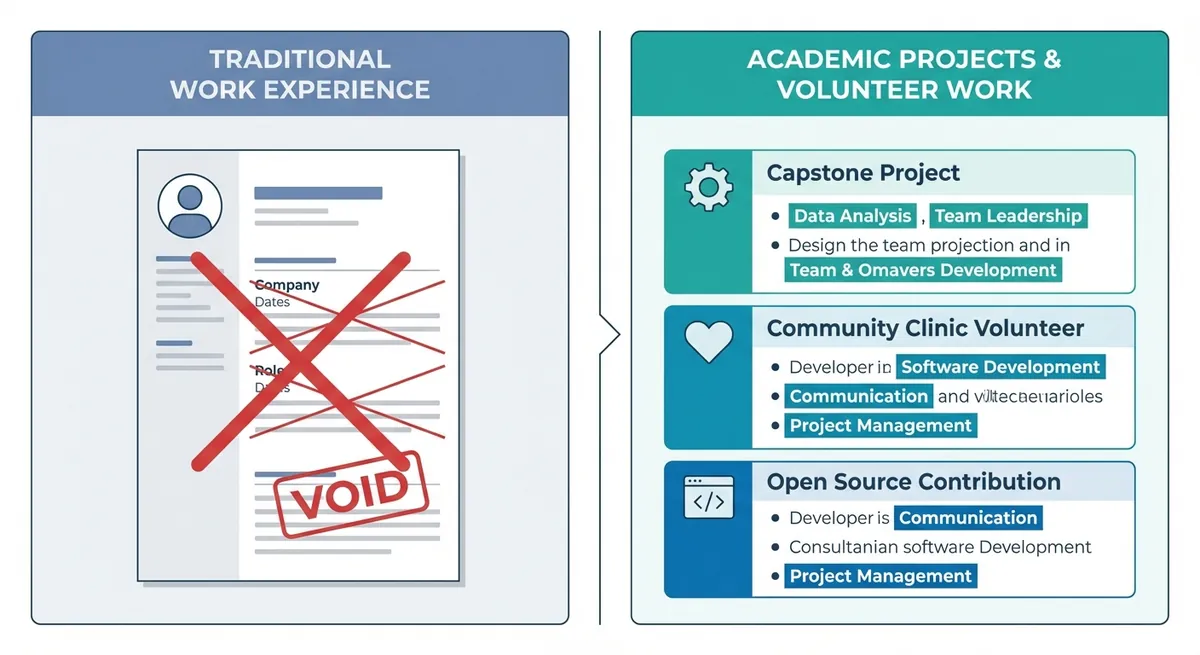
A split-screen visual showing a traditional blank 'Work Experience' section crossed out on the left, compared to a robust 'Academic Projects & Volunteer Work' section on the right, highlighting skill keywords.
Making your education work harder
Your degree is your biggest asset right now. Make it work for you. Don't just list your university and graduation year. Include your GPA if it's above 3.5. List highly relevant coursework. Mention any honors, awards, or specialized training.
This builds out your professional resume beautifully. It proves you can commit to long-term goals. It shows you can hit deadlines. To a hiring manager, a four-year degree is proof that you are trainable and disciplined. Don't sell it short.
What are the biggest red flags to watch out for?
Hiring managers will often forgive a lack of formal experience. But they will automatically reject your application for spelling errors, vague bullet points, or sloppy formatting.
Dodging common traps
You need to know the biggest resume mistakes to avoid. The most common trap is adding fluff. Beginners often try to fill the page with generic words like "hard worker" or "team player." Nobody cares. They want proof. If you are a team player, show them a project where you led a team.
You absolutely need data. If you raised money for a charity, state exactly how much. If you managed a social media account, state the follower growth.
If you're worried about your formatting falling apart, you can always use a dedicated Resume Builder to keep things perfectly aligned. A clean design is half the battle.
Writing better bullet points
Look, good bullet points are the backbone of a professional resume. They need action verbs. They need specific metrics. Look at how you can transform basic statements into powerful achievements.
| Weak Bullet Point | Strong Bullet Point | Why It Works |
|---|---|---|
| Helped with a school project | Led a 4-person team to research and present a 20-page marketing plan | Uses numbers and shows leadership |
| Ran social media | Grew Instagram following by 35% over three months | Includes specific metrics and timelines |
| Volunteered at shelter | Organized weekly inventory for a shelter serving 50+ daily visitors | Quantifies the exact scale of the work |
Getting past the applicant tracking systems is another major hurdle. These robots scan your document before a human ever sees it. You can run your document through a Resume Checker to make sure it reads perfectly for the software. If the robot can't read it, the hiring manager won't see it.
Key Takeaways
- Format matters immensely. Put your education and skills at the top of the page.
- School projects count. Treat major academic assignments like actual jobs.
- Numbers win every time. Always use metrics to describe your volunteer work or hobbies.
- Skip the fluff. Avoid generic terms and focus on provable hard skills.
- Proofread everything. A single typo can ruin your chances of getting a call.
Writing your first professional resume takes time. But you have the skills. You have the background. You just need to structure it right. If you want a head start, let OneTwo Resume help you format everything perfectly so you can start applying with total confidence.