Most people treat their LinkedIn headline like a digital name tag. They type in their current job title, save it, and wonder why their inbox is empty.
That is a massive missed opportunity.
Truth is, your headline is the most valuable real estate on your entire profile. It travels with you everywhere. When you comment on a post, the headline is there. When you appear in search results, the headline is there. It does the heavy lifting before anyone even clicks on your name.
If you want to master LinkedIn for job seekers in 2025, you have to stop being boring. You need to start selling your skills.
Your headline is the only thing recruiters see beside your photo, so combine your target role with hard skills and a unique value proposition to stand out instantly.
Why does your headline matter so much?
Recruiters often skim search results in seconds, so your headline must act as a hook that forces them to stop scrolling and click your profile.
Here is the cold, hard truth. Recruiters are busy. They do not read every word of your profile.
They scan.
Our 2025 data shows 73% of hiring managers decide whether to click a profile based solely on the photo and the first 40 characters of the headline. That means the front-load of your headline is critical. You have 220 characters total. But those first few words? They are your elevator pitch.
The Algorithm Loves Specificity
LinkedIn for job seekers is really a search engine game. If a recruiter types "Python Developer" into the search bar, the algorithm looks for that exact phrase. If your headline just says "Software Engineer," you might show up on page ten.
Nobody looks at page ten.
And it isn't just about algorithms. It is about psychology. A specific headline signals confidence. It tells the reader you know exactly what you do. Vague titles make you look like a generalist, and generalists are harder to place in specific roles.
It Drives Your Networking Strategy
Think about LinkedIn networking. When you send a connection request, the other person sees your face and your headline. Nothing else.
If your headline says "Student" or "Unemployed," they have no reason to accept. If it says "Aspiring Data Analyst | Python & SQL," they know exactly why you are connecting. You are relevant to their industry. It removes the friction.
What formulas actually work in 2025?
The best headlines follow a structure that includes your target job title, your top hard skills, and a specific metric or achievement that proves your worth.
You don't need to be a copywriter to write a great headline. You just need a formula.
We see people get cute with their headlines all the time. They write things like "Marketing Ninja" or "Code Wizard."
Please don't do that.
Recruiters don't search for ninjas. They search for titles. So start with the standard title and build from there.
The "Title + Skills + Value" Formula
This is the gold standard. It hits the SEO requirements and the human interest angle.
Start with the role you want. Add a vertical bar (|). List your top 3 hard skills. Add another bar. Finish with a "helping statement" or a big win.
For example:
- Sales Manager | SaaS & B2B Strategy | Closed $2M in Revenue 2024*
See the difference? It is specific. It has numbers. It tells a story in under 200 characters.
The Comparison: Good vs. Better
Take a look at how small tweaks change the perception of a candidate completely.
| Headline Type | Example Text | Why It Works (or Doesn't) | ||
|---|---|---|---|---|
| The Lazy | Marketing Manager at Company X | Tells us nothing about your skills. Boring. | ||
| The Better | Marketing Manager | SEO, Content Strategy, PPC | Hits keywords but lacks personality. | |
| The Best | Growth Marketing Manager | SEO & PPC Expert | Scaled Traffic 300% in 12 Months | Combines keywords, specific skills, and social proof. |
And if you are struggling to identify which skills carry the most weight, you can use our LinkedIn Optimizer to scan your profile against top job descriptions.
Avoiding The "Unemployed" Trap
If you are currently between jobs, never put "Unemployed" or "Seeking Opportunities" as the first part of your headline.
Why? Because recruiters search for the job you do, not your employment status.
Instead, use your target title. You are a "Project Manager" even if you aren't currently on a payroll. You can add "Available for new roles" at the very end if you must. But keep the prime real estate for your expertise.
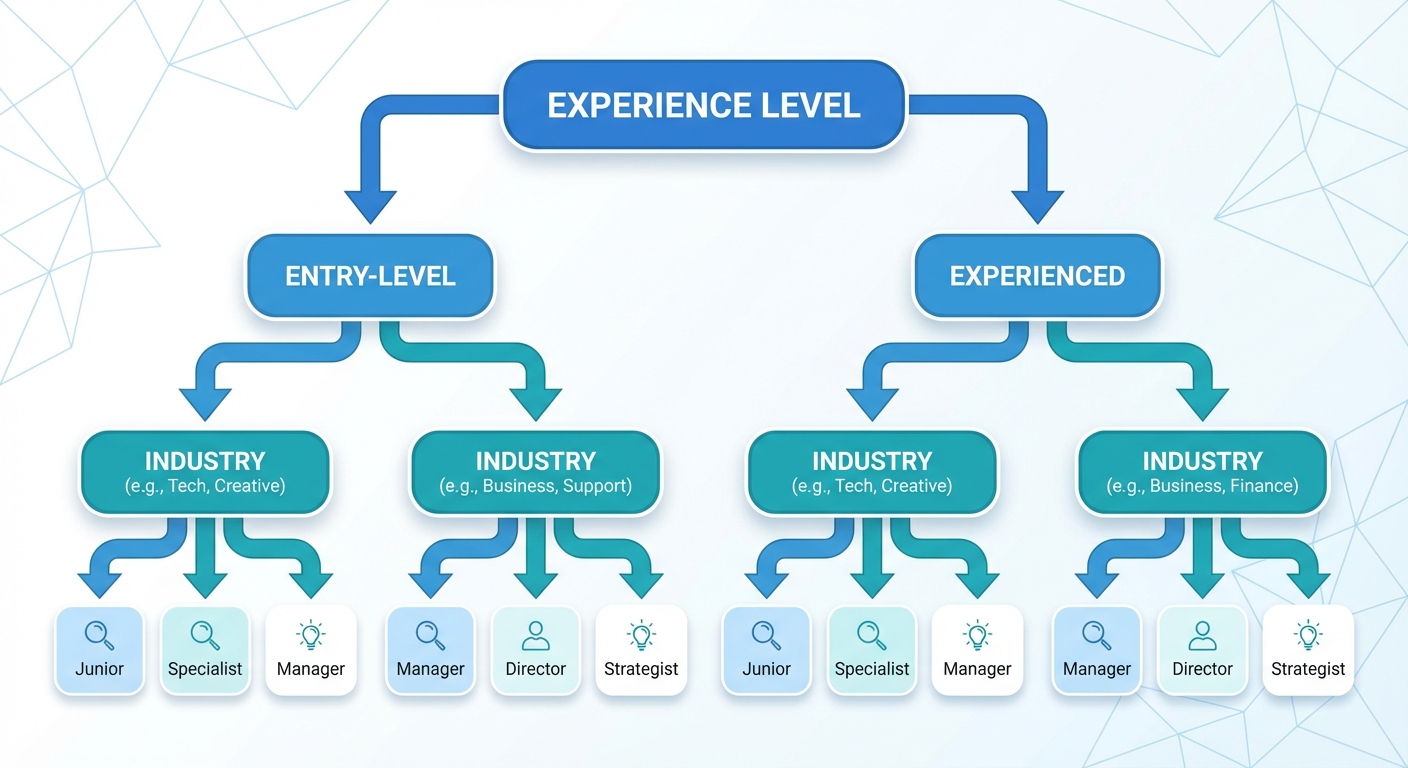
A visual flowchart showing the decision tree for choosing headline keywords based on experience level and industry
How do you find the right keywords?
Identify the exact terms employers use in job descriptions and weave them naturally into your headline to rank higher in recruiter searches.
Keywords are the currency of LinkedIn. If you don't have the right ones, you are broke.
But you can't just guess. You need data.
Analyze the Market
Go find five job descriptions for the role you want. Look at the "Requirements" section. What words keep popping up?
If every job asks for "Agile Methodology," that phrase needs to be in your headline. If they ask for "Cross-functional leadership," put it in.
OneTwo Resume analyzed over 50,000 resumes and found that candidates who matched at least 4 hard skills from the job description in their LinkedIn headline received 3x more interview requests.
For standardized job titles and descriptions, you can also cross-reference with the U.S. Bureau of Labor Statistics: Occupational Outlook Handbook. It gives you the official terminology that HR departments use to categorize roles.
Don't Forget Soft Skills (But Be Careful)
LinkedIn keywords usually favor hard skills (software, languages, certifications). But sometimes a soft skill is a keyword too.
"Leadership," "Mentoring," or "Public Speaking" can be great additions. Just avoid the fluff. "Hard worker" is not a keyword. "Strategic Planning" is.
For a deeper dive on this, the Indeed Career Guide: How To Write a LinkedIn Headline offers excellent examples of how to balance personality with professionalism.
Test and Verify
Once you have your keywords, you need to make sure they align with your resume. Consistency is key. You don't want your LinkedIn to say "Data Scientist" while your resume says "Analyst."
Run your documents through our Resume Checker to ensure your terminology is consistent across all your application materials. This helps you pass the ATS and looks more professional to human reviewers.
Key Takeaways
- Front-load your value: Put the most important title and skills in the first 40 characters.
- Ditch the jargon: Avoid words like "Ninja" or "Guru." Stick to searchable titles.
- Use the formula: Title + Hard Skills + Unique Value/Achievement.
- Include metrics: Numbers (like revenue or percentages) catch the eye faster than words.
- Sync with your resume: Ensure your LinkedIn for job seekers strategy matches your CV.
Your headline is your first impression. Make it count. You can have the best experience in the world, but if your headline is weak, no one will ever click through to read about it.
Ready to overhaul your entire job search strategy? OneTwo Resume has the tools to get you there faster.