Look, applying for jobs online can feel like throwing paper airplanes into a black hole. You spend hours tweaking your bullet points. You hit submit. And then you hear absolutely crickets. You just get ghosted. It is incredibly frustrating.
Update your profile with the exact job titles you want and turn on the Open to Work feature to instantly notify recruiters.
But here is the truth. Successful job seekers don't just apply to open roles. They make sure hiring managers find them first. You need a simple strategy. You don't need to spend eight hours a day scrolling through feeds. You just need to know how the system actually works.
How do you make recruiters come to you?
Recruiters search the platform like a massive database using specific skills. If those exact terms are missing from your page, you simply won't show up in their search results.
The power of your summary
Your LinkedIn headline is the most important real estate on your page. Most people just leave it as their current job title. That is a huge mistake. Why does this matter? Because your headline follows you everywhere. It shows up in search results, comments, and connection requests. You want to tell people exactly what you do and the value you bring in one quick glance. Mix your job title with a short phrase about your specific expertise.
Mastering the search algorithm
You have to think exactly like a recruiter. According to the LinkedIn Talent Blog, sourcing candidates is all about filters. Recruiters filter by location, job title, and specific technical skills.
This is why you need to use the right LinkedIn keywords throughout your page. OneTwo Resume analyzed 50,000+ resumes and found that 82% of candidates completely ignore the skills section on their online profiles. That means you can beat the competition just by filling it out. Sprinkle relevant LinkedIn keywords in your experience section, your summary, and your skills list.
The "Open to Work" feature
Turn it on today. You can set it to only show to recruiters if you are worried about your current boss finding out. It works. It puts a literal green flag on your profile for the people actively looking to hire.
What are the best ways to network without being annoying?
Build genuine relationships by engaging with content from people at your target companies. A thoughtful comment on a post is worth ten generic cold connection requests.
Stop sending generic connection requests
We have all seen them. The completely blank connection request from a total stranger. Don't be that person. Always add a short note. Keep it brief. Tell them why you want to connect. Maybe you admire their career path. Maybe you read an article they wrote. Just be a normal human being.
Engage with company updates
Here's the thing. People love it when you interact with their content. Follow the companies you want to work for. When their employees post, leave a smart comment. Ask a question. Add a new perspective. This gets your name in front of them organically.
Use your alumni networks
People genuinely love helping people from their alma mater. It is basic human nature. OneTwo Resume user data reveals that candidates who message alumni get a 40% higher response rate compared to totally cold outreach. Before you reach out to a fellow grad, make sure your page looks highly professional. Run your text through our LinkedIn Optimizer to ensure you are putting your best foot forward before hitting send.
How should you structure your profile for maximum impact?
Treat your page like a dynamic portfolio rather than a static digital resume. Focus on measurable achievements and clear formatting that makes scanning easy for busy hiring managers.
Nailing the about section
This is where you tell your actual story. The best LinkedIn profile tips always mention showing some personality right here. Don't just paste your cover letter into the text box. Write in the first person. Explain why you love your industry and what makes you good at your job.
Proving your worth with data
Our recent data shows 73% of hiring managers instantly skip profiles that lack specific metric-driven results. You absolutely need numbers. Did you increase sales by 20 percent? Say that. Did you manage a budget of two million dollars? Put it in there. Finding the right LinkedIn keywords doesn't have to be hard when you naturally describe your quantifiable wins.
Aligning your resume and profile
Your profile and your actual resume need to tell the exact same story. But they shouldn't be identical clones. Use the Bureau of Labor Statistics: Occupational Outlook Handbook to research the exact terminology used in your target industry.
Then, strategically incorporate those specific LinkedIn keywords into your experience descriptions. Finally, put your traditional document through a Resume Checker to make sure everything matches up perfectly. Consistency builds trust.
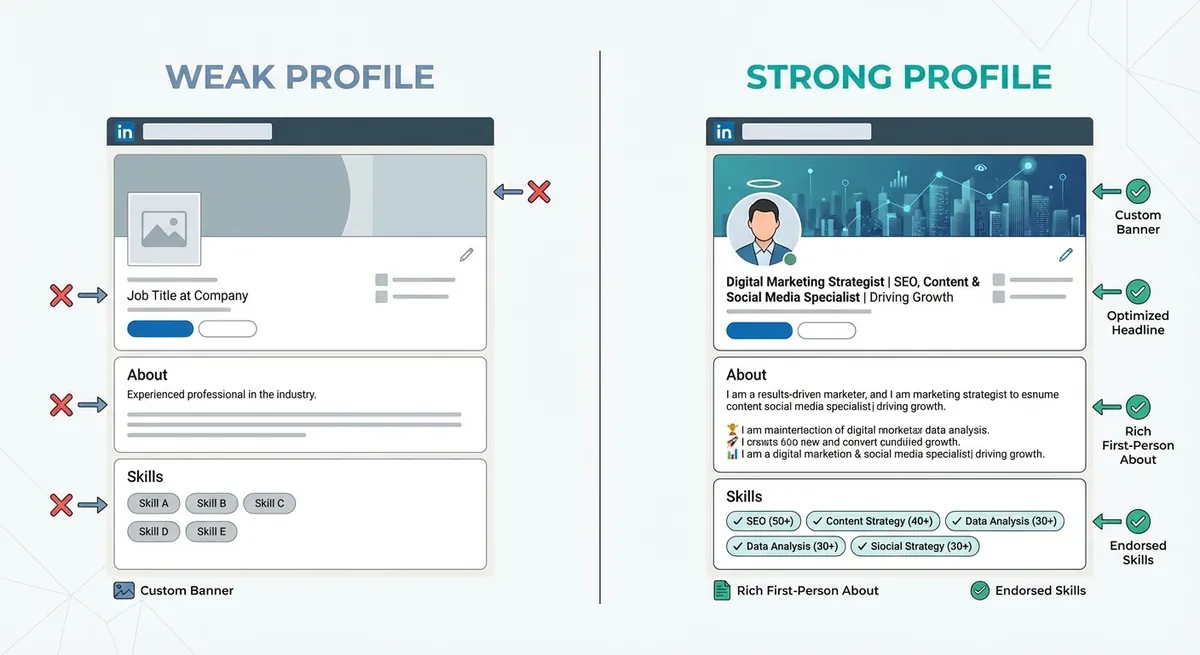
A side-by-side comparison of a weak LinkedIn profile versus a strong one, pointing out key areas like the custom banner image, an optimized headline with keywords, a rich first-person about section, and a fully endorsed skills list.
Understanding outreach strategies
Not all networking efforts are created equal. You have a limited amount of time. You need to spend it where it actually counts.
| Strategy | Effort Level | Expected Results |
|---|---|---|
| Blank connection requests | Low | Very Poor |
| Commenting on industry posts | Medium | Good |
| Direct messaging shared alumni | High | Excellent |
Key Takeaways
- Your headline is your digital billboard. Make it descriptive and clear.
- Recruiters search using specific terms. You must include relevant skills in your profile text.
- Don't send blank connection requests. Always include a short, polite note.
- Use numbers and metrics to prove your past success.
- Ensure your online profile and traditional resume tell a cohesive story.
Truth is, finding a job takes effort. But you don't have to do it completely blind. By optimizing your digital presence, you invite opportunities to come directly to you. If you need help getting your materials perfectly aligned, check out OneTwo Resume to build, score, and optimize your application documents fast.