Everyone tells you to "get on LinkedIn" if you want a new job. But that advice is vague. It's frustrating. You might have a profile, a photo, and a list of past jobs. Yet, your inbox remains empty. You aren't getting interviews.
Here is the reality. LinkedIn isn't just a digital resume. It is a massive search engine database. Recruiters use it to shop for talent. If you aren't on the shelf with the right label, they can't buy what you're selling. You need a strategy that goes beyond just clicking "Easy Apply" and hoping for the best.
To find a job on LinkedIn, you must optimize your headline with searchable skills, engage with industry content daily, and message connections for advice rather than immediate job offers.
Is your profile actually ready for recruiters?
Recruiters use software to scan for specific criteria, so if your profile lacks the right job titles and hard skills, you remain invisible regardless of your actual experience.
Think about how you use Google. You type in exactly what you want. Recruiters do the same thing. They don't search for "hard worker" or "visionary leader." They search for specific hard skills and titles. This is where LinkedIn keywords come into play.
We found that 62% of qualified candidates were rejected by screening software simply because they used creative job titles instead of standard industry terms. Don't be creative. Be clear.
The headline is prime real estate
Most people just put their current job title in their headline. That is a wasted opportunity. You have 220 characters. Use them.
Include your target role and your top 3 hard skills. If you are in marketing, don't just write "Marketing Manager." Write "Marketing Manager | SEO & Content Strategy | Google Analytics Certified." These are the LinkedIn keywords a recruiter types into their search bar. If you don't have them, you don't show up. It is that simple.
Also, check your dashboard. If you aren't appearing in search results, your keywords are wrong. You can use our LinkedIn Optimizer to see exactly which terms you are missing compared to the job descriptions you want.
Your summary is a pitch, not a bio
Your LinkedIn summary (the "About" section) is often the only thing a recruiter reads if they click your profile. Do not write it in the third person. It sounds distant. It sounds stiff.
Write like you speak. Explain what you do, how you do it, and the results you get.
Harvard Business Review highlights that recruiters are looking for context that a resume can't provide. They want to know your story. But keep it punchy. Use short paragraphs. Use bullet points for your achievements. Make it skimmable.
How do you find the hidden jobs?
The best roles often aren't posted on the main job board, so you need to follow company pages and connect with hiring managers to see posts about openings before they go public.
Browsing the "Jobs" tab is fine. But everyone else is doing that too. Competition there is fierce. You want to find the roles that haven't been flooded with 500 applications yet.
Search specifically, not broadly
When you use the search bar, don't just type "Project Manager." The results will overwhelm you. Use boolean search tactics. Put quotes around exact phrases. Use AND to combine requirements.
Example: "Project Manager" AND "SaaS" AND "Remote".
This filters out the noise. It helps you find roles that actually match your criteria. And remember to look for posts, not just jobs. Search for "hiring marketing manager" and filter by "Posts" from the last week. You will find hiring managers posting about open roles directly. These posts often get fewer applications than the official job listings.
Align your documents
Once you find a job, your application needs to be consistent. Your resume and your LinkedIn profile shouldn't look like two different people wrote them. But they shouldn't be identical copies either.
If there is a disconnect, they get suspicious. Ensure your dates match. Ensure your LinkedIn keywords appear in your resume too. You can use our Resume Builder to ensure your application documents are perfectly synced with your online presence.
| Feature | Resume | LinkedIn Profile |
|---|---|---|
| Purpose | Specific pitch for one job | General brand presence |
| Length | 1-2 pages strictly | Comprehensive history |
| Tone | Formal and objective | Conversational and personal |
| Visuals | Text-only (usually) | Rich media, photos, links |
Does networking actually work?
Cold messaging strangers rarely works, but engaging with their content first and asking for specific, low-pressure advice dramatically increases your response rate.
LinkedIn for job seekers often feels like shouting into the void. You send connection requests. No one accepts. It's discouraging. The problem is usually your approach.
The "warm" cold message
Never send a connection request without a note. Ever. And never ask for a job in that first note. It’s like asking someone to marry you on the first date. It’s too much. It scares people away.
Instead, find a commonality. Did you go to the same school? Do you share a mutual connection? Mention it. If you have nothing in common, engage with their posts first. Comment on an article they shared. Do this for a few days. Then connect.
Say something like: "Hi Sarah, I loved your post about AI in healthcare. I'm moving into that space and would love to follow your work here."
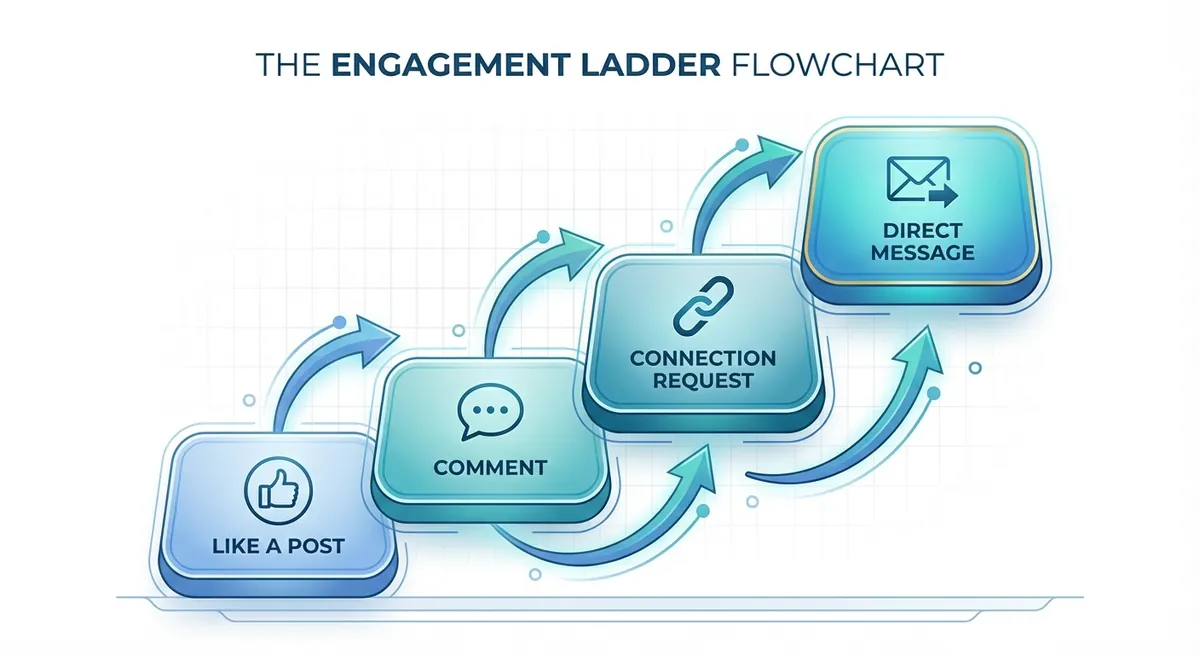
A flowchart showing the 'Engagement Ladder' starting from 'Like a post' -> 'Comment' -> 'Connection Request' -> 'Direct Message'
Build a routine
Networking isn't a one-time event. It is a habit. According to CareerOneStop, maintaining your online network is critical even when you aren't looking for a job. But when you are looking, it's non-negotiable.
Spend 15 minutes a day. That's it.
1.Comment on 3 posts.
2.Send 2 connection requests with notes.
3.Check your job alerts.
Consistency beats intensity. You can't cram networking into one weekend.
Look, the modern job market is noisy. To cut through, you need to be strategic. You need the right LinkedIn keywords to get found, and the right human approach to get hired.
Key Takeaways
- Optimize your headline: Don't just list your job title. Include hard skills and the keywords recruiters search for.
- Tell a story: Your summary should explain the "why" behind your career, not just the "what."
- Network softly: Engage with content before you send connection requests. Never ask for a job in the first message.
- Search smart: Use boolean search operators to find specific roles and look for "hiring" posts to bypass the crowded job board.
- Stay consistent: 15 minutes a day is better than 2 hours once a week.
Ready to get your application materials in perfect shape? Check out OneTwo Resume to build a resume that beats the bots and impresses the humans.