It’s the worst part of the job hunt. You have the skills. You found the job. But now you’re staring at a blank page. The cursor just blinks at you. It’s taunting you. You type "To Whom It May Concern" and then delete it immediately because it feels stiff. Sound familiar?
You aren't alone. Most people freeze up when they have to write about themselves. But the opening lines of your cover letter are critical. They determine if the hiring manager keeps reading or clicks 'next'.
Start with a strong hook that highlights your biggest achievement or connection to the company. Avoid generic greetings and jump straight into value.
Why does the opening matter so much?
Recruiters skim. In Ladders' eye-tracking study, the initial screen of a resume averaged 7.4 seconds. Your cover letter opening needs to buy you more time by proving relevance instantly.
Here’s the thing. Hiring managers are busy. They are often sifting through hundreds of applications for a single role. They don't have time to read a novel. They scan.
And if your first sentence is "I am writing to apply for the position of Marketing Manager found on LinkedIn," you have wasted precious real estate. They know what job you're applying for. It's in the subject line.
That is a massive difference. You need to hook them immediately. You need to show them you understand their pain points. Or you need to show them you are already a fan of their work. If you bore them in the first paragraph, it doesn't matter how good your cover letter format is later on. They won't get there.
The psychology of the hook
Think of it like a movie trailer. If the first thirty seconds are boring, are you going to watch the whole two-hour film? Probably not. Your cover letter is the trailer for your career. You want the recruiter to buy a ticket to the interview.
What are the best ways to start a cover letter?
You can open with a specific achievement, a shared connection, or genuine enthusiasm for the company's mission. Just keep it professional and true.
There isn't one single "perfect" way to start. But there are several proven strategies that work better than the standard boring greeting. We have seen these approaches work time and time again.
1. The Achievement Hook
This is usually the strongest option. You lead with a hard number or a major win. It shows competence immediately.
- Example:* "Last year, I helped my previous team cut operational costs by 22% while implementing a new CRM system."
See the difference? You aren't just saying you are hardworking. You are proving it with data. This style is fantastic if you are in sales, marketing, or operations.
2. The "Fan" Hook
This works well for startups or brands with a strong mission. If you genuinely love the product, tell them.
- Example:* "I’ve used [Product] for three years to run my freelance invoicing, and it changed how I organize my business."
Companies love to hire users. It means the onboarding time is shorter. And it means you actually care.
3. The Referral Hook
If you know someone inside, use it. Name-dropping (politely) is a golden ticket.
- Example:* "John Smith, your Senior Developer, suggested I contact you regarding the open UX Designer role."
This almost guarantees your letter gets read. But make sure you actually have permission from John Smith before you type his name.
And once you have your hook, you need to ensure the rest of your application matches this quality. You can use our Resume Builder to ensure your resume looks just as professional as your new cover letter.
How should I address the hiring manager?
Your header must match your resume exactly for consistency. Try to find a specific name, but if you can't, use a specific functional title rather than a generic greeting.
Research is key here. In the age of LinkedIn, there is rarely an excuse for "To Whom It May Concern." That phrase screams 1995.
Try to find the hiring manager's name. Look at the job posting. Check the company's "About Us" page. If you really can't find it, address the team or the specific role.
Here is a breakdown of how to handle the salutation:
| If you know... | Then write this... | Why it works |
| :--- | :--- | :--- |
|---|---|---|
| The Name | "Dear Sarah Jones," | Personal and direct. Shows you did your homework. |
| The Department | "Dear Engineering Team," | Inclusive. Shows you know where you fit in. |
| The Recruiter | "Dear Hiring Manager," | Professional fallback. Better than "To whom it may concern." |
| Nothing | "Dear [Company Name] Team," | Friendly but professional. |
And avoid "Dear Sir or Madam" at all costs. It is outdated. It assumes gender. It feels robotic.
For more detailed advice on the heading and greeting, see CareerOneStop's cover letter guide. CareerOneStop is sponsored by the U.S. Department of Labor.
Should I use a cover letter template?
A template provides structure but shouldn't replace your voice. Use it as a skeleton to organize your thoughts and save time during the application process.
Truth is, writing from scratch is hard. Using a cover letter template is smart. It saves time. It ensures you have the right margins. It makes sure you don't forget your contact info.
But you have to be careful.
If you use a template, you must customize the meat of the content. Keep the structure. Keep the pretty header. But rewrite the sentences to sound like you.
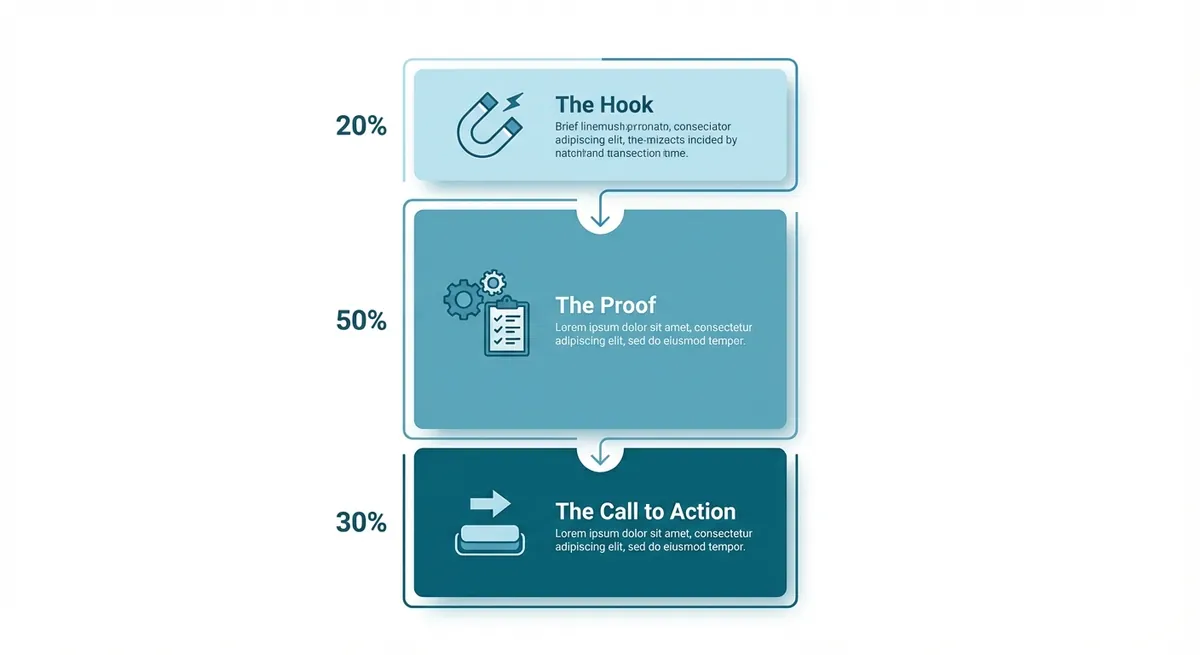
A visual breakdown of a cover letter anatomy. Top section labeled 'The Hook', middle section 'The Proof', bottom section 'The Call to Action', showing how much space each should take up on the page.
As career strategist John Lees told the Harvard Business Review, a cover letter "should be brief enough that someone can read it at a glance." A good cover letter template forces you to be concise because it limits your space.
Don't ramble. Stick to the highlights.
Common formatting mistakes to avoid
Even with a great cover letter template, you can mess up the details.
- Font size: Keep it between 10 and 12 points.
- Font style: Stick to clean fonts like Arial, Calibri, or Helvetica.
- Length: Never go over one page. Half a page is usually better.
Before you send anything, run your documents through a tool that can spot errors. Our Resume Checker is great for catching issues in your resume that might contradict what you just wrote in your cover letter.
Key Takeaways
- Ditch the generic openers. Never start with "I am applying for..." if you can avoid it.
- Use data immediately. Start with a 20% increase in sales or a $50k savings win.
- Name drop if you can. A mutual connection is the fastest way to build trust.
- Keep it short. Hiring managers scan. They don't read novels.
- Customize your template. A cover letter template is a starting point, not the final product.
Final thoughts
Learning how to write a cover letter that actually gets read isn't rocket science. It’s about empathy. Put yourself in the recruiter's shoes. Would you want to read a boring form letter? No.
You want to read something interesting. Be interesting. Be specific. And if you need help getting the rest of your application package ready, OneTwo Resume is here to help you build a career story that wins.