Getting a job right now feels like shouting into a void. You apply. You wait. Crickets. Truth is, competing for remote jobs means you're up against the whole country instead of just people in your zip code. It's tough out there.
Standing out requires proving you can communicate flawlessly and manage your time without someone looking over your shoulder.
Why is getting noticed so much harder now?
The talent pool has grown exponentially. You have to beat hundreds of global applicants by showing tangible results instead of just listing basic responsibilities.
The math is brutal
Look, the numbers tell the whole story. We found that fully remote listings get 400% more applications than office roles. Let that sink in. You're competing with top talent everywhere. Hiring managers are overwhelmed. And they're actively looking for any small reason to filter you out.
Skills vs Location
Not every role translates perfectly to your living room. The Bureau of Labor Statistics breaks down exactly which occupations telework successfully. If your field heavily relies on work from home flexibility, expectations are much higher. Employers expect you to already know the digital tools. They want concrete proof you can thrive without a physical office. This also heavily applies if you want a hybrid work setup. Splitting time between your house and the corporate office still requires intense digital organization skills.
How do you build a resume that actually converts?
A winning remote resume highlights asynchronous communication skills and technical proficiency. It proves you are a self starter who consistently delivers on time.
Prove you can manage yourself
Nobody wants to micro-manage you from three time zones away. You need to highlight massive self-reliance. Did you run a major project entirely via Slack and Zoom? Put that in. Did you transition an old-school team to a modern hybrid work model? That is absolute gold. Use numbers to back up your claims. Say you increased sales by 22% while fully remote. That proves you get serious things done in sweatpants mode.
Optimize for the machines
Your resume has to beat the software first. If you miss the right keywords, a human will never even see your application. This is where you need a little digital help. Run your document through our Resume Checker to make sure you hit the mark. It scores your text against what ATS robots actually want to see before passing you to a real person.
Show, do not just tell
Vague bullet points kill your chances instantly. You have to be incredibly specific. Look at the difference a few well-placed details can make.
| Standard Bullet Point | Remote-Optimized Bullet Point | Why It Works Better |
| ---------- | ---------- | ---------- |
|---|---|---|
| Managed a team | Led a 6-person remote team across 4 time zones | Shows specific scale and geographic complexity |
| Good communicator | Handled daily asynchronous updates via Slack | Highlights specific tools and modern remote methods |
| Finished projects | Delivered 14 client projects 5 days ahead of schedule | Focuses entirely on measurable, independent output |
What is the secret to acing the digital screening?
A successful video interview demands perfect lighting and flawless audio. You must project energy through the camera to build a genuine personal connection.
The technical setup matters
We've all been on painful video calls. Don't be the person with terrible, crackly audio. And it makes perfect sense. If you can't fix your mic for the remote interview, how will you handle important daily client calls? Harvard Business Review has a fantastic guide on how to nail a job interview remotely. Read it twice. Test your camera. Clean up your messy background. Be ready.
Cultivate your digital footprint
But your resume is only half the battle. They're going to Google you. They will definitely check your professional profiles before making an offer. A polished online presence shows you truly understand digital networking. If your profile needs a serious facelift, try our LinkedIn Optimizer tool. It helps you align your public profile perfectly with your customized resume. Consistency is everything here.
Master the hybrid conversation
Even if you want a fully remote gig, the company itself might be transitioning. Hybrid work is incredibly common right now. Some employees are in the office. Some aren't. You need to confidently show you can collaborate with both groups seamlessly. Ask smart questions about their communication culture. It shows you completely understand the tricky nuances of distributed teams. If you'd rather focus on employers that are remote to the core, our guide to the best companies for remote work breaks them down by industry.
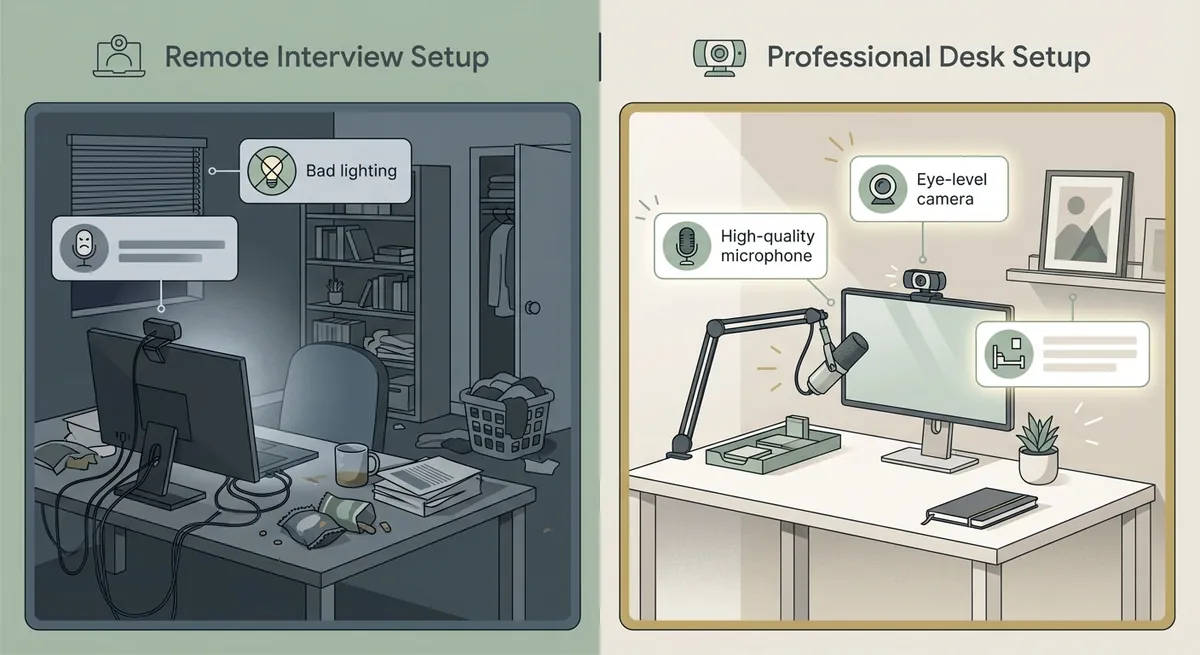
A side-by-side visual comparison showing a poorly lit, cluttered remote interview setup versus a professional, well-lit desk setup with callout boxes highlighting key elements like a good microphone, eye-level camera, and clean background
Key Takeaways
Let's wrap this up with the most important points.
- Treat your asynchronous communication skills as your most valuable professional asset.
- Back up every single resume bullet point with hard, verifiable numbers.
- Perfect your technical setup and background before hopping on any video calls.
- Prove you can adapt quickly to both fully distributed and hybrid work environments.
- Always run your documents through scoring tools to beat the initial software filters.
Stop sending out the exact same boring document and hoping for a different result. You need a highly targeted approach. Use our Resume Builder to craft a customized application that speaks directly to modern remote hiring managers. Let's get you that dream job.