You hit a milestone birthday. Now you want a fresh start. Starting a new career at 40 is incredibly common today. But staring at a resume you haven't updated in ten years is terrifying.
Truth is, your old resume format won't work for this transition.
Switching to a new career at 40 means you must ditch strict chronological timelines and highlight your highly relevant, transferable skills instead.
Getting a hiring manager to take a chance on your career change requires strategy. You have decades of professional experience. You just have to package it so it speaks directly to your new target industry.
Here is exactly how you do that.
Why is a chronological resume hurting your chances?
A purely chronological resume highlights the glaring gap between your past job titles and your brand new goals. You need a hybrid format to bridge that divide effectively.
The problem with traditional formats
When you apply for a job in a completely different field, hiring managers scan your past titles first. If they don't see a match in six seconds, you get ghosted. And that is exactly what a traditional chronological resume does. It puts your least relevant information front and center. It essentially forces the recruiter to figure out why a former restaurant manager is applying for an IT project manager role. They won't bother trying.
Embracing the hybrid resume style
Look, you need a hybrid resume. This format starts with a massive, heavy skills section right at the top. It groups your achievements by skill category rather than by employer. Your work history still sits on the document. But it takes a back seat. You place it at the very bottom.
That is a massive difference. It literally forces the hiring manager to read your capabilities before they judge your past job titles.
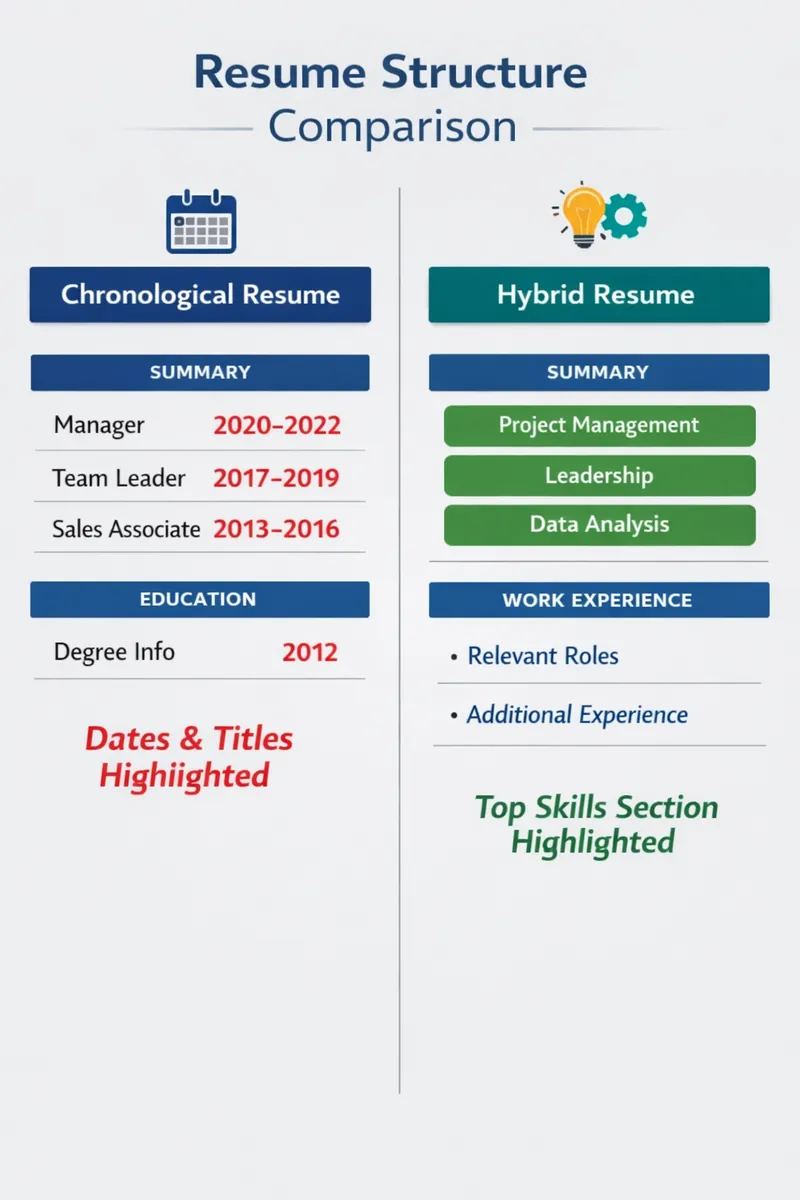
A side-by-side visual comparison of a traditional chronological resume structure versus a hybrid resume structure. The chronological side highlights dates and titles in red to show weakness for career changers. The hybrid side highlights the prominent top skills section in green.
How do you translate past experience into new skills?
Your past jobs taught you hard and soft skills that your target industry desperately needs today. The trick is identifying those exact abilities and renaming them to fit your new field.
Identifying your transferable abilities
What did you actually do all day in your last job? Did you manage angry clients? You have conflict resolution skills. Did you balance massive spreadsheets? You have data analysis skills. You already possess the tools required for switching careers.
Look at resources like the Bureau of Labor Statistics: Occupational Outlook Handbook to read up on the daily duties of your target role. Match your past realities to their current needs. Building a new career at 40 requires this exact translation process. You aren't starting from scratch. You are just repackaging.
Speaking the language of your new industry
You can't use your old industry jargon. A marketing agency doesn't know what a "Tier 3 Escalation Protocol" is. You must scrub your resume of confusing acronyms.
If you need inspiration on industry phrasing, browse our Resume Examples to see exactly how professionals talk in your target sector. Learning to speak this new dialect is non-negotiable.
| Old Industry Phrasing | Translated Skill | New Industry Phrasing |
|---|---|---|
| Managed retail floor shifts | Leadership | Led cross-functional team operations |
| Handled patient intake forms | Data Management | Processed complex client data securely |
| Cold-called 50 leads daily | Business Development | Executed outbound sales strategies |
What should you do with decades of older job experience?
You simply don't need to list every single job you have held since high school. Cut off your work history after 10 to 15 years to keep the focus entirely on your most relevant experience.
The 10-to-15 year rule
You have a lot of experience. But nobody cares about the job you held in 2004. Cut the fluff. Keep your work history strictly to the last 10 or 15 years. This prevents age bias. It also keeps your resume punchy and highly relevant to the modern job market.
Keep it tight. Less is absolutely more here.
Crafting a powerful career summary
Start your resume with a bang. A career summary sits right at the top of the page. It explains exactly who you are and why you are pivoting. Don't make them guess why a 15-year teacher is suddenly applying for a corporate training role. Tell them directly.
The Indeed Career Guide: How to Write a Resume for a Career Change suggests framing your past experience as a unique asset for your new role. Tell a quick, compelling story. Once you write this summary section, run your document through a Resume Checker to make sure your new keywords register properly with applicant tracking systems.
Dealing with stepping-stone roles
Maybe you took a software bootcamp. Maybe you did some unpaid freelance work to build a fresh portfolio. Put these front and center. They prove you are serious about this career change. Starting a new career at 40 is much easier when you can point to recent, practical education that bridges your knowledge gap.
Key Takeaways
- Use a hybrid resume format to highlight skills over job titles.
- Scrub your old industry jargon and adopt the vocabulary of your new field.
- Identify your transferable skills and map them to the requirements of your target role.
- Delete any job experience older than 15 years to avoid age bias and keep the document concise.
- Write a clear career summary that explains the "why" behind your pivot.
Building a completely new resume from scratch is totally daunting. But you don't have to do it alone. Use the OneTwo Resume Resume Builder to format your hybrid resume perfectly and start your next professional chapter with absolute confidence.