You did everything right. Your resume looked perfect. The interviews went incredibly well. You nailed every single question. And then the email arrives with the official numbers. You open it and your heart sinks. The number is way lower than you thought it would be.
Getting a lowball job offer feels like a kick to the teeth. It is frustrating. It makes you question if they even listened to you during the screening calls. But don't let your emotions take the wheel. This is not the end of the road. You can push back.
Respond to a lowball offer by expressing gratitude and enthusiasm for the role while calmly presenting hard market data to justify a higher number.
Why did they offer such a low number?
Companies often start with lower numbers to leave room for negotiation or because their internal budgets are strictly capped. It rarely reflects their actual evaluation of your worth.
Don't take it personally
Here's the thing. When a company gives you a low number, your first instinct is to feel insulted. You think they don't value your experience. But that's rarely the reality. Hiring managers are working within strict corporate budgets. They get a range from HR and they usually start at the absolute bottom of that range. Why? Because they assume you are going to negotiate.
They leave wiggle room on purpose. So don't sweat it. Take a deep breath and start planning your next move.
Time for hard data
You need proof before you push back. This is where solid salary research comes in. You can't just tell them you want more money because you have bills to pay. You have to prove you are worth the investment based on industry standards. Having accurate salary expectations prevents you from either lowballing yourself or asking for the moon.
Start by looking at reliable sources. The U.S. Bureau of Labor Statistics: Occupational Outlook Handbook gives you incredible baseline data for hundreds of roles. Print it out. Bring facts to the table.
Truth is, if you clearly stated your salary expectations during the initial phone screen, remind them. Sometimes communication breaks down between the recruiter who screened you and the hiring manager who made the offer. A gentle reminder of your original numbers can easily fix the disconnect.
How do you structure your counteroffer?
A successful counteroffer starts with appreciation and quickly moves into a polite but firm request for a specific number based on your market research.
Formulate a strong counteroffer
You need a tight strategy for your job offer negotiation. You can't just throw out a random number and hope they say yes. Pick a specific figure that sits near the top of your realistic range. Interestingly, odd numbers actually work a lot better than round ones. Asking for $83,500 sounds like you did your homework. Asking for $80,000 sounds like you picked a number out of thin air.
This is a core principle in learning how to negotiate salary effectively. If you want advanced tactics, you should really read the Harvard Business Review: 15 Rules for Negotiating a Job Offer. It outlines exactly how to keep the conversation positive while fighting for your worth.
Write the perfect email script
Keep your tone incredibly professional. Start with a massive thank you. Tell them how excited you are to join the team and list one specific project you are eager to start. Then pivot smoothly.
Say something like, "I am thrilled about the offer. But based on my market research and the specific responsibilities of this role, my salary expectations are slightly higher. I was hoping we could explore a starting salary closer to $83,500."
You aren't making demands. You're opening a polite conversation. Make sure they know you are still very interested in the job.
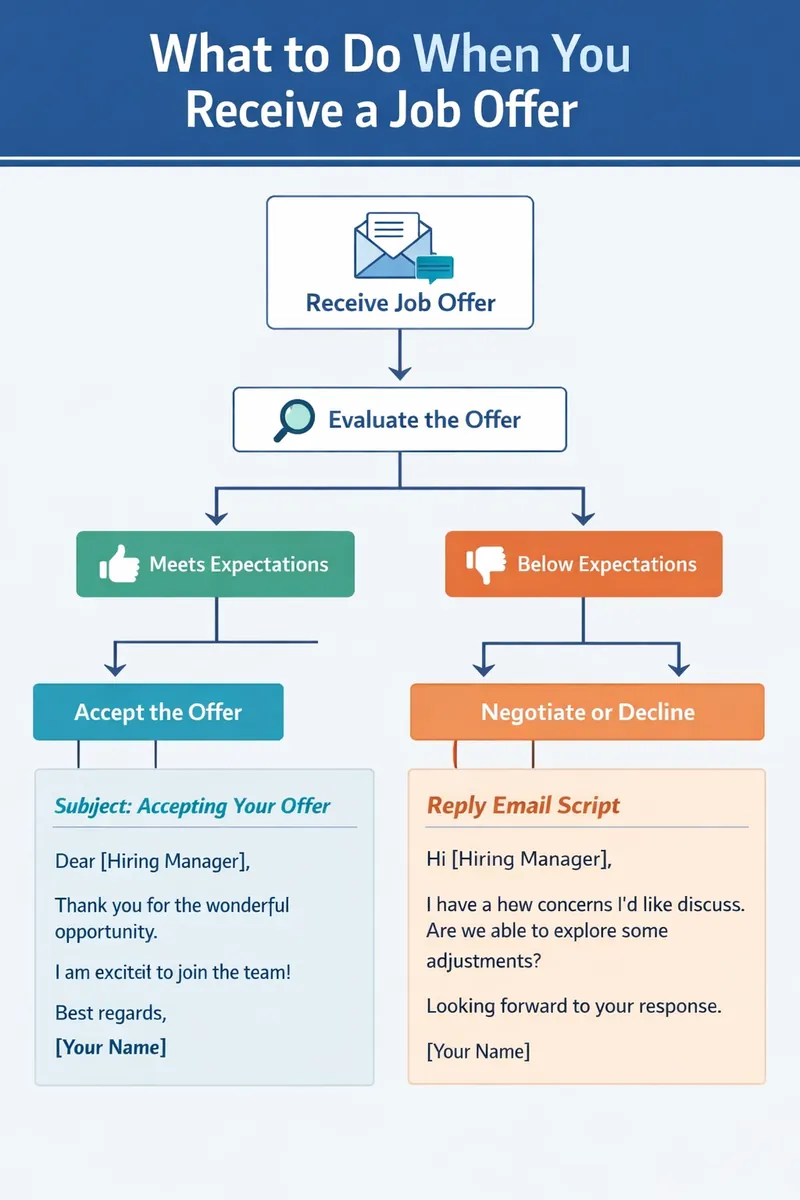
A flowchart showing the exact steps to take when you receive a job offer, branching into 'Meets Expectations' and 'Below Expectations' with email script prompts for each specific path.
What if they absolutely won't budge on base pay?
When a company simply cannot increase the base salary, shift your focus to negotiating bonuses, extra vacation days, or a more flexible working schedule.
Look at the whole picture
Sometimes their hands are entirely tied. Budgets get frozen by finance departments and the hiring manager has zero control over the base number. But base pay is only one piece of the puzzle. You can negotiate for plenty of other perks.
Think about asking for a one-time signing bonus. Or ask for an extra week of paid time off. You could even request a guaranteed performance review in six months. That gives you a formal opportunity to ask for a raise once you've proven your immediate value to the team.
Let's compare what a seemingly low offer looks like when you add the right perks.
| Compensation Type | Base Salary Offer | Additional Negotiated Perks | Total First-Year Value |
|---|---|---|---|
| The Initial Offer | $65,000 | Standard benefits | $65,000 |
| The Counteroffer | $65,000 | $5,000 signing bonus | $70,000 |
| The Lifestyle Win | $65,000 | 5 extra PTO days | $65,000 + 1 week off |
| The Hybrid Win | $65,000 | Fully remote work allowed | $65,000 + zero commute |
Keep your options open
You don't have to accept a bad deal. If the offer is truly terrible and they refuse to offer any flexibility, you might need to walk away. It's incredibly hard to reject a job when you need one. But accepting a massive pay cut sets your earning potential back for years.
Keep applying. Keep pushing forward.
Make sure your application materials are flawless before you jump back into the market. You can use a Resume Checker to see exactly how your current document scores against modern applicant tracking systems. If your document needs a complete overhaul, try a Resume Builder to start fresh and highlight your most valuable skills.
Key Takeaways
You've got this. Standing up for your worth is hard, but it's absolutely necessary. Remember these key points:
- Do not reject an offer out of anger. Stay calm and stay professional.
- Use concrete data to build your case.
- Anchor your counteroffer near the top of your range using precise numbers.
- Be clear about your salary expectations early in the process.
- Negotiate alternative benefits if the base pay is locked.
- Be ready to walk away if the total compensation doesn't meet your needs.
It takes courage to push back on a lowball offer. But taking control of your career means having these tough conversations. Get your documents ready, know your numbers, and confidently step into the negotiation. Ready to sharpen your career tools? Check out OneTwo Resume to build a profile that commands top dollar.