Let's be honest. Money is awkward. Most of us were raised not to talk about it. But when you are looking for a job, silence is expensive. If you don't know the market rate for your skills, you are flying blind.
And that is exactly what employers are hoping for. They want to set the price. You want to get paid fairly. To bridge that gap, you need data. You need confidence. You need to know exactly what that position is worth before you ever walk into the interview room.
Researching salary expectations requires combining online market data with personal networking to find a realistic range based on your location, experience, and the company’s specific industry.
Where do I actually find accurate salary numbers?
Don't rely on a single source like Glassdoor; aggregate data from government sites and industry-specific job boards to triangulate a more accurate figure.
Most people Google "Marketing Manager salary" and click the first result. That is a mistake. The internet is full of outdated numbers. Or vague averages that don't apply to you. To get a real number, you have to dig deeper.
Start with the aggregators. Look at Glassdoor, Payscale, and Salary.com. But take them with a grain of salt. These are often self-reported numbers. They might be three years old. And inflation has changed things fast.
For a more objective look, check government data. The Bureau of Labor Statistics: Occupational Outlook Handbook is a goldmine. It breaks down pay by region and industry. It’s not flashy. But it is accurate.
Specificity builds trust. It shows you did your homework.
Also, consider the cost of living. A \$100,000 salary in Ohio goes a lot further than in New York City. Use a cost-of-living calculator to adjust your expectations based on where the job is located.
Before you start throwing out numbers, make sure your resume actually reflects the experience level you are claiming. If you are asking for a senior-level salary, your resume needs to look the part. You can use our Resume Checker to see if your bullet points are hitting the right impact level for the pay grade you want.
Who should I talk to about money?
Networking provides the context that data sites miss, so ask mentors or peers for a salary range rather than their specific income to make the conversation comfortable.
Online data is great. But it lacks nuance. It can't tell you that this specific company pays 20% above market because they have high turnover. Or that they pay in equity.
So you need to talk to humans.
Here's the thing. You don't have to ask your friend, "How much money do you make?" That is rude. And it makes people defensive. Instead, ask about the market. Try this: "I'm looking at Senior Designer roles in Chicago. Based on what you're seeing in the market, is a range of \$85k to \$95k realistic?"
See the difference? You aren't asking for their bank balance. You are asking for their expertise.
Recruiters are also excellent sources. Even if you aren't taking a job with them right now. They look at salary data all day long. Shoot a message to a recruiter in your field. Ask them what the current bands are for your experience level. Most are happy to share.
Check out Indeed Career Advice: How to Research a Fair Salary for more tips on how to frame these conversations without being awkward.
It makes the salary negotiation feel like a business transaction. Not a personal favor.
If you aren't sure who to ask, you need to expand your circle. Our LinkedIn Optimizer can help you polish your profile so you can connect with peers in your industry who might be willing to share insights.
How does the company type affect the paycheck?
Startups often offer equity to offset lower base pay, while established corporations usually have rigid salary bands that leave less room for negotiation on the base figure.
Not all dollars are created equal. A tech giant and a non-profit might hire for the same job title. But the pay will be wildly different. You need to know the context of the company you are applying to.
Big corporations usually have "salary bands." These are strict ranges. If the band for a Level 3 Engineer is \$110k to \$130k, they literally cannot pay you \$140k. No matter how much they like you. Knowing this helps you manage your salary expectations.
Startups are different. They might be cash-poor. They might offer you a lower salary but give you stock options. That could be worth millions. Or it could be worth zero. You have to weigh that risk.
Here is a quick breakdown of how different companies structure pay:
| Company Type | Base Salary | Bonuses | Equity/Stock | Flexibility |
|---|---|---|---|---|
| Early Stage Startup | Low to Mid | Rare | High | High (on perks/title) |
| Established Corp | High | Standard (10-15%) | RSUs (stable) | Low (rigid bands) |
| Non-Profit/Gov | Low | None/Low | None | Very Low |
| Consulting Agency | Mid to High | Performance-based | None | Medium |
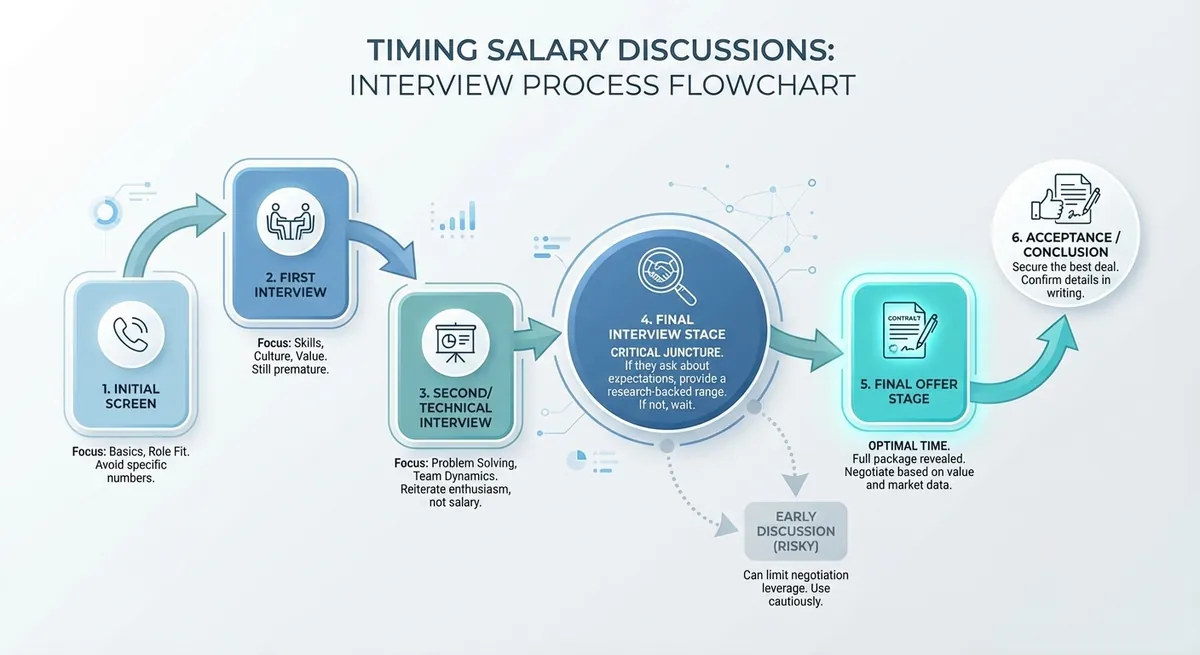
A flowchart showing when to bring up salary during the interview process, from initial screen to final offer
How do I prepare for the actual discussion?
Use the application process to screen them as much as they screen you; if they refuse to give a range during the first screen, it is often a red flag for underpayment.
So you have your data. You have talked to people. You know the company type. Now you have to actually say a number.
Truth is, the person who says a number first often loses some power. But in the modern job market, transparency is becoming the norm. Many states now require salary ranges in job postings.
If the posting doesn't list a salary, you need a "walk away" number. This is the absolute lowest amount you can accept to pay your bills and meet your savings goals. Do not settle for less than this. You will resent the job within three months.
When you are learning how to negotiate salary, remember that it is a package deal. Maybe they can't match your salary number. Can they offer a signing bonus? More vacation days? A flexible schedule?
Look at the total compensation.
And don't be afraid to pause. When they make an offer, you don't have to say yes immediately. Say, "Thank you. I need to review this against my research and personal needs."
Prior to getting to this stage, you need to make sure your application materials scream value. If your resume looks generic, you have no leverage. Use our Resume Builder to ensure your achievements are quantified. You want them to look at your paper and think, "We have to pay whatever it takes to get this person."
Key Takeaways
- Triangulate your data. Never rely on just one website. Mix Glassdoor, government data, and competitors' job listings.
- Talk to humans. Ask mentors or peers about "market ranges" rather than their personal income to get honest answers.
- Know the company structure. Startups pay in equity. Corporations pay in cash. Adjust your salary negotiation strategy accordingly.
- Calculate your bottom line. Know your walk-away number before you pick up the phone.
- It's business, not personal. Backing your request with data makes you look professional, not greedy.
Researching salary isn't just about getting more money. It's about respect. It's about knowing the value you bring to the table. When you know your numbers, you can interview with confidence. You aren't hoping for a fair wage. You are expecting one.
Ready to land the interview so you can use this research? Start by perfecting your resume with OneTwo Resume today.