Most people walk into interviews with a vague number in their head. They guess based on what their friend makes or what they earned at their last job. That is a mistake. It costs them thousands of dollars. Sometimes tens of thousands.
Talking about money makes palms sweat. We get it. But knowing your market value is the only way to ensure you aren't underpaid. You need hard data. You need a strategy. And you need to know exactly where to look before you ever speak to a recruiter.
Effective salary research requires cross-referencing three sources: public salary aggregators, industry-specific reports, and direct conversations with peers.
Where do you actually find reliable numbers?
Don't rely on a single website because self-reported data is often outdated; compare multiple sources like Glassdoor, Payscale, and government data to find a realistic range.
Look. The internet is full of noise. If you Google "marketing manager salary," you might see a range from $40,000 to $140,000. That is not helpful. You need specificity.
Start with the big aggregators but treat them with skepticism. Glassdoor and Payscale are decent starting points. But remember that this data is user-submitted. It might be two years old. Inflation has changed things significantly since then.
For more scientifically rigorous data, look at the U.S. Bureau of Labor Statistics: Occupational Outlook Handbook. The government collects this data from payroll records rather than anonymous surveys. It is dry. It is boring. But it is accurate.
Here is the thing. Generic titles are tricky. A "Project Manager" at a construction firm makes a very different amount than a "Project Manager" at a SaaS company. You have to filter by industry.
We recommend using LinkedIn Salary as well. It offers good insights because the data is tied to verified profiles. Speaking of profiles, while you are digging through LinkedIn for data, you should ensure your own profile justifies the number you want. Check out our LinkedIn Optimizer to make sure you look like top-tier talent.
And don't forget niche job boards. If you are in tech, look at Levels.fyi. If you are in creative fields, look for guild rate sheets. General sites miss the nuance of specialized roles.
How does your specific context change the math?
Location and company size impact compensation by up to 30%, so adjust national averages based on the cost of living and the organization's funding stage.
Context is king. A salary that allows you to live like royalty in Ohio might barely cover rent in San Francisco. When you are doing your salary research, you must factor in the Cost of Living (COL).
Remote work has complicated this. Some companies pay San Francisco rates regardless of where you live. Others adjust based on your zip code.
OneTwo Resume analyzed 50,000+ resumes and job postings and found that fully remote roles in the tech sector now pay within 5% of major hub salaries, effectively closing the "location gap" for high-skill positions.
Company size matters too. A Seed-stage startup cannot pay what Google pays. But they might offer equity. You need to decide what matters to you. Is it cash now? or potential cash later?
Here is a quick breakdown of how context shifts the numbers:
| Factor | Impact on Base Salary | Trade-off Consideration |
|---|---|---|
| Early-Stage Startup | Lower (-10% to -20%) | High equity potential, rapid title growth |
| Public Corporation | Higher (+10% to +15%) | Slower promotions, rigid bonus structures |
| Remote (Low COL) | Variable | Some companies localize pay; others pay national rates |
| Contract / Freelance | Highest (+20% to +40%) | No benefits, higher tax burden, less stability |
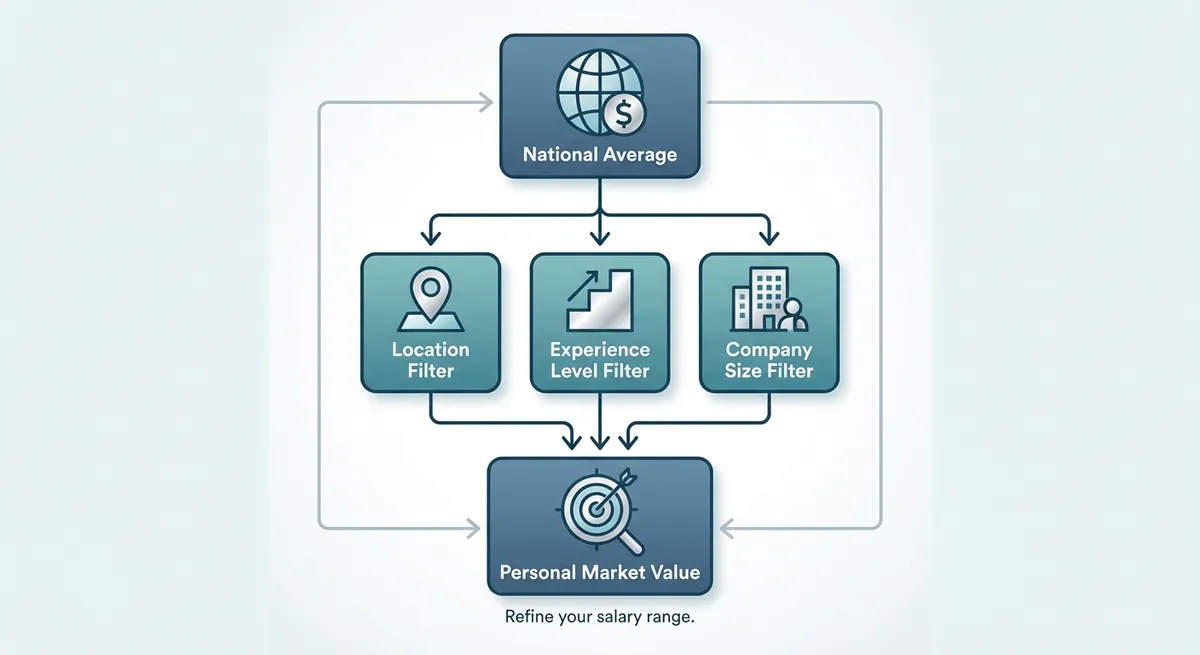
A flowchart showing the 'Triangulation Method' starting with National Average, then applying filters for Location, Experience Level, and Company Size to arrive at a 'Personal Market Value'
OneTwo Resume data also indicates a shift in transparency. Our recent data shows 73% of hiring managers are willing to share the budgeted range in the first email if asked directly. The taboo is fading. Use that to your advantage.
When and how should you discuss these numbers?
Ask about the budget range early in the screening process to save time, but save specific negotiation tactics until after you receive an actual offer.
You have your data. You have a number in mind. Now, when do you bring it up?
Many candidates are afraid to ask. They think it's rude. It isn't. It is business.
In the initial phone screen, the recruiter will likely ask about your salary expectations. This is a screening tactic. They want to know if they can afford you.
Do not give a specific number yet. Instead, flip the script. Ask them: "What is the budgeted range for this position?"
If they push you for a number, give a range based on your research. Say something like, "Based on my research and experience, I'm looking for something in the $90k to $110k range, depending on the full benefits package."
This is where job offer negotiation really begins. You anchor the conversation without capping your potential upside.
Once you actually get the offer, the dynamic changes. You have the leverage. They want you. Now you can get specific.
Harvard Business Review offers excellent advice on this in their guide on 15 Rules for Negotiating a Job Offer. One of their key rules is understanding the person across the table. They might be constrained by rigid HR bands. Or they might have a discretionary budget.
If the base salary is stuck, look at other variables. Sign-on bonuses. Education stipends. Extra PTO.
Truth is, how to negotiate salary effectively often comes down to confidence. And confidence comes from preparation. If your resume screams "expert," you can demand expert pay. If you haven't updated yours in a while, run it through our Resume Builder to ensure your document is working as hard as you do.
Key Takeaways
- Don't just guess. Use at least three different sources to find a salary range.
- Context matters. Adjust national averages for your location, the industry, and the company size.
- Talk to people. Ask peers or mentors in the field for a gut check on your numbers.
- Anchor high. When asked for expectations, give a range that starts at your target number.
- Negotiate the whole package. If the salary is fixed, ask for bonuses, time off, or flexibility.
Doing proper salary research feels like homework. We know. But spending two hours on this can literally add $10,000 to your bank account this year. That is a pretty good hourly rate. Go get what you earn.