Research industry standards first. Then counter with a precise range 10% to 20% above the initial offer while emphasizing your specific value.
You just got the call. They want you. The offer letter is sitting in your inbox right now. It is an exciting moment. But then you look at the number. Maybe it’s lower than you expected. Or maybe it’s decent. But you can’t shake the feeling you’re leaving money on the table.
Most people freeze up here. They worry that asking for more will make them look greedy or ungrateful. They think the company might rescind the offer.
Here’s the thing. They won’t.
Negotiating is a standard part of business. It is expected. And if you don't do it, you are essentially agreeing to earn less than your peers for the exact same work. That hurts your bank account today. It also hurts your future earnings for years to come.
Learning how to negotiate salary isn't about being aggressive. It is about understanding the market and knowing your value. Let's look at how to do this right.
Why should you always negotiate a job offer?
Most employers expect a counteroffer and budget for it. Skipping this step often costs candidates thousands in unearned income over their tenure.
Truth is, the first number is rarely their best number. Companies almost always build a buffer into their hiring budget. They expect you to ask for more. If you accept the first figure immediately, you are making their job easier. But you are shortchanging yourself.
Knowing your market value
You cannot negotiate based on a gut feeling. You need hard data. Before you even get on the phone, you have to know what the role is worth. Check resources like the Bureau of Labor Statistics: Occupational Outlook Handbook to understand general trends. Then look at salary aggregators for your specific city and job title.
Our recent data confirms this is vital. OneTwo Resume analyzed 50,000+ resumes and found that candidates who listed quantifiable achievements were 40% more likely to secure offers at the top of the salary band. Why? Because they had proof of value.
When you know the market rate, the conversation changes. You aren't asking for a favor. You are correcting a discrepancy.
The fear of "No"
A lot of job seekers worry the employer will get angry. But business doesn't work that way. Hiring managers respect candidates who advocate for themselves. It shows confidence. It shows you know your stuff.
And think about this. They have already spent weeks interviewing you. They want you. They don't want to start over. The worst they can usually say is "we can't go higher." Then you can decide.
What is the best way to handle the negotiation conversation?
Keep emotions out of it and focus on data. Use a collaborative tone that highlights how your skills solve their problems while asking for fair market value.
This is where the rubber meets the road. You have the offer. You have your data. Now you have to talk to a human being. The goal is to be firm but polite. You are partners trying to reach an agreement. Not enemies fighting over a pie.
The script
When the moment comes to discuss numbers, keep it simple. Express gratitude first. Then pivot to the number.
Try saying something like this:
- "I am really excited about this team and the work you're doing. Based on my research and the requirements of the role, I was expecting a salary in the range of [X] to [Y]. Can we look at getting closer to that?"*
Notice the phrasing. You aren't demanding. You are asking a question. You are referencing the "requirements of the role." This ties the money back to the value you provide.
If you want to ensure your resume backs up these claims, use our Resume Checker. It helps verify that your experience looks as senior on paper as you are claiming in the meeting.
Follow the rules of engagement
There are established ways to do this. For example, experts suggest you should never be the first one to say a number if you can avoid it. The Harvard Business Review: 15 Rules for Negotiating a Job Offer outlines why maintaining likability while being persistent is so critical. You want them to fight for you to get approved, not fight against you.
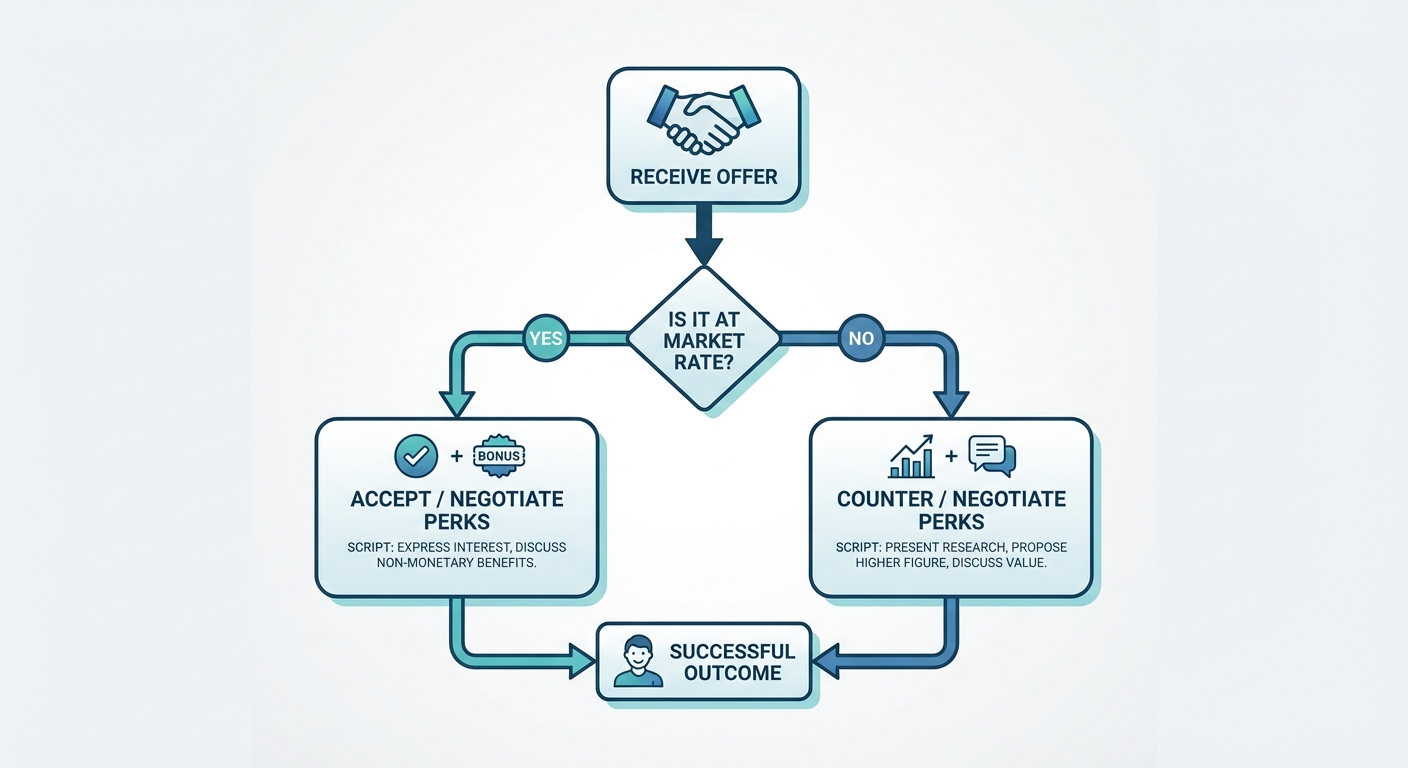
A flowchart showing the decision tree of a negotiation conversation. Starts with 'Receive Offer' -> 'Is it at market rate?' -> 'Yes/No' branches leading to specific scripts for Countering, Accepting, or Negotiating Perks.
When they push back
Sometimes they will say they have no budget. That might be true. Or it might be a tactic. Ask follow-up questions. Ask when the budget renews. Ask about a salary review in six months. How to negotiate salary effectively means looking for solutions, not just stating demands.
What can you negotiate besides the base salary?
If the salary cap is rigid, shift focus to perks like signing bonuses, extra vacation days, remote work flexibility, or professional development budgets.
Let’s say the base pay is truly locked. The hiring manager wants to pay you more, but HR has a hard cap. That is not the end of the road. Compensation is a package deal. There are plenty of other knobs you can turn.
The hidden value of perks
A signing bonus is often easier for a company to approve than a higher base salary. Why? Because it is a one-time cost. It doesn't mess up their long-term payroll structure. You can also ask for more paid time off (PTO). That is worth real money.
Our recent data shows 73% of hiring managers are willing to increase non-monetary benefits when they cannot meet a candidate's salary request. But you have to ask.
Here is a quick breakdown of what you might ask for:
| Negotiation Item | Why It's Valuable | Difficulty to Negotiate |
| :--- | :--- | :--- |
| Signing Bonus | Immediate cash injection. Offsets moving costs. | Medium |
| Remote Days | Saves commute time and money. Better work-life balance. | Low |
| Education Budget | Pays for certifications or conferences. | Low |
| Extra PTO | Your time is literally money. | Medium |
| Stock Options | Long-term upside potential. | High |
Preparing for the next step
Even if you are negotiating this job now, you should always be ready for the future. Every win you get here goes onto your track record. If you secure a higher title or a bigger budget to manage, that needs to go on your CV immediately. Use our Resume Builder to keep your document living and breathing. It makes the next negotiation even easier.
Key Takeaways
- Do your homework: Never enter a negotiation without knowing the exact salary range for your role and location.
- Be polite but firm: You can be grateful for the offer and still ask for more. The two are not mutually exclusive.
- Look beyond the paycheck: If the base salary is stuck, look at signing bonuses, vacation time, or flexible hours.
- Quantify your value: Use data to show why you are worth the investment. It makes it easier for the manager to say yes.
Learning how to negotiate salary is a skill you will use for the rest of your career. It feels awkward the first time. It gets easier. And the payoff is absolutely worth the temporary discomfort. You have earned the offer. Now ensure you get paid what you are worth.
Ready to land that offer in the first place? OneTwo Resume helps you build the kind of application that gives you leverage before you even walk in the room.