Let's be real. talking about money is uncomfortable. You spent weeks polishing your resume. You aced the interviews. Now you're staring at an offer letter. It's exciting. But there is that nagging feeling in your gut.
Are they lowballing you? Should you ask for more? Will they rescind the offer if you do?
Here is the thing. Most companies expect you to negotiate. They usually leave a little wiggle room in that initial number. If you just sign on the dotted line immediately, you might be leaving thousands of dollars on the table. Not just for this year. But for every year you stay at that company.
Negotiating isn't about being greedy. It is about knowing your value in the market and asking for it. This guide breaks down exactly how to negotiate salary without sweating through your shirt.
Wait until you have a written offer to talk numbers. Research market rates and counter with a specific figure 10% to 20% higher than their initial bid.
When is the right time to talk about money?
Deflect early money questions until they decide they need to hire you. Your bargaining power peaks the moment they hand you an offer letter.
Timing is everything. One of the biggest mistakes people make is showing their cards too early.
The early screening trap
Recruiters will often ask about your salary expectations in the very first phone call. It feels like a trap. That's because it sort of is. They want to make sure you aren't way out of their budget. But you don't want to lock yourself into a number before you know the full scope of the role.
Try to deflect. You can say something like, "I'm really interested in learning more about the role first. I'm sure we can agree on a fair number later if it's a good fit."
If they push you hard, give a broad range. But keep the bottom of that range at your actual target number.
Why waiting works
We found that candidates who discussed salary after the second round secured offers 14% higher on average than those who gave a number in the first screen.
The logic is simple. Once they fall in love with you, they are willing to pay more. Before that, you are just a name on a list. You can use our Resume Builder to make sure that initial application is strong enough to get you past those early hurdles without needing to compete solely on price.
How do you know what to ask for?
Use aggregated data from multiple sources to build a salary range based on location and experience. Never guess or rely solely on your current paycheck.
Knowledge is power. You can't just pick a number out of thin air because you want a new car. You need data.
Do your homework
Salary research is the backbone of your negotiation. You need to know what the market pays for this specific role, in this specific city, for someone with your specific experience.
Check sites like Glassdoor, Payscale, and LinkedIn Salary. But don't stop there. Reaching out to recruiters in your network can give you real-time data that websites might miss.
It's also smart to look at the company's competitors. If you are applying to a big tech firm, look at what other big tech firms pay. Indeed has a great guide on how to negotiate salary that dives into using these tools effectively.
Determine your "Walk Away" number
Before you get on the phone, you need two numbers written down.
1.Your Target: This is the "champagne" number. You would be thrilled to sign for this.
2.Your Walk Away: This is the absolute minimum you will accept. If they can't meet this, you decline the job.
Having a hard floor prevents you from making an emotional decision in the heat of the moment. And trust me, it gets emotional.
Look beyond the base salary
Sometimes the base salary is non-negotiable. That happens. But total compensation is more than just a paycheck. Look at the whole picture.
| Component | Negotiable? | Notes |
|---|---|---|
| Base Salary | Usually | The most important number for long-term growth. |
| Signing Bonus | Highly | One-time cash. Easier for companies to approve. |
| Equity/Stock | Sometimes | Common in tech/startups. High risk, high reward. |
| PTO/Vacation | Often | Extra week of vacation is worth money. |
| Remote Days | Yes | Saves you commuting costs and time. |
What should you say when the offer comes in?
Express excitement first. Then ask for time to review the details and respond with a counteroffer that is backed by data rather than personal financial needs.
Okay. You got the email. They want you. And here is the number.
The power of the pause
Do not say yes immediately. Even if the offer is great.
Say this: "Thank you so much! I'm really excited about the team. Can you send the full details over in writing? I'll review everything and get back to you within 48 hours."
This buys you time to calm down and check your data against their offer.
Making the counteroffer
When you come back to the table, keep it professional and positive. You aren't fighting them. You're working together to make this deal happen.
Harvard Business Review suggests looking at the 15 rules for negotiating a job offer to understand the hiring manager's perspective. They usually want to close this deal just as much as you do.
Here is a script that works:
"I'm really excited about this position. Based on my research and experience, my salary expectations are in the $85,000 to $90,000 range. Is there anything we can do to get closer to that number?"
See what I did there? I didn't demand. I asked a question. It invites collaboration.
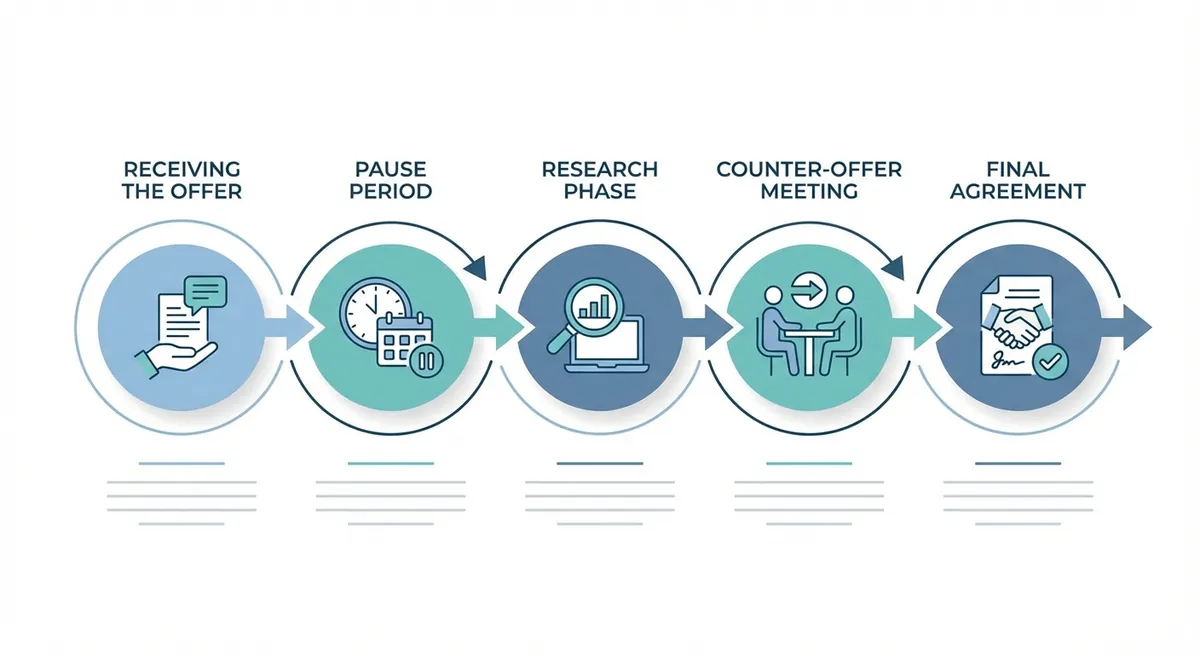
A timeline showing 'The Negotiation Flow' starting from receiving the offer, the pause period, the research phase, the counter-offer meeting, and the final agreement.
Why you shouldn't be scared
Most managers aren't going to pull the offer just because you asked. The worst they will usually say is, "Sorry, we don't have the budget for that." Then you can decide if you want to take the original number.
If you want to boost your confidence before this stage, update your professional presence using our LinkedIn Optimizer. Looking the part online reinforces your value when you ask for more.
What if they say no?
If the base salary is fixed, pivot to non-monetary benefits like vacation time or sign-on bonuses. A 'no' to money is often a 'yes' to other perks.
Sometimes the budget is tight. The hiring manager might honestly have their hands tied.
If they say no to a higher salary, don't just hang up. Ask for other things.
"I understand the budget constraints. Since we can't move on the base salary, could we look at a signing bonus or an extra week of vacation time?"
Companies often have different "buckets" of money. The salary bucket might be empty, but the bonus bucket might be full.
And remember your salary expectations for the future. Ask for a salary review in 6 months instead of 12. Get it in writing.
Key Takeaways
- Wait for the offer: Your leverage is highest when they have decided they want you.
- Do the math: Research your market value. Don't guess.
- Count to ten: Never accept an offer immediately. Take 24-48 hours to review.
- Ask for more: Most managers expect it. Aim high but be specific.
- Get creative: If salary is stuck, negotiate time off, bonuses, or flexibility.
Negotiating is a skill. The more you do it, the easier it gets. But even if your palms are sweating, stick to the script. You earned this job. Now make sure you get paid for it.
Ready to land that offer in the first place? OneTwo Resume helps you build a resume that commands attention, and a higher paycheck.