You just got the job offer. That is amazing news. But now the anxiety sets in. You want more money. You need to ask for it. Truth is, asking for a higher starting salary makes most people sweat bullets. Writing an email feels safer than a phone call. But you worry about sounding greedy or ungrateful.
The secret to negotiating a job offer via email is combining genuine gratitude with objective market data to justify your specific request.
Here is the thing. You can advocate for your worth without sounding like a diva. You just need the right strategy. Let us look at exactly how to handle this tricky conversation.
Why should you negotiate over email anyway?
Email gives you complete control over your words and emotions while creating a documented paper trail of your compensation agreement.
You control the narrative
Look, phone calls can go sideways fast. You might get nervous. You might stumble over your words. You might agree to a number too quickly just to end the awkward silence. Email lets you craft the perfect message. You can draft it. You can edit it. You can walk away and read it fresh an hour later.
The power of the pause
When you negotiate in writing, nobody is staring at you waiting for an immediate answer. You have time to breathe. And more importantly, the hiring manager has time to think. It removes the friction.
How do you figure out your exact numbers?
Determining your target number requires looking at objective industry data and aligning it with the specific skills you bring to the role.
Find the real market rate
You cannot just pull a number out of thin air. You need hard data to back up your salary negotiation. Start your salary research by looking at trusted government figures. The Occupational Outlook Handbook - U.S. Bureau of Labor Statistics provides highly accurate median pay statistics for almost every career path. This is objective proof. And do not forget to look at trusted career sites. Check out expert guides on how to negotiate salary (with tips and examples) - Indeed to see how others frame their financial requests.
Align your value
Look closely at your background. Did you recently use a Resume Builder to completely revamp your work history? Think about the specific metrics you highlighted there. That is your proof of value. Your salary expectations must match the actual results you can prove you will deliver.
What is the best way to write the email?
A successful negotiation email sandwiches your specific counteroffer between clear expressions of excitement about the role and the company.
The gratitude sandwich
Start with a massive thank you. Tell them you are thrilled about the offer. Then state your case logically. Then end on a highly positive note. It really is that simple. This collaborative approach completely removes any aggressive tone. You want them to feel like you are on the same team working toward a shared goal.
Pick the right words
Word choice matters immensely. You want to be firm but totally flexible. You are having a conversation, not issuing a list of demands. Let us compare some common phrases.
| Demanding Language | Collaborative Language | Why It Works Better |
|---|---|---|
| I need $85,000. | Based on my research, I am looking for $85,000. | Relies on data, not ego. |
| If you cannot pay this, I will walk. | Is there flexibility in the base compensation? | Opens a friendly dialogue. |
| I want more vacation time. | Could we discuss the PTO structure? | Asks a collaborative question. |
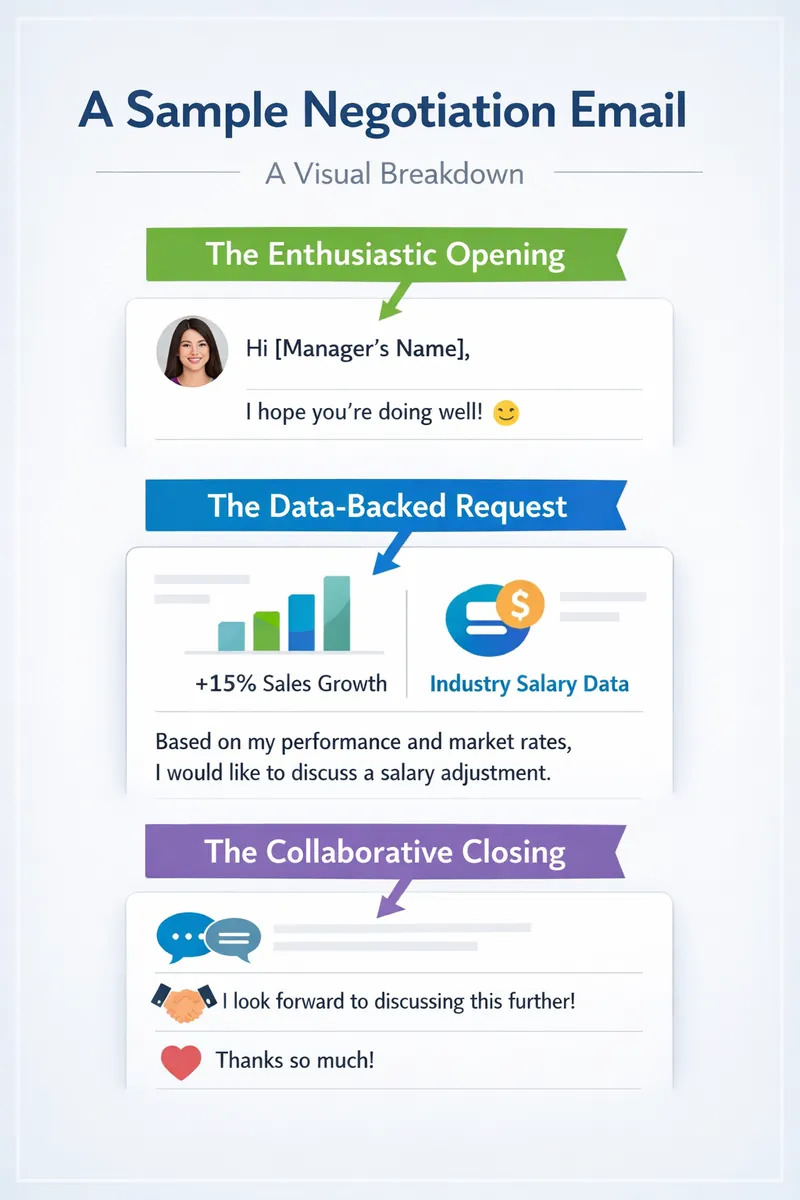
A visual breakdown of a sample negotiation email. It highlights the three main sections with arrows: The Enthusiastic Opening highlighted in green, The Data-Backed Request highlighted in blue, and The Collaborative Closing highlighted in purple.
Keep it incredibly brief
Do not write a novel. Nobody wants to read four paragraphs of justification. Get straight to the point. Make your job offer negotiation simple for the hiring manager to digest. Short paragraphs are your best friend here. And before you hit send, it might be smart to run your profile through a LinkedIn Optimizer so your public presence perfectly matches the high-value professional they are reading about in your email.
Key Takeaways
- Always start and end your email with genuine excitement and gratitude.
- Base your request on solid market research and objective data.
- Use collaborative language that invites a discussion rather than making a strict demand.
- Keep the email short and highly focused on the exact numbers you want.
- Remember that writing gives you the power to carefully edit your tone.
Navigating a salary negotiation does not have to be a terrifying experience. By keeping your tone collaborative and leaning on hard data, you can ask for what you deserve without burning any bridges. And if you are still looking for that perfect role to negotiate for, OneTwo Resume has the tools to get your application noticed.