You wake up on a Tuesday. The alarm goes off. You stare at the ceiling and realize you can't do this job for another fifteen years. The thought of starting over at 50 can make you sweat — but that framing is the mistake. At 50 you aren't starting anything over. You're moving thirty years of judgment to a place that values it more.
In short: a career change at 50 works when you pivot on experience instead of against it: target roles that buy judgment (operations, program management, compliance, training, advising, consulting), enter through your network rather than job portals, and keep the runway math honest — a move at 50 still has 15+ working years to pay off, which is longer than most careers had lasted when the "too late" cliché was coined. What kills later-in-life changes isn't age; it's accepting an entry-level reset nobody asked you to accept.
Why are you thinking about switching careers?
Finding your core motivation is step one. Leaving a toxic boss is very different from wanting to learn a totally new profession.
Identify the real push factors
You need to know why you want out. Are you burnt out from the long hours? Do you hate the actual daily work? Sometimes people think they need a completely new industry when they really just need a new company. Be honest with yourself. Write down exactly what drains your energy right now — at 50, a company change is often the two-month fix that makes the two-year fix unnecessary.
Look at the pull factors
What is drawing you in? Maybe it's meaning, maybe flexibility, maybe a field you shelved decades ago. Before you act, get real data: research target roles in the Occupational Outlook Handbook — U.S. Bureau of Labor Statistics and confirm the jobs you want are actually growing. There is no point jumping ship for a sinking boat.
Is 50 too late to change careers?
No — but the winning strategy at 50 is different from 30: you sell judgment, not potential.
The fields that reliably hire later-in-life changers are the ones where gray hair is a feature: operations and program management, compliance and risk, corporate training, client advisory work, teaching and instruction, and consulting in your existing domain. What they share is that the product is accumulated judgment. Fields that sell potential and stamina — most entry-level tech ladders, junior creative roles — are the headwind options; possible, but you'd be volunteering for their bias. If you're a decade younger, the calculus shifts — see career change at 40 and career change at 30 for the age-by-age differences.
The runway math, honestly
A change at 50 has roughly 15–17 working years to pay off. That's long enough to fully arrive in a new field and senior-up in it — but not long enough to absorb a full restart plus a multi-year retraining detour. So the rule tightens: no entry-level resets, no speculative degrees. A pay dip of one cycle is recoverable; five years of tuition plus junior wages generally is not. Protect retirement contributions in the transition year — that compounding is doing more for you now than any raise.
| Pivot stage | Main advantage | Biggest challenge |
|---|---|---|
| Early career (20s) | Easy to learn new technical skills | Lack of proven track record |
| Mid career (30s–40s) | Network and soft skills | Matching previous salary levels |
| Late career (50s+) | Deep judgment, calm, references | Refusing unnecessary resets; outdated-tech bias |
How do you identify your transferable skills?
You do not need to start from scratch. Three decades of work holds skills that translate directly into a different field.
Audit what you already know
List your last three roles and every major project under each. Identify the exact skills that made those projects succeed — budgets managed, teams led, crises absorbed, systems replaced. At 50 the audit usually reveals the opposite problem from 30: too much material, needing ruthless selection. Keep what the target field buys; archive the rest. The transferable skills guide has the full method.
Map your experience to the new role
Read ten postings for the target role and match your list to their requirements. Whatever gap appears in most of them is the one thing worth a certificate. Everything else, your record already covers.
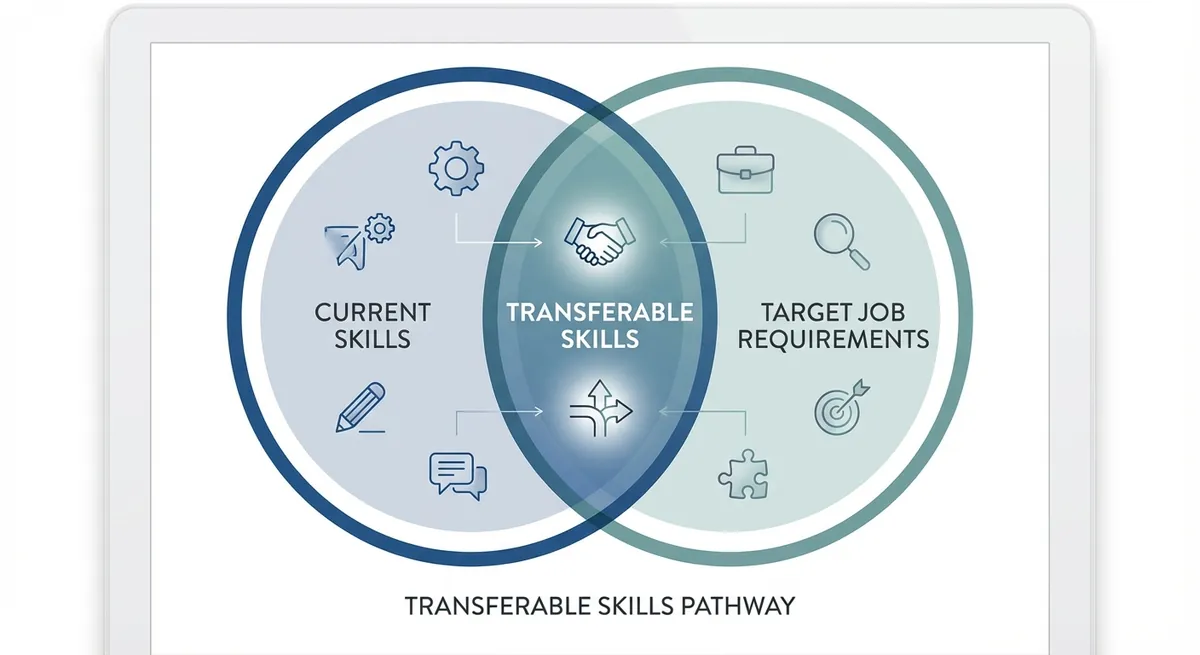
A Venn diagram showing 'Current Skills' and 'Target Job Requirements' overlapping to highlight 'Transferable Skills'
How should you rebrand your application?
Your old resume will not work for your new path. Rewrite your work history around the exact skills your future employer wants — and trim it to the last 15 years.
Overhaul your resume
Build a new document rather than tweaking the old one, led by a summary that names the target role. Standard convention for later-in-life applications: show the last 15 years in detail, compress everything earlier into one line, drop graduation dates. That's how every career coach formats it — it keeps the conversation on what you'll do, not when you started. Use our Resume Builder for the structure and the career changer resume format guide for layout choices.
Beat the automated systems
Applicant tracking systems scan for the target field's keywords, and thirty years of old-field vocabulary will fail that scan on autopilot. Run your draft through a Resume Checker to make sure the new terminology actually lands.
Update your online presence
Recruiters will look you up. If your profile still describes your old life, you'll confuse them; refresh it with a LinkedIn Optimizer pass. And at 50, your network is the primary channel, not a nice-to-have: most later-in-life placements come through someone who already knows your work. Tell people you're moving — specifically, and before you need the favor.
Key takeaways
- Be clear on exactly why you want out before making sudden moves — sometimes the fix is a new company, not a new career.
- Target fields that buy judgment: operations, compliance, training, advisory, consulting.
- No entry-level resets and no speculative degrees — the runway is long enough for a pivot, not a restart.
- Trim the resume to 15 years, translate the vocabulary, and go through people rather than portals.
- The full sequencing — bridge roles, timeline, worked examples — is in how to change careers without starting over.
Switching at 50 takes nerve. But staying fifteen more years in a job you're done with is the bigger risk — and unlike the cliché, the market for judgment is growing. When you're ready, OneTwo Resume has the tools to tell three decades of story in the new field's language.